Research Brief
Long-Term Demographic Dynamics
July 2026

Long-term Demand Drivers
Continue to Favor CRE
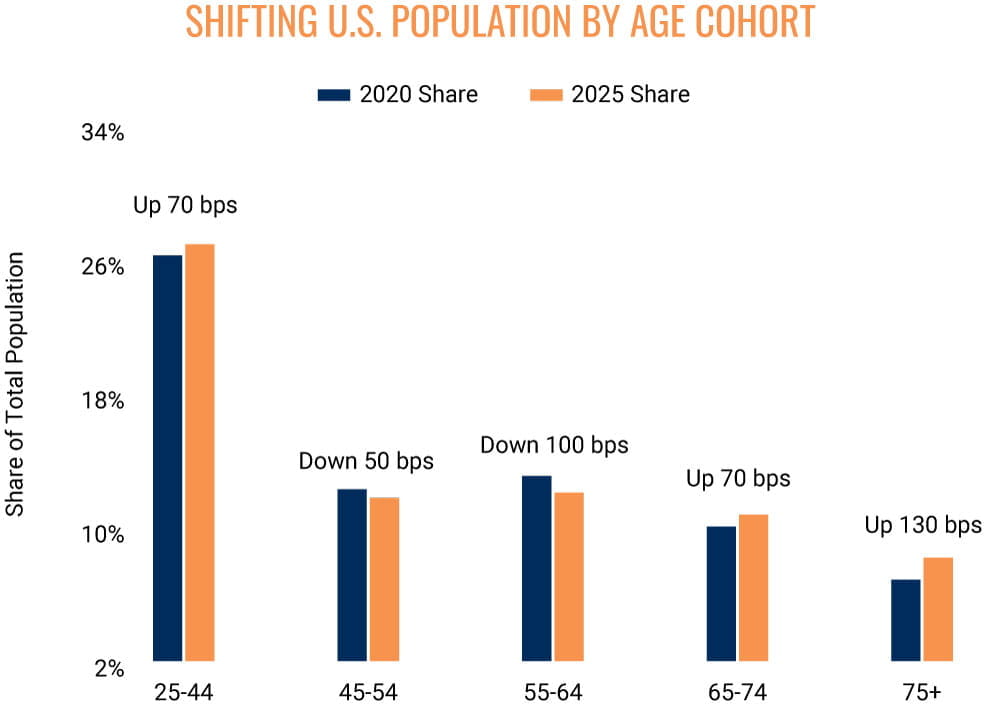
Investors positioning ahead of demographic shifts. Welltower’s expansion into seniors housing during the pandemic reflects an investment strategy focused on long-term structural trends.
- Welltower expanded aggressively into seniors housing in 2020 despite declining occupancy and significant pandemic-driven headwinds, illustrating how investors can position ahead of the demand implications of the aging-population.
- Leadership focused less on near-term volatility and more on long-term growth of the 75+ population.
- The 80+ age cohort is projected to grow roughly 4.8 percent annually for the next five years, while construction has slowed.
- As a result, demand has begun to outpace supply, with occupancy now exceeding pre-pandemic levels and still rising.
- This dynamic highlights how underlying trends can outweigh short-term market disruptions.
Population fundamentals support multifamily demand. Demographic patterns, affordability constraints, and delayed household formation are reinforcing demand for rental housing.
- In the housing market, homeownership affordability has deteriorated, with elevated home prices and higher mortgage rates pushing ownership costs well above rents, even as home prices have been relatively stable over the past year.
- The median age of first-time home buyers has risen to 40 years old, up from 33 years in 2021 and 30 years in 2011.
- As a result, renter retention has improved, and the average age of renter households continues to increase.
- At the same time, young adults living with family have reached a record 25.2 million, a pattern that has historically preceded stronger rental household formation.
- This combination of demographic support, affordability constraints, and delayed household formation points to strengthening multifamily demand over the next five years.
Generational change broadens CRE demand. As millennials shift into higher incomes and changing preferences, demand is expanding across retail, industrial, and other CRE sectors.
- The millennial generation is entering its prime earning and spending years, supporting long-term consumption growth.
- This cohort is expected to help drive a net increase in consumer spending of roughly 5.1 percent over the next decade.
- Increased spending at restaurants and bars is strengthening demand for experiential and service-oriented retail.
- Retail properties continue to shift toward entertainment, dining, and service-based tenants to meet changing preferences.
- E-commerce penetration has risen to about 23.4 percent of total core retail sales and continues to grow with total spending.
- This sustained growth in online sales is driving increased demand for industrial space, further supported by rising business inventories to contend with broader uncertainties in geopolitics.
- Taken together, demand drivers across multifamily, retail, industrial, and seniors housing remain favorable, reinforcing a compelling long-term outlook despite near-term uncertainty
| 84% | 6% |
| Share of Seniors Housing Residents Age 75+ |
Growth in Millennial Age Cohort Over Next 5 Years |
Sources: Marcus & Millichap Research Services; Freddie Mac; Moody’s Analytics; National Association of Realtors; NIC Map®
Data and Analysis Service (www.nicmap.org); RealPage Inc.; U.S. Census Bureau
TO READ THE FULL ARTICLE