Research Brief
Housing Affordability
November 2026
Homeownership Woes Create Mix of Results for Commercial Real Estates
Housing market loses momentum. Worsening affordability is cooling transaction volume and prompting builders to temper future development.
- Since the onset of the conflict in the Middle East, the 10-year Treasury has risen by more than 100 basis points while 30-year mortgage rates have increased roughly 130 basis points to about 7.3 percent as of late-October.
- Higher mortgage rates have reduced homebuyer purchasing power by approximately 8 percent.
- The monthly payment on a $390,000 home today is roughly equivalent to that of a $425,000 home in February.
- Pending home sales as of September were down 8.5 percent from February and 11.3 percent year over year, while existing and new home sales have declined by 2.2 percent and 5.3
percent on an annual basis, respectively. - Despite these national trends, inflation remains below the U.S. rate in several metros, including Houston at 1.3 percent, Tampa at 1.9 percent, and Phoenix at roughly 2.5 percent.
- With mortgage rates elevated and sales slowing, homebuilders are beginning to scale back construction pipelines.
- Diesel prices also vary considerably, ranging from roughly $5.60 to $5.80 per gallon across several Southern states, compared with about $8.50 per gallon in California.
- With mortgage rates elevated and sales slowing, homebuilders are beginning to scale back construction pipelines.
Downside risk to commercial real estate appears limited. Reduced residential housing market activity presents only a marginal drag on retail and industrial property performance.
- Each home purchase generates an estimated $8,700 in retail spending, including appliances, furniture, and home renovations.
- As housing transactions taper, home-related retail categories could face pressure, despite healthy overall retail sales.
- Slowing residential sales activity and construction could therefore create modest headwinds for retail and industrial space demand, though the impacts would likely be limited.
- Third-quarter industrial net absorption increased to about 88 million square feet, exceeding new completions and reducing national vacancy by 10 basis points to 7.6 percent.
- Retail net absorption also remained positive during the third quarter, reducing the national average vacancy rate by 10 basis points to 4.8 percent
Silver lining for multifamily fundamentals. Rising homeownership costs are partially offsetting apartment demand headwinds from weaker job creation, slower household formation, and more young adults living at home.
- While the median single-family home price has increased just 1.2 percent year over year, the monthly cost of ownership has risen about 8 percent, largely due to higher interest rates.
- By comparison, average apartment rents have increased just 1.9 percent, widening the gap between the mortgage payment on a median-priced home with 10 percent down and average rent to a record $1,411 per month.
- Just 27 percent of U.S. households, including existing homeowners, can now qualify for that mortgage under Freddie Mac underwriting guidelines, suggesting more people could remain renters for longer.
- The median age of a first-time homebuyer has risen from 30 years old to 40 years old over the past 15 years.
- Multifamily lease renewal rates have risen to 57.7 percent, approaching the 58.5 percent level reached during the pandemic.
- Third-quarter multifamily net absorption exceeded 56,000 units, but trailed roughly 82,000 completions, pushing vacancy up 10 basis points to 4.6 percent
- Year-to-date net absorption totaled nearly 340,000 units, well above the 230,000 units completed through September, leaving national vacancy 60 basis points below year-end 2025 levels.
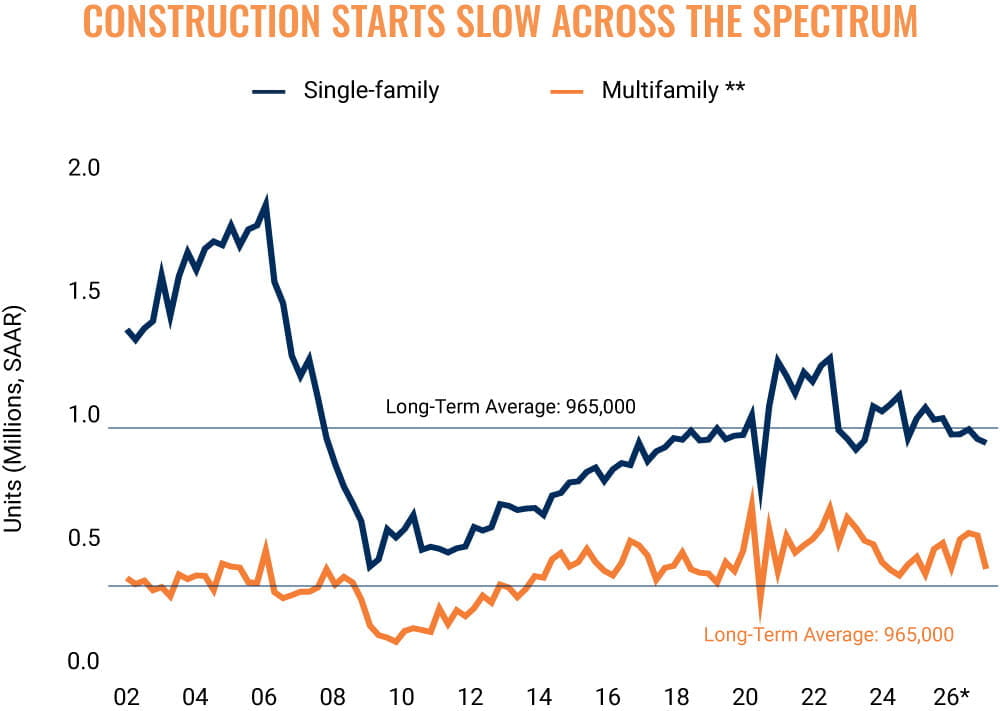
* Through September ** Includes multifamily buildings with five or more units
Sources: Marcus & Millichap Research Services; Bureau of Labor Statistics; CoStar Group, Inc.;
Federal Reserve; Freddie Mac; National Association of Realtors; RealPage, Inc.; U.S. Census Bureaus
TO READ THE FULL ARTICLE