Research Brief
Canada Tourism
July 2026

Strengthening Inbound Tourism
Fuels Continued Gains in Hotel Sector
International leisure travel driving sector growth. The tourism industry continued to expand at a faster pace than the overall economy in the first quarter of 2026, with real output rising by 0.5 per cent compared with a modest 0.1 per cent gain across all industries. Growth was supported by stronger international activity, as spending by inbound tourists increased by 0.9 per cent, more than offsetting a slight 0.2 per cent decline in spending by domestic leisure travellers. Total accommodation spending rose by 0.5 per cent, driven primarily by a 1.3 per cent increase from foreign visitors. As a result, demand from nonresident travellers now sits firmly above levels recorded at the end of 2024, before trade and geopolitical tensions that weighed on international travel through the third quarter of 2025.
Further expansion to continue through the summer. High frequency international travel data indicate that arrivals of both Canadian residents and nonresident visitors by land and air increased in April and May. Volumes are expected to rise further in June and July, supported by travel activity tied to the 2026 FIFA World Cup. This points to continued tourism sector expansion into the early third quarter. Beyond leisure-driven travel, business travel has been improving faster than transient leisure travel. While still below pre-pandemic levels at the end of 2025, business travel contributed most to industry growth from 2023 to 2025. According to the Global Business Travel Association, total business travel spending is projected to increase by 4.3 per cent in 2026. With roughly 60 per cent of business trips extended for leisure purposes, this segment is expected to further support overall tourism growth.
Commercial Real Estate Outlook
Hotel sector projected to finish 2026 on solid footing. The latest demand data show the national occupancy rate reached 70.7 per cent in May, up 70 basis points year-over-year, with the luxury segment leading gains at 530 basis points. With inbound tourism and business travel sustaining momentum through the remainder of the year, national occupancy is projected to reach a multiyear high of 66.4 per cent. This increase is expected to be most pronounced in Vancouver, where strong summer tourism, combined with limited supply, could push occupancy well above 90 per cent in high-demand submarkets such as downtown. Elevated demand conditions are also expected to support further ADR growth, with the national average forecast to rise by 4.8 per cent, lifting annual RevPAR 5.1 per cent above last year’s level.
Abundant capital meets limited buyer opportunity. The postpandemic recovery in hotel operating fundamentals has driven a significant rebound in investment activity. Limited availability of high-quality assets has further intensified competition for prime properties, prompting some buyers to expand into secondary and tertiary locations in major destination markets in search of higher yields and relative value. As supply remains constrained — a defining characteristic of Canada’s hotel investment market — transaction activity is expected to remain largely shaped by asset availability, amid abundant capital seeking deployment.

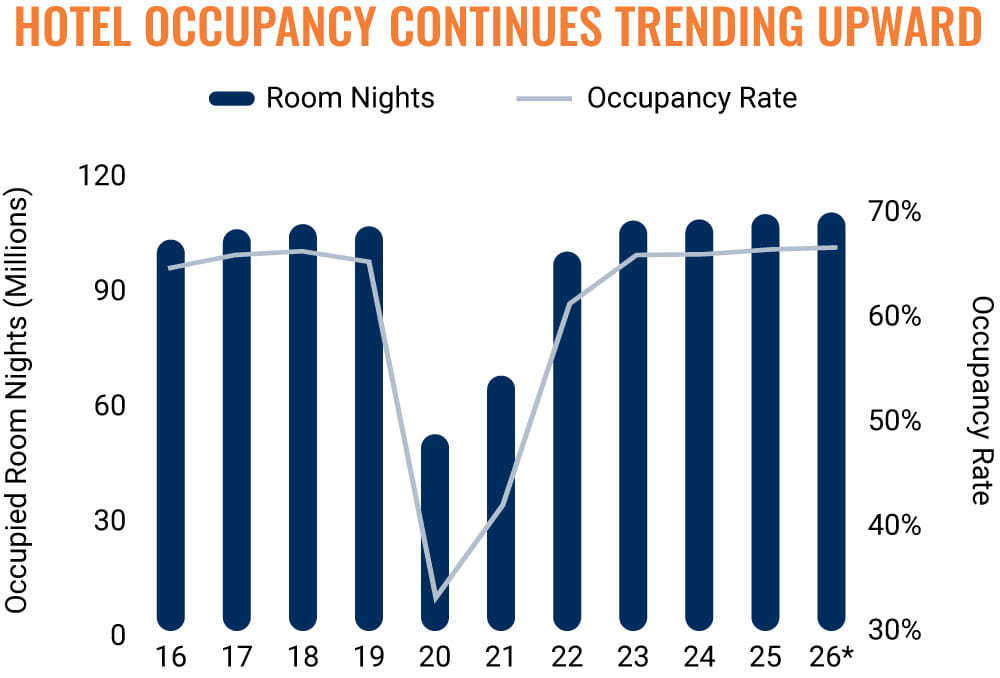
* Forecast | Sources: Altus Data Solutions; Capital Economics; CoStar Group, Inc.;
Global Business Travel Association; Oxford Economics; Statistics Canada
TO READ THE FULL ARTICLE