Research Brief
Canada Monetary Policy
July 2026

Confidence Returning to Commercial Real Estate
Amid Improving Rate Visibility
Policy rate held as inflation expected to ease. The Bank of Canada held its overnight rate at 2.25 per cent, saying that the current rate environment remains appropriate to support the early economic recovery underway while guiding inflation back toward its 2 per cent target. Although headline inflation has temporarily accelerated due to higher gasoline prices linked to conflict in the Middle East, underlying price pressures remain considerably more subdued, with core inflation measures continuing to track close to target. As temporary energy-related pressures gradually fade and economic slack persists, the Bank expects inflation to ease over the coming months before returning to approximately 2 per cent in early 2027. Nonetheless, the outlook remains highly sensitive to global geopolitical developments and evolving trade conditions.
Broader growth recovery expected. Canada’s economic outlook has improved after a period of weak growth. The nation has recorded two consecutive quarters of annualized GDP contraction as of April amid tariffs, slower population growth, and elevated uncertainty. That said, the economy is estimated to rebound by 2.5 per cent annualized in the second quarter. While some gains reflect the unwinding of temporary factors, the Bank expects broader recovery as consumer spending, exports, and business investment gradually strengthen. As a result, real GDP is projected to grow by 1.8 per cent in both 2027 and 2028, gradually absorbing economic slack. Against this backdrop, the Bank of Canada is expected to remain on hold as policymakers monitor the durability of the recovery and the gradual easing in inflation.
Commercial Real Estate Outlook
Borrowing costs remain elevated but appear to be stabilizing. After volatility earlier this year due to inflation concerns, geopolitical tensions, and fiscal uncertainty, Canada’s five-year bond yield has trended lower over the past three years. With the central bank expected to remain on hold and inflation expected to gradually return to target, further bond yield increases seem unlikely. However, volatility will likely persist as markets respond to evolving economic and geopolitical developments. For commercial real estate investors, a more accommodative and stable interest rate environment should improve financing visibility and reduce a key source of uncertainty that has weighed on transaction activity in recent years.
CRE investment activity continues its gradual recovery. Both transaction volume and the number of trades have risen meaningfully from their 2023 lows, reflecting improving investor confidence as price discovery has progressed and financing conditions have become more predictable. While activity remains below the exceptionally strong levels recorded in 2022, investors are returning to the market, supported by more realistic asset pricing, Canada’s resilient economic backdrop, and commercial real estate’s defensive characteristics. Assuming stable interest rates and a broadening economic recovery, transaction momentum could strengthen further in the medium term.

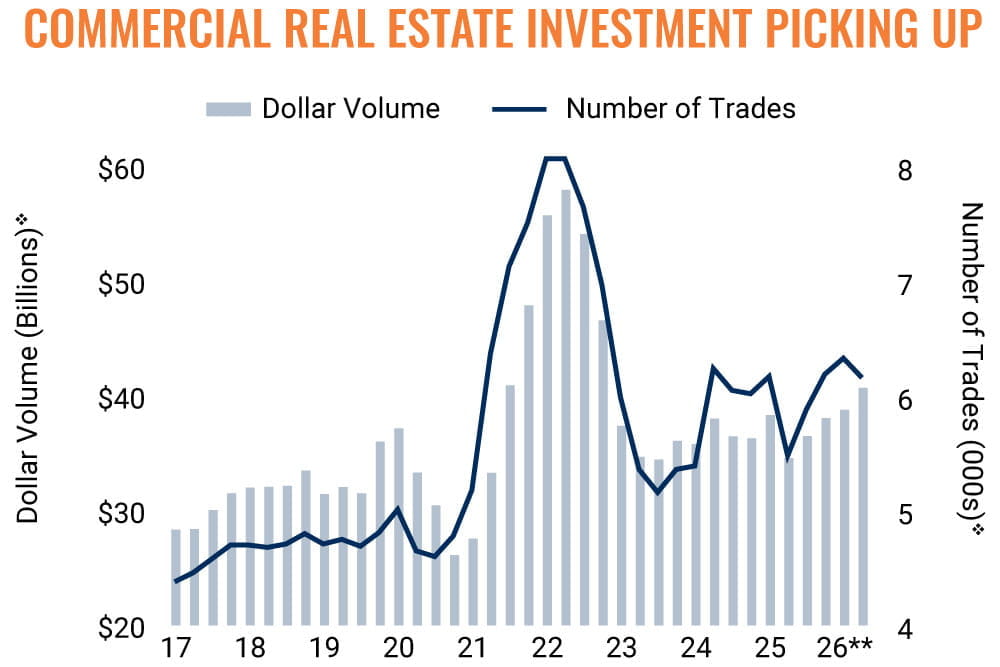
* Forecast; ** Trailing 12 months through 2Q; v Trailing-12-month total | Sources: Altus Data
Solutions; Capital Economics; CoStar Group, Inc.; Oxford Economics; Statistics Canada
TO READ THE FULL ARTICLE