Research Brief
Transaction Market Trends
September 2026

Factors Beyond Financing Continue to Support CRE Investment
Shifting interest rate dynamics. Higher borrowing costs have created headwinds for commercial real estate transactions. Interest rates alone, however, do not fully explain market activity.
- Treasury yields declined early in 2026, supporting investor sentiment and commercial real estate transaction activity amid expectations of dovish monetary policy by year-end.
- Following the outbreak of the current conflict in the Middle East, interest rate projections shifted materially and Treasury yields rose by approximately 70 basis points.
- In turn, market expectations have shifted from potential rate cuts to a growing probability of rate hikes later this year.
- Higher financing costs are creating pressure on transaction activity across property sectors.
- While interest rates remain a key consideration, CRE transaction velocity does not consistently move inversely with debt costs, evidenced by historical periods in which elevated rates
- coincided with robust deal flow and vice versa.
- As such, transaction activity is ultimately influenced by a broader set of economic and investor-specific factors.
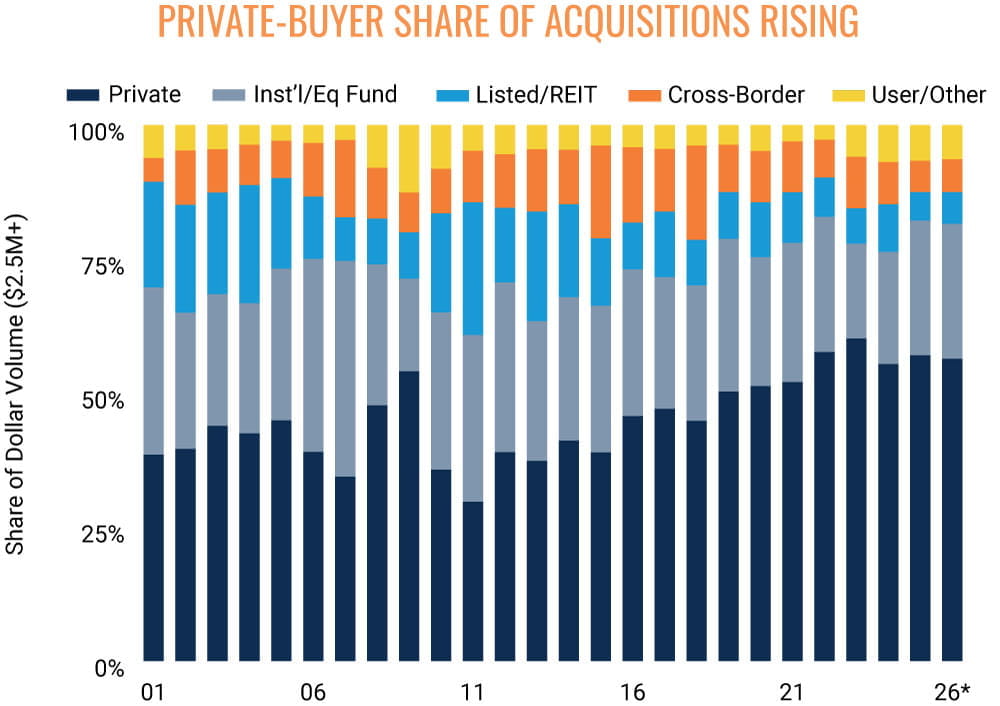
Deal flow tilts toward private investors. The outsized growth in smaller transactions underscores the growing prominence of private investors in the CRE marketplace
- Private investors have accounted for roughly 55 to 60 percent of commercial property acquisitions over the past five years, exceeding their average market share of 50 percent in the five years preceding the pandemic.\
- Transaction activity in the first half of 2026 outpaced the pre-pandemic mean across all major price tranches.
- The strongest gains have occurred in assets trading between $1 million and $10 million, where deal flow is nearly 39 percent
above the 2015-2019 first-half average. - By comparison, transaction counts increased 22 percent for assets priced above $20 million, and 15 percent for assets priced between $10 million and $20 million.
- Single-tenant retail, small offices, and industrial spaces have experienced the strongest gains in private investor activity, while apartment growth has been comparatively modest.
Key themes for the second half of 2026. Interest rates, private investor activity, and slowing new supply will influence the commercial real estate outlook.
- Interest rates may remain a headwind, though current Treasury yields appear to reflect anticipated rate hikes.
- As a result, borrowing costs may remain elevated, though the risk of a material near-term increase appears low.
- Private investors are expected to remain active as buyers and sellers continue adapting to prevailing market conditions.
- Compared with other investors, private buyers are often motivated by factors beyond current pricing and financing conditions, such as estate planning, tax considerations, and long-term wealth preservation objectives.
- These factors, together with localized market knowledge and longer investment horizons, often support sustained private-market activity across economic cycles.
- Construction activity is slowing across all major property sectors, limiting the pipeline of new CRE supply.
- While demand growth remains modest, improved economic confidence could allow space and rental housing absorption to accelerate faster than supply, supporting stronger fundamentals in the future
* Year ended 2Q | Sources: Marcus & Millichap Research Services; Bureau of Labor Statistics; CME
Group; CoStar Group, Inc.; Federal Reserve; Real Capital Analytics; RealPage, Inc.
TO READ THE FULL ARTICLE