Research Brief
Retail Sales
November 2026

Value-Focused Consumers May Benefit Discount Retailers and Goods Distributors
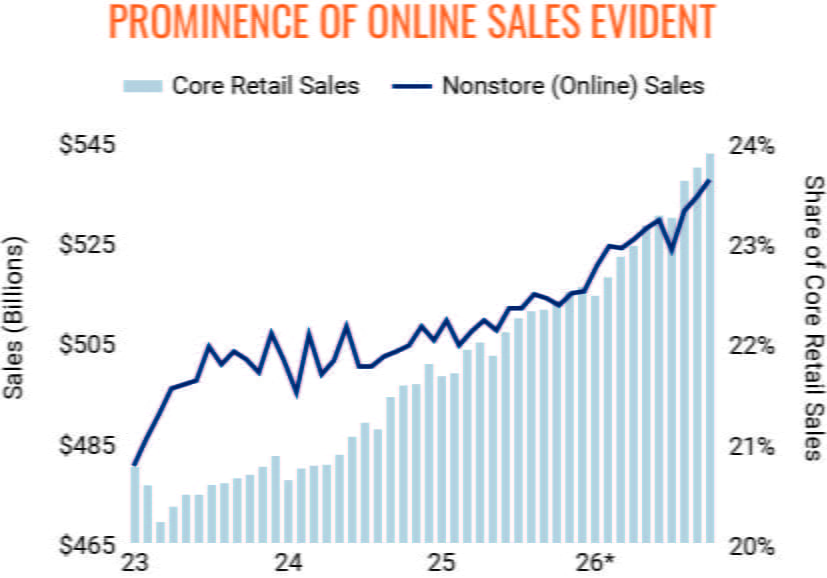
Spending increased modestly. Core retail sales reached yet another record high, with spending up 0.5 percent in October and 5.9 percent year over year prior to adjusting for inflation. Positive momentum, however, was not universal across retail categories. Instead, online and miscellaneous retail — segments synonymous with discounts — played a significant role in the overall increase, with the health and personal care category also contributing. Higher spending across these segments suggests more consumers are hunting for discounts across multiple retail categories that carry similar items, which hurt sales at grocery and apparel stores last month. With energy and transportation cost pressures noted earlier this year appearing to filter into other parts of the economy, including supermarkets, this consumer behavior is poised to continue. Fortunately, diesel and alternative fuel prices rose just 2.7 percent in October and have trended down this month, moderation that may limit future increases in essential goods prices. The improving employment outlook, with 165,000 jobs added in October and unemployment at 4.1 percent, should further reinforce consumer spending during the holidays.
Chains focus on strategic growth amid increased competition. Supermarket sales declined by roughly 0.6 percent in October after accounting for food-at-home inflation, with four of the six major food groups advancing. Nevertheless, grocers of various sizes remain in expansion mode. Last month, Kroger announced plans to open 110 new stores through 2029, while Food Lion agreed in November to acquire a group of Winn-Dixie stores in Georgia. Aldi, T&T Supermarket, and Trader Joe’s are also expanding regionally, a positive trend for certain shopping center owners.
Omnichannel presence a must for retailers. Last month, one in every four dollars spent in core retail categories occurred online. Still, brick-and-mortar sales, which exclude online purchases and spending at restaurants and bars, set a record in October. These concurrent increases are bolstering the outlook for warehouse and distribution center property performance. During the 12 months ended in the third quarter, the nation’s industrial vacancy rate fell by 10 basis points to 7.6 percent, marking the first year-over-year compression since late 2022. Demand for cold-storage space could improve, as several sources estimate that 15 percent of U.S. adults now order groceries online at least once a week. DoorDash’s potential acquisition of Instacart, which the Department of Justice is reviewing, further highlights online grocery growth.
Key Takeaways
- Core retail sales, which exclude motor vehicle and gas sales, rose 0.5 percent in October and 5.9 percent year over year. Last month’s gain coincided with a third straight 0.3 percent uptick in core CPI, indicating spending rose in real terms despite persistent inflation.
- More households are becoming value-conscious, hunting for discounts across multiple retail categories that carry similar items. This is impacting spending at grocery stores and apparel shops.
- Online sales accounted for a record 23.6 percent share of core retail spending in October, with the category notching a 1.2 percent monthly gain. This dynamic has positive implications for industrial demand.
0.5% |
5.9% |
|
Rise in Core Retail Sales (Monthly) |
Rise in Core Retail Sales (Year Over Year) |
* Through October
Note: Core retail sales exclude auto and gasoline purchases
Sources: Marcus & Millichap Research Services; Bureau of Labor Statistics; Census Bureau; Circana; CoStar Group, Inc.; Gallup
TO READ THE FULL ARTICLE