Research Brief
Interest Rate Outlook
November 2026

October’s Interest Rate Reprieve Faces Challenges from Recent Economic Data
Treasury yields retreated in October. A mix of economic, political, and financial market developments helped ease borrowing conditions after September’s elevated rates.
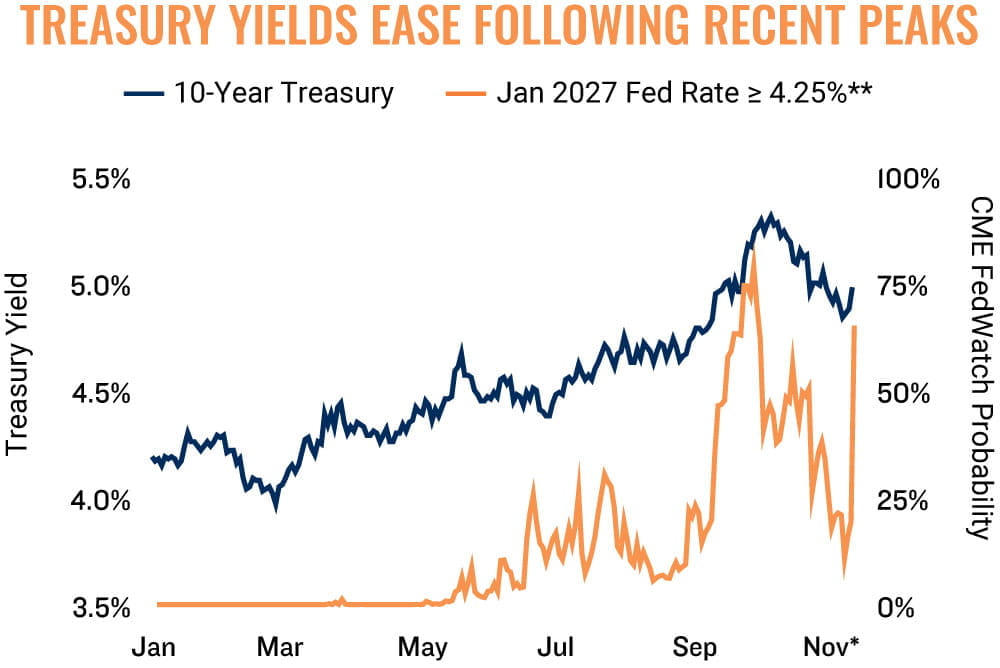
- The 10-year Treasury yield fell from about 5.3 percent on Sept.29 to 4.8 percent on Nov. 4, offering some investors relief.
- Expectations for further Federal Reserve tightening eased in October as inflation risks appeared to subside and September employment data came in weaker than expected.
- Optimism surrounding the midterm elections suggested that divided government could provide additional checks on policymaking, potentially reducing policy uncertainty.
- A shift in capital away from artificial intelligence-related investments and toward the relative safety of bonds put downward pressure on yields,
Headwinds, however, resurfaced. Employment and inflation data released in November challenged the outlook for lower interest rates, renewing concerns that tighter monetary policy may follow.
- The U.S. economy added 165,000 jobs in October, and upward revisions to August and September added another 84,000 positions, bringing year-to-date job growth to 861,000.
- Although hiring remains well below historical norms, unemployment edged down to 4.1 percent, indicating the labor market is at its healthiest level in roughly two years and giving the Federal Reserve greater latitude to raise rates.
- October inflation is estimated at about 4 percent, nearly twice the rate at the start of the year, although the 2025 government shutdown has prevented a precise year-over-year comparison.
- Price pressures have broadened beyond energy and transportation to include groceries, restaurants, and recreation, raising concerns about more entrenched inflation.
- As of Nov. 11, investors assigned an 87 percent probability to a 25-basis-point rate hike in December and a 13 percent chance to a 50-basis-point increase.
- At the same time, the odds of the overnight rate reaching at least 4.25 percent in January have risen to 69 percent, putting renewed pressure on longer-term Treasury yields.
A changing landscape for CRE investors. Evolving market dynamics may complicate asset-retention strategies while presenting alternative pathways for those seeking to deploy capital.
- Despite October’s decline in Treasury yields, reemerging upward pressure on interest rates could erode some of the recent relief for commercial real estate investors.
- Higher borrowing costs could make debt financing more expensive for both property acquisitions and refinancing.
- Some owners may face difficult decisions when refinancing, such as contributing additional equity, accepting higher debt payments or selling their properties.
- Conversely, rising interest rates could create acquisition opportunities as property prices adjust and more assets facing financing challenges enter the market.
- Although October provided a temporary reprieve, the underlying forces pushing interest rates higher remain in place, with shortterm movements subject to considerable uncertainty.
4.0% |
87% |
|
Estimated Y-O-Y October |
Probability of a 25-bps Fed |
* Through Nov. 10 ** Probability of the federal funds target range reaching 4.25 percent or higher
following the January 2027 FOMC meeting
Sources: Marcus & Millichap Research Services; Bureau of Labor Statistics; CME Group; Federal Reserve
TO READ THE FULL ARTICLE