Research Brief
Housing
November 2026
Slowing Development and Higher Interest Rates Create Crosscurrents
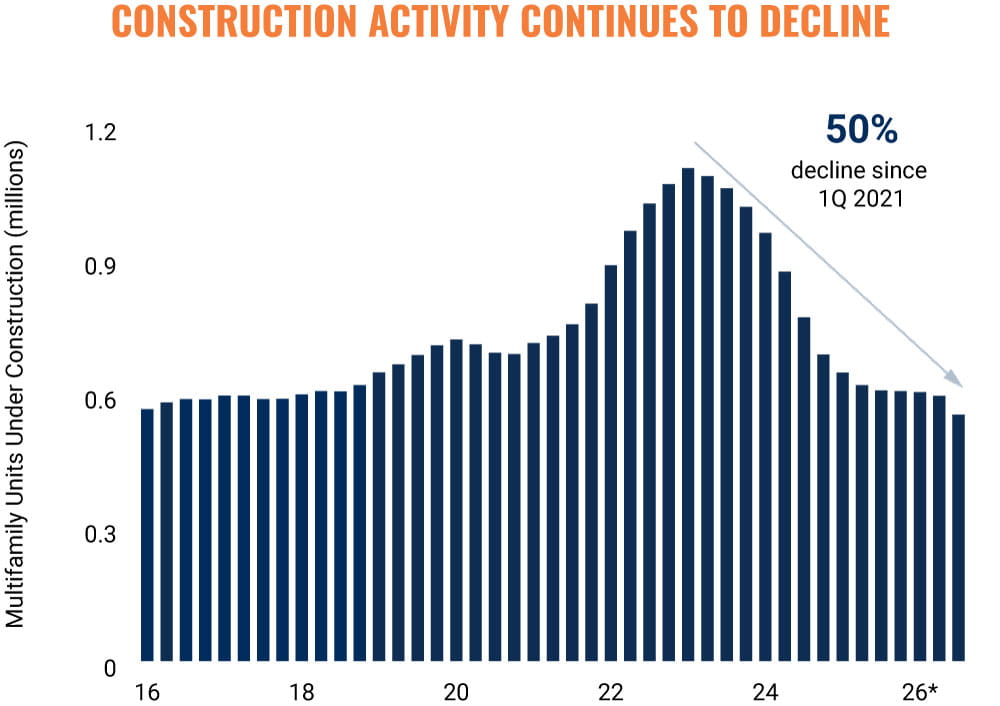
Development constraints persist. Housing construction continued to retreat in the third quarter, with roughly 550,000 multifamily units underway, the lowest tally in more than 10 years. Seasonally adjusted annual single-family starts also fell to a one-year low in September. Softer buyer demand and rising costs should limit a near-term rebound. In October, 43 percent of homebuilders cut prices, up from 38 percent in September. Meanwhile, the construction cost index rose for the tenth consecutive month in September. Labor shortages have added to these pressures, as competition from data center projects intensifies. Together, these factors could constrain builders’ ability to lower prices further while maintaining project feasibility. Subdued housing construction could persist beyond 2027. Combined single-family and multifamily permitting declined by 3.2 percent year-over-year in September on a seasonally adjusted basis.
Rising interest rates pressure near-term buyer-seller alignment. Multifamily transaction velocity in the third quarter reached the second-highest level in four years based on preliminary date. While diminishing construction activity should support improving fundamentals and investor sentiment across many markets, higher interest rates could constrain acquisition leverage and widen the gap between buyers’ underwriting and sellers’ expectations. Even with tightening vacancy and stronger rent-growth prospects, sellers may have to accept lower valuations to accommodate higher financing costs, potentially slowing dealmaking as pricing recalibrates. Longer term, improving property cash flows could help offset those pressures and support renewed alignment.
Key Takeaways
- Sun Belt markets are poised to maintain the strongest apartment absorption relative to inventory.
- Concessions continue to decline, although longer times to fill vacant units may still require some incentives.
- The active multifamily pipeline and the number of single-family houses starting development continued to shrink during the third quarter.
- Higher borrowing costs could challenge buyer-seller alignment and temper transaction momentum, even as improving fundamentals support investor interest.
4.94% |
7.24% |
|
10-Year U.S. Treasury Rate |
30-Year Mortgage Rate |
* Through 3Q
Sources: Marcus & Millichap Research Services; Freddie Mac; Moody’s; Mortgage Bankers
Association; National Association of Home Builders; National Association of Realtors; RealPage,
Inc.; U.S. Bureau of Economic Analysis; U.S. Census Bureau
TO READ THE FULL ARTICLE