Research Brief
Holiday Retail Outlook
November 2026
Retail Sector Maintains Solid Footing, Bolstered by Healthy Fundamentals
Consumer finances support seasonal outlook. Higher liabilities are offset by rising incomes and ample savings, helping sustain purchasing power heading into the holidays.
- Holiday spending is forecast to increase 4 percent to 5.5 percent this year, while core retail sales rose 5.9 percent year over year in October and 5.6 percent in September.
- Online channels should capture a meaningful share of holiday purchases, as nonstore retailers have recently accounted for about 28.5 percent of retail spending in recent months.
- Household debt reached a record $19.1 trillion in the third quarter, with auto and credit card balances also at record highs. • Despite elevated debt, household debt relative to income remains well below its 2009 peak, even after rising from 57.3 percent to 58.3 percent in the third quarter.
- Consumer savings, including money market mutual funds, also reached a record high and were up 4 percent year over year in October, providing an additional spending cushion.
- Holiday spending intentions remain optimistic, with 78 percent of ICSC respondents planning to spend the same or more this year and 93 percent expecting to visit physical stores.
Property fundamentals remain firm. Healthy tenant demand and constrained space availability are creating opportunities to capture higher rates as contracts roll over.
- Foot traffic at open-air shopping centers increased 5.6 percent year over year as of September.
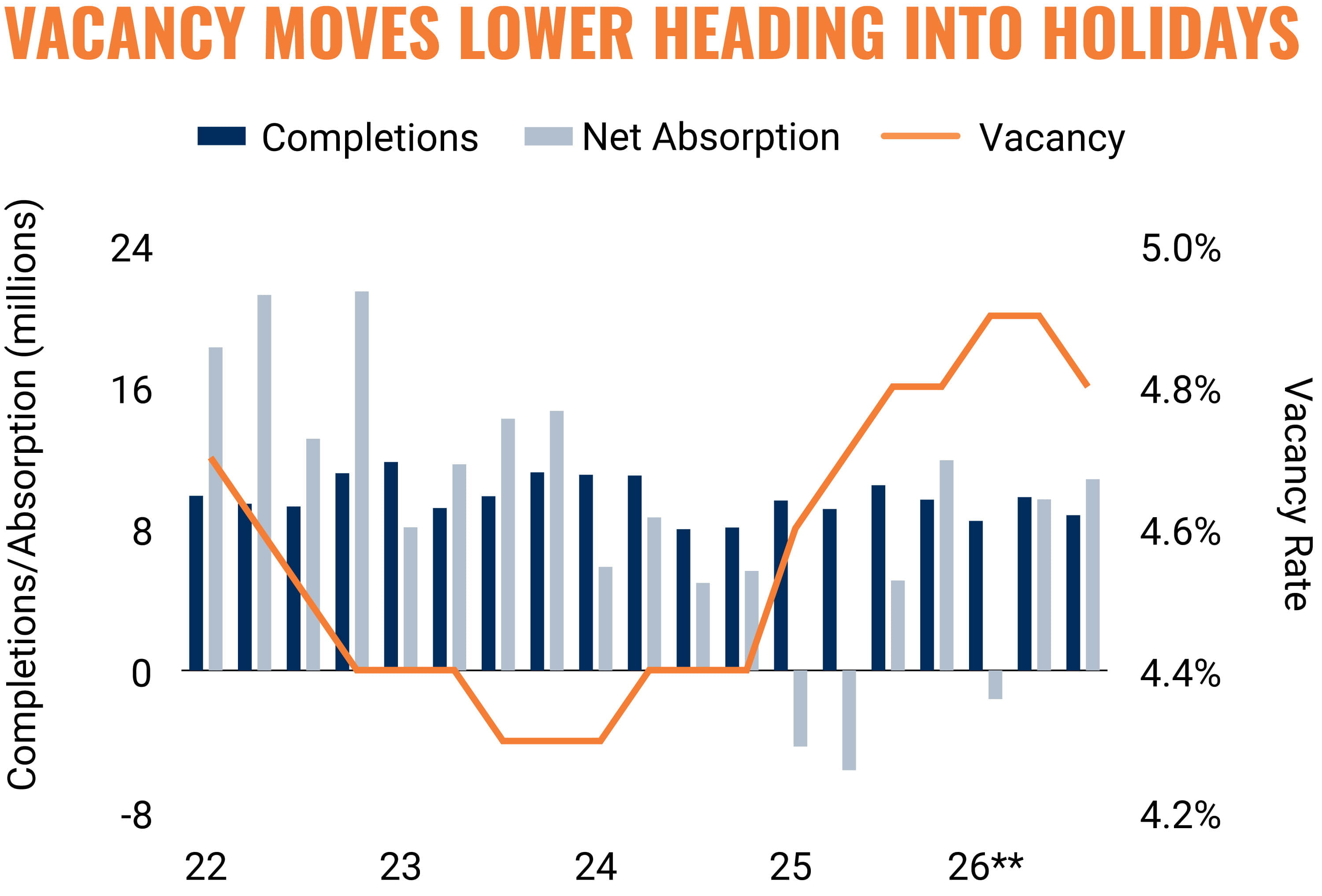
- Overall retail net absorption outpaced completions in the third quarter, lowering the average vacancy rate to 4.8 percent.
- Vacancy remained tight across retail formats, ranging from 4.6 percent for single-tenant properties to 5.0 percent for unanchored multi-tenant retail.
- Stable vacancy supported 2.9 percent annual multi-tenant rent growth as of September, while new leases and renewals posted stronger rent gains.
- The gap between in-place and current lease rates suggests embedded income upside, particularly for centers with vacant space that can be leased at higher rates.
Investment outlook supported despite headwinds. Improving deal flow and a constrained construction pipeline provide a favorable backdrop, although higher borrowing costs pose a pricing risk.
- Transaction activity for both single- and multi-tenant retail has steadily increased since 2023.
- Average cap rates remain relatively stable at 6.6 percent for single-tenant and 7.4 percent for multi-tenant properties.
- Recent interest rate increases are pressuring pricing and could push cap rates higher if debt costs continue to rise.
- New retail development should remain limited, with annual inventory growth below 0.5 percent, reducing competitive supply pressure on existing properties.
- Restrained development and healthy property fundamentals support a positive retail investment outlook for 2027.
- Retailers nevertheless face pressure from tariff-driven inflation and elevated transportation costs, which could temper the sector’s momentum.
4.8% |
16% |
|
3Q Retail Vacancy Rate; |
Y-O-Y Rise in Transaction |
* * Trailing 12-month time periods, with preliminary 3Q data
**Through 3Q Sources: Marcus & Millichap Research Services; Bureau of Economic Analysis; CoStar Group, Inc.; ICSC; Mastercard;
New York Federal Reserve; NRF; Placer.ai; Real Capital Analytics; U.S. Census Bureau; Visa
TO READ THE FULL ARTICLE