Research Brief
Gross Domestic Product
November 2026

Stronger Economic Growth Reinforces Retail and Industrial Demand
Tailwinds continue for retail properties. For a second consecutive quarter, consumer spending contributed roughly 2.5 percentage points to headline GDP growth, as expenditures on both goods and services continued to rise. With the U.S. stock market hovering around historic highs and the unemployment rate low, consumers continued to spend, supporting retail properties. Nationally, more than 10 million square feet of retail space was absorbed on net during the third quarter, marking the second-highest quarterly total since 2024 and contributing to the first quarterly decline in overall vacancy in three years to a national rate of 4.8 percent. Still, weak hiring and income growth, along with persistent inflation pressure, could make this resilience increasingly vulnerable. Healthcare spending also led growth in services during the quarter, a trend that should largely continue over the near to medium term and support tenant demand for healthcare-related real estate.
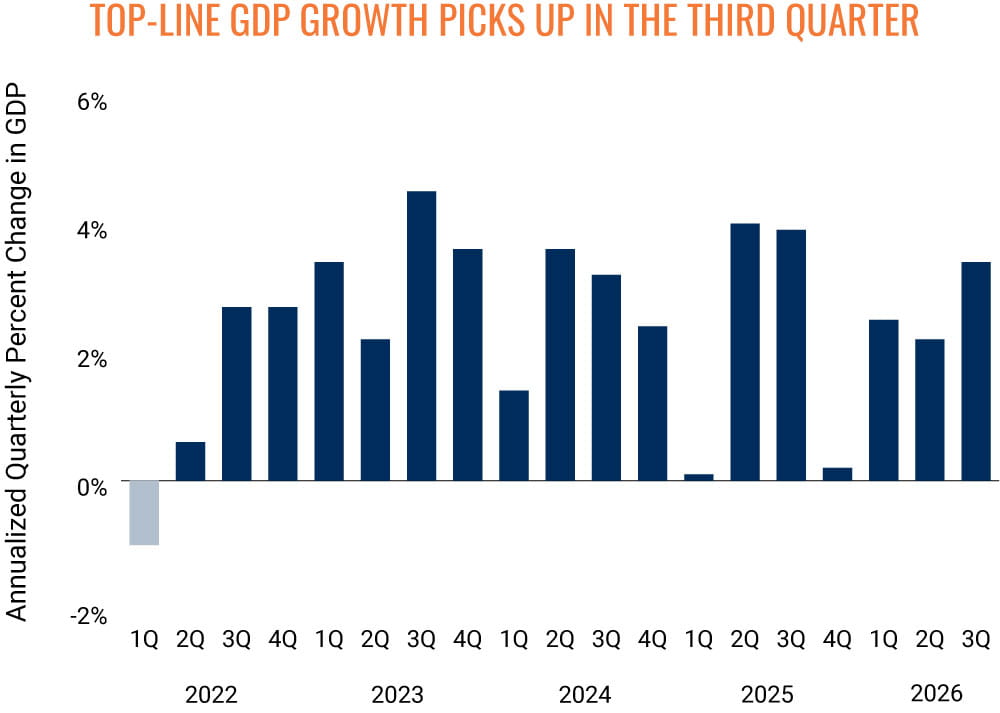
AI investment coincides with broader industrial momentum. Fixed investment contributed 1.6 percentage points to thirdquarter GDP growth, the most in seven quarters, partly reflecting continued expansion in data center construction and other AI infrastructure. This elevated spending illustrates the growing role such investments have on the broader economy. Meanwhile, nearly 87 million square feet of industrial space was absorbed on net, the highest total since 2022, led by distribution and warehouse properties in Sun Belt markets. This total excludes data centers, whose buildout could generate additional warehouse demand from equipment and construction suppliers. However, proposals to address power constraints and restrict development could substantially temper this tailwind if enacted.
- Economic growth accelerated in the third quarter, with broad gains across private-sector activity even as inflation remained elevated.
- Persistent underlying inflation alongside stronger economic growth could prompt tighter monetary policy from the Federal Reserve in the coming months.
- Healthy household spending continues to support retail and healthcare properties, though weakening labor-market momentum presents a growing risk to demand.
- AI-related capital spending continues to expand rapidly, while strengthening warehouse and distribution demand points to broader gains across the industrial sector.
3.4% |
3.1% |
|
Annualized Rate of |
Year-Over-Year Change in Core |
Sources: Marcus & Millichap Research Services; Bureau of Economic Analysis; Bureau of Labor Statistics; U.S. Census Bureau
TO READ THE FULL ARTICLE