Research Brief
Employment
November 2026

Industrial and White-Collar Hiring Expands Despite AI Fears, Lifting CRE Prospects
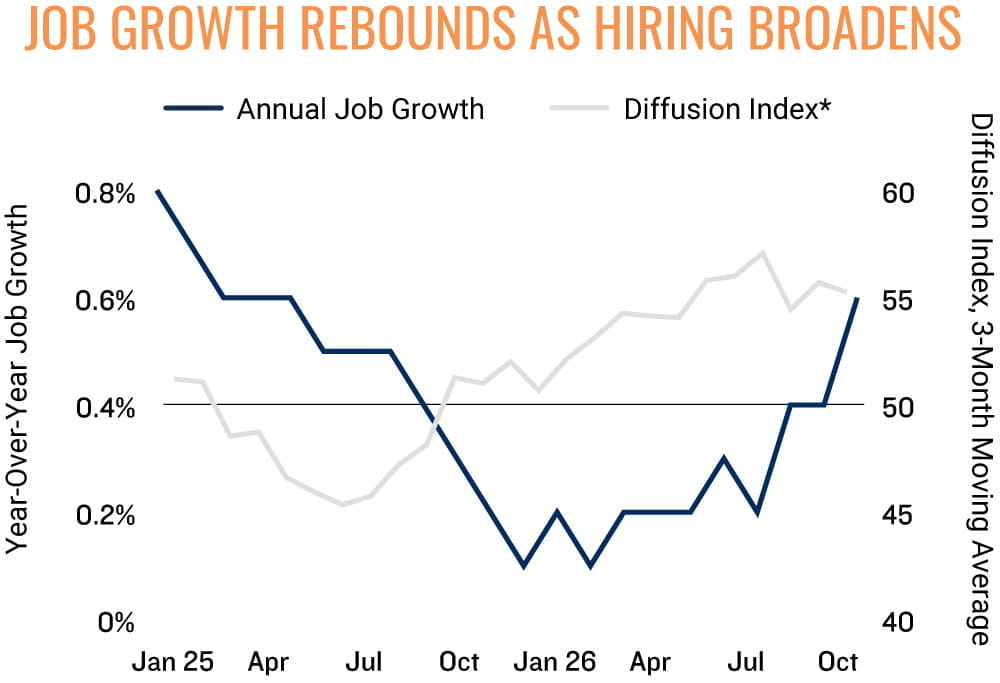
Employment momentum presents an investment trade-off. Employers added 165,000 jobs in October, among the largest monthly gains this year, while upward revisions added a combined 84,000 positions to the prior two months. Hiring was led by professional and business services, healthcare, and transportation and warehousing. Although these gains suggest broadening labor demand, the potential for substantial revisions warrants caution. If the hiring rebound persists, stronger employment growth, alongside subdued construction activity, should help commercial real estate fundamentals continue to firm. Nevertheless, a resilient labor market may allow the Federal Reserve to maintain its focus on inflation, keeping borrowing costs elevated and potentially weighing on investment activity. As a result, occupancy and rents may recover ahead of transaction volume. For buyers who can navigate current financing conditions, this gap may offer opportunities to capitalize on strengthening property performance before investment competition fully rebounds.
Industrial leasing and hiring strengthen. The transportation and warehousing sector added 25,000 jobs in October, while manufacturing gained another 19,000, reinforcing signs of improving industrial demand. Third-quarter industrial leasing also approached record levels, suggesting businesses are expanding both their physical footprints and labor capacity. Some hiring may reflect renewed inventory building and seasonal holiday fulfillment. However, larger lease commitments and a 1.9 percent annual increase in September freight shipments, after roughly three and a half years of declines, point to a potentially more sustained recovery in goods movement. With leasing led by warehouse and distribution facilities, major logistics hubs may capture much of this demand, particularly modern big-box properties where renewed tenant activity has accelerated vacancy declines.
White-collar hiring expands despite AI restructuring. Professional and business services added 70,000 new jobs in October, contrasting with ongoing weakness in financial activities and information. Temporary staffing and management consulting led the gains, suggesting employers may be favoring flexible labor and outside expertise over permanent hires. This comes as major technology and financial firms restructure around AI, with Microsoft and FICO among those announcing workforce reductions or buyouts. These trends point to a shift in office employment rather than broad weakness. Growing professional services firms may offset some space reductions among larger corporate users, favoring properties with diverse tenant rosters and flexible layouts over those reliant on major technology and financial tenants.
Key Takeaways
- Stronger October job gains and upward revisions to prior months improve the employment outlook, with hiring across more sectors suggesting broader labor demand.
- Firming employment trends, coupled with limited new supply, should support property fundamentals even as elevated borrowing costs pose investment headwinds.
- Industrial activity is picking up, with leasing nearing record highs in the third quarter as manufacturing and transportation and warehousing continued to add jobs.
- Despite AI-related restructuring at major employers, broader white-collar hiring gains suggest AI is not triggering widespread job losses, potentially favoring office assets with diverse tenant bases and flexible suites.
861,000 |
82,500 |
|
Jobs Added Year to Date Through October |
Average Monthly Job Gain, Past Six Months |
*The diffusion index measures the breadth of hiring across industries, with readings above 50
indicating more industries adding jobs than cutting jobs.
Sources: Marcus & Millichap Research Services; Bureau of Labor Statistics; Cass Information
Systems Inc.; CoStar Group, Inc.
TO READ THE FULL ARTICLE