Research Brief
Canada Housing
November 2026

Housing Recovery Remains Elusive Despite Improving Momentum
Housing market picks up despite rising borrowing costs. Canadian home sales edged up 0.3 per cent monthly in October, while new listings increased 0.8 per cent. The median price of a singlefamily home also rose 0.1 per cent monthly while annual declines narrowed to 3.2 per cent, despite deteriorating affordability stemming from higher borrowing costs. The average five-year fixed mortgage rate has climbed 50 basis points since the summer to 4.6 per cent, with further near-term increases possible. While pricing momentum has improved across several major markets, underlying fundamentals remain soft. The national sales-to-new listings ratio remains consistent with further annual price declines, while available inventory increased to five months of supply, exceeding its long-term average of 4.8 months.
Economic policy could support a housing market recovery in 2027. Despite the Bank of Canada embarking on a renewed tightening cycle, its cautious policy guidance alongside moderating oil prices suggests interest rates may not rise as aggressively as financial markets anticipate. Government bond yields and fixed mortgage rates could consequently ease next year, helping restore some purchasing power. Meanwhile, additional federal spending announced in Budget 2026 is likely to support economic growth and labour market conditions, strengthening household confidence. Although elevated borrowing costs and relatively loose market conditions will likely keep housing prices subdued over the next six months, an improving economic backdrop could facilitate a more sustained recovery over the latter half of 2027.
Commercial Real Estate Outlook
Federal policy offers some relief to residential developers. Budget 2026 proposes exempting newly constructed housing from the foreign buyer ban, potentially expanding the purchaser pool and supporting pre-construction sales. This follows Ontario’s expansion of GST/HST rebates earlier this year, which has helped stimulate new home sales across the Greater Toronto Area. The recovery, however, has been concentrated in low-rise properties, with September high-rise sales falling to a record low for the month. Additionally, the growing inventory of newly completed but unsold apartment units will likely constrain construction activity. While recent policy measures could help stabilize developer sentiment, a meaningful recovery in condominium construction remains unlikely until excess inventory is absorbed.
Moderating rental construction could aid fundamentals. National housing starts held near an annualized pace of 250,000 units in October, with elevated rental development offsetting condominium market weakness. However, slower population growth, softer rental conditions, and elevated financing costs are likely to gradually curb rental construction. While elevated completions and subdued population growth will likely constrain near-term performance, a moderating development pipeline could help rebalance market conditions, strengthening the longer-term investment appeal of existing rental assets. Early signs of stabilization are emerging, with apartment rent growth slowly beginning to reaccelerate.

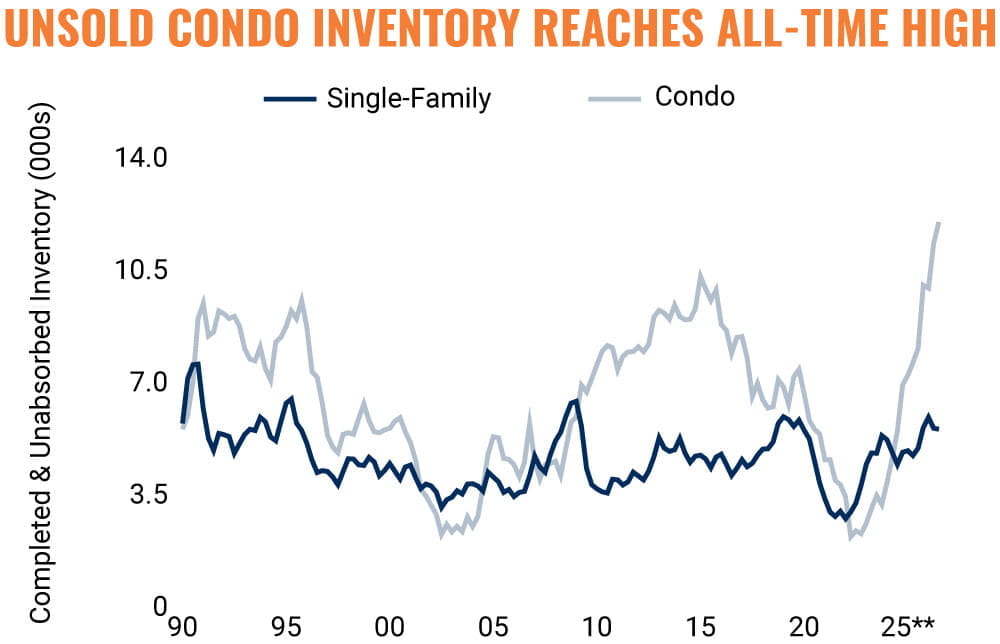
* Forecast; ** Through 3Q 2026 | Sources: Altus Data Solutions; Capital Economics;
CMHC; CoStar Group, Inc.; CREA; Oxford Economics; Statistics Canada
TO READ THE FULL ARTICLE