Research Brief
Economic Outlook
October 2026

Shifting Workforce Dynamics Contribute to an Evolving CRE Environment
Break-even employment is changing. Demographic and productivity trends are reshaping the pace of hiring required to keep the national unemployment rate stable.
- The U.S. added only 29,000 jobs in September, while downward revisions to July and August removed another 60,000 jobs from previously reported gains.
- The newly published report places year-to-date payroll gains at 612,000, with Moody’s now forecasting 735,000 jobs for fullyear 2026 and 645,000 for 2027.
- The labor market has undergone a structural shift, driven by policy changes, lower immigration, and rising worker productivity, which is about 16 percent above its 2019 level.
- Although payroll gains have been weak compared to prepandemic trends, the unemployment rate has remained stable in the low-4 percent range as retirements and lower net immigration constrain labor force growth.
- As a result, the economy might need to add only 40,000 to 50,000 jobs per month to sustain the unemployment rate, well below the previous break-even pace of roughly 100,000..
Housing bears more pressure. Multifamily faces greater headwinds from shifting employment conditions, while retail fundamentals have proven comparatively resilient.
- Weaker job creation is weighing on multifamily demand, reducing household formation and slowing apartment absorption.
- Domestic migration has also slowed as fewer people relocate for work, weakening apartment demand in metro areas that previously benefited from strong job growth and in-migration.
- The slowdown has been particularly impactful in Sun Belt markets, where construction scaled alongside strong demand, leaving a supply overhang as net absorption moderated.
- Retail properties have been more resilient, with consumer retail spending up 6 percent year over year through August and approximately 2.5 percent after adjusting for inflation.
- Despite healthy retail sales, space demand has weakened, with absorption averaging less than 2 million square feet per quarter since the start of 2025, compared with more than 6 million in 2024 and 12 million in 2019.
Uneven effects across property types. Sector-specific tailwinds and improving supply conditions offer investors avenues to create value amid the changing labor market backdrop.
- Industrial demand has been less sensitive to slower job creation, as rising e-commerce activity and tariff-driven changes in business inventories have played a larger role in shaping the segment’s space demand.
- Office-using employment has declined by nearly 325,000 positions over the past two years, yet the sector has generated roughly 185 million square feet of positive net absorption.
- Return-to-office momentum has helped offset employment losses, with office visits at 64 percent of prepandemic levels, up from 58 percent in the second quarter of 2024.
- Across commercial real estate, weaker hiring will weigh on space demand, although property- and market-specific factors may counter some of the impact.
- With job creation providing less support for new absorption, near-term revenue growth will increasingly depend on operational efficiency, economies of scale, value creation, and expense control.
- Longer term, reduced construction and an eventual acceleration in payroll growth could strengthen property performance, benefiting investors positioned for the shift.
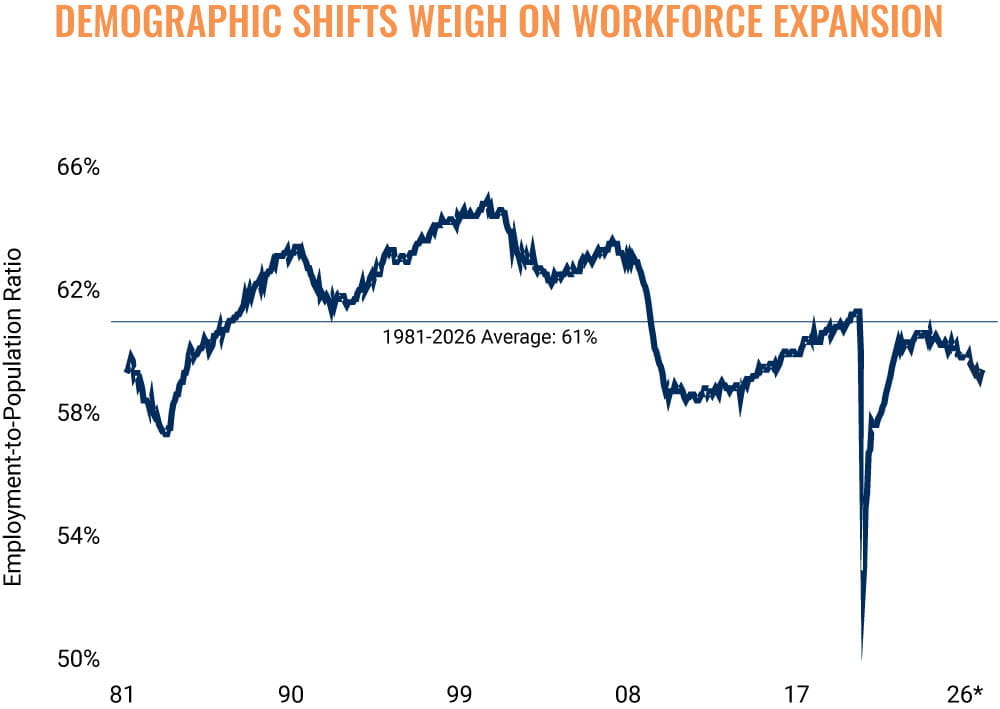
* Data through September
Sources: Marcus & Millichap Research Services; Bureau of Labor Statistics; CoStar Group, Inc.;
Federal Reserve Bank of St. Louis; Moody’s; Placer.ai; RealPage, Inc.; U.S. Census Bureau
TO READ THE FULL ARTICLE