Research Brief
Construction Outlook
October 2026
Navigating Supply-Side Dynamics Key Part
of Positioning Investment for the Future
The other half of the equation. Future construction plays a critical role in shaping long-term commercial real estate performance, including vacancy and rent growth, as well as investment decisions.
- Demand represents only one side of the market, with long-term supply trends equally important to commercial real estate.
- The supply outlook should therefore be a central component in CRE investment strategy.
- New construction typically lags market conditions, creating recurring cycles of excess capacity and supply shortages.
- As supply tightens, vacancies decline and rents rise, eventually encouraging development, which can reverse those trends
- Property types and individual markets move through distinct cycles, which structural shifts can also disrupt.
- Offices face a prolonged oversupply following the pandemic-driven shift in demand, while retail may be approaching a space shortage as it continues to adapt to e-commerce.\
- Apartments and industrial properties are absorbing excess supply nationally, but the construction outlook will affect even markets that are not currently oversupplied.
New projects face a higher threshold to break ground. Capital and resource constraints could limit inventory additions and extend favorable operating fundamentals.
- Three forces are aligning to restrain new construction and potentially delay the next development cycle by several years.
- Higher interest rates have significantly increased financing costs and reduced project feasibility.
- Trade policy, namely tariffs, and elevated shipping expenses are keeping building material prices high.
- Labor expenses are also under pressure from immigration policy and strong demand from AI and data center development.
- With overall costs elevated, new projects will likely remain limited until rents rise enough to support construction economics.
- Slower building activity could extend the falling-vacancy, rising-rent phase of the cycle, giving investors a longer runway for rent growth than the historical norm.
Identifying the next opportunity. Evaluating future growth alongside barriers to new supply can uncover opportunities before they become readily apparent.
- Apartment units under construction are down 50 percent from their 2023 peak and continue to trend lower.
- Industrial space under construction has fallen 60 percent from its 2022 peak, with the pipeline continuing to contract.
- Self-storage construction investment is down 32 percent from its 2023 peak, while seniors housing and medical office are seeing similar declines.
- Retail and office construction remain subdued, with higher building costs likely delaying the next development cycle.
- Those demand drivers should be cross-indexed against shrinking supply pipelines and barriers to new construction.
- Policy, land availability and land cost, and infrastructure constraints such as water and power can further limit future supply and reveal opportunities that may otherwise be overlooked.
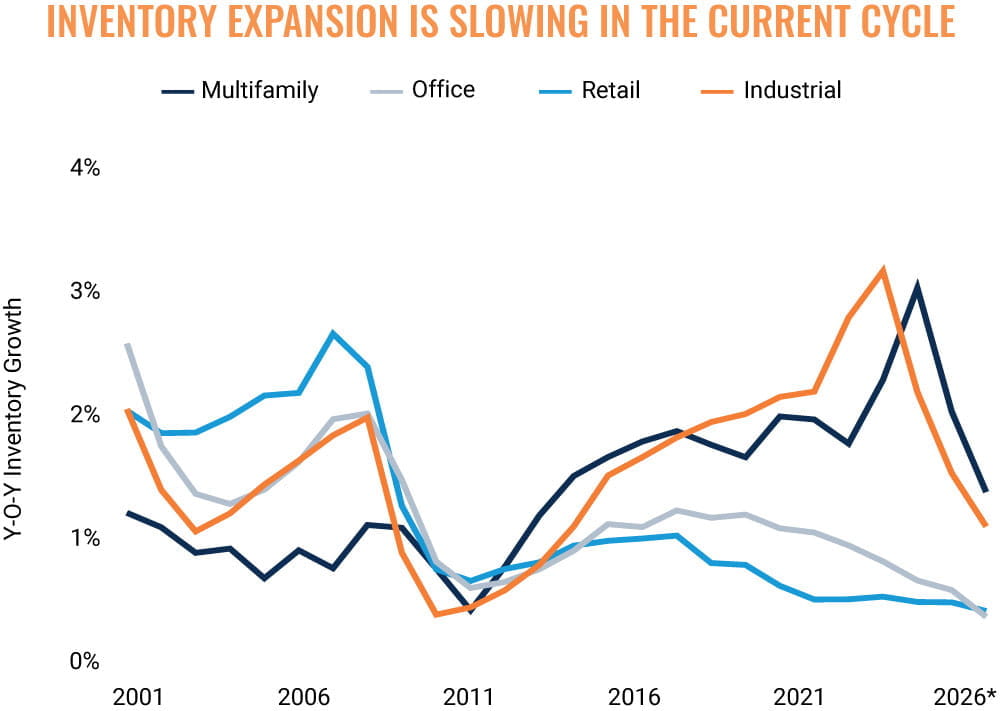
* Forecast
Sources: Marcus & Millichap Research Services; Bureau of Economic Analysis; Bureau of Labor
Statistics; CoStar Group, Inc.; Federal Reserve; NIC Map® Data and Analysis Service (www.nicmap.
org); RealPage, Inc.; U.S. Census Bureau.
TO READ THE FULL ARTICLE