Research Brief
Canada Retail Sales
October 2026

Retail Sales Rebound Adds to Rate Hike Risk as Property Fundamentals Improve
Broad-based rebound signals consumer resilience. Retail sales rose 1.2 per cent in August, with gains in all nine subsectors reversing July’s decline. Core sales, which exclude gasoline and motor vehicles, increased 1.1 per cent, while sales volumes jumped 1.2 per cent, indicating that stronger spending reflected more purchases rather than higher prices. While sales were 5.4 per cent above year-earlier levels, longer-term provincial trends reveal an uneven expansion. By 2027, Alberta’s sales are projected to stand 22.4 per cent above 2020 levels, narrowly surpassing Quebec’s 20.5 per cent gain. Ontario follows at 18.5 per cent, while British Columbia trails at 9.7 per cent, highlighting comparatively subdued growth since the pandemic. Alberta’s relative affordability and population inflows support spending, while elevated housing costsconstrain purchasing power in British Columbia and Ontario.
Resilient spending adds to the case for an October hike. August’s increase in retail volumes supports economic growth, reinforcing the preliminary estimate that real GDP expanded 0.2 per cent during the month. However, that estimate already incorporated stronger retail activity, limiting the likelihood of an upward revision. For the Bank of Canada, continued consumer spending suggests that weak demand may be becoming less of a constraint on businesses passing higher energy costs through to customers. This adds to the case for a potential interest rate increase this month, despite recent labour market weakness and softer core inflation. Nevertheless, the preliminary estimate of a 0.7 per cent rise in September sales warrants caution, as higher gasoline prices could account for much of that gain.
Commercial Real Estate Outlook
Online spending aids industrial demand. Seasonally adjusted e-commerce sales increased 1.1 per cent in August to $5.6 billion, rising 15.3 per cent year over year and supporting fulfillment and distribution requirements. Industrial vacancy declined 30 basispoints annually to 3.4 per cent in September, reflecting positive net absorption in each of the past four quarters and lower construction levels. While the development pipeline is expanding again, it remains 30 per cent below its 2022 peak, with nearly half the space already preleased. Together, sustained online spending, improving absorption, and a more contained supply should support industrial fundamentals, particularly for efficient logistics properties near major population centers.
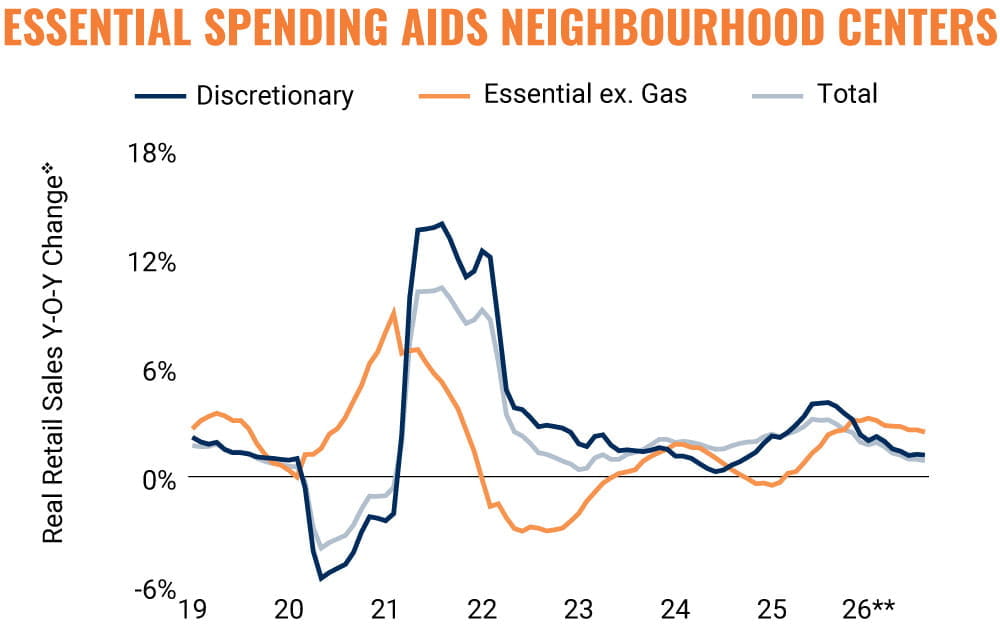
Spending patterns reinforce essential retail. Health and personal care sales rose 1.6 per cent in August, marking the tenth consecutive monthly increase. Together with the recovery in grocery spending, this supports the investment appeal of centers anchored by food retailers, pharmacies, and complementary services. These tenants benefit from recurring purchases that can help sustain visits to neighbouring businesses when households become more selective. For retail investors, sustained spending across a property’s tenant base provides a firmer foundation for underwriting rent growth. Meanwhile, the sharp rebound in home furnishings and gains in recreational goods warrant greater caution, as tariff-related purchasing may have temporarily lifted activity.
.

* Forecast; ** Through August; v Trailing 12-month total | Sources: Altus Data Solutions; Capital
Economics; CoStar Group, Inc.; Oxford Economics; Statistics Canada
TO READ THE FULL ARTICLE