Research Brief
Canada Monetary Policy
October 2026
Bank of Canada Resumes Tightening as Inflation Risks Rise
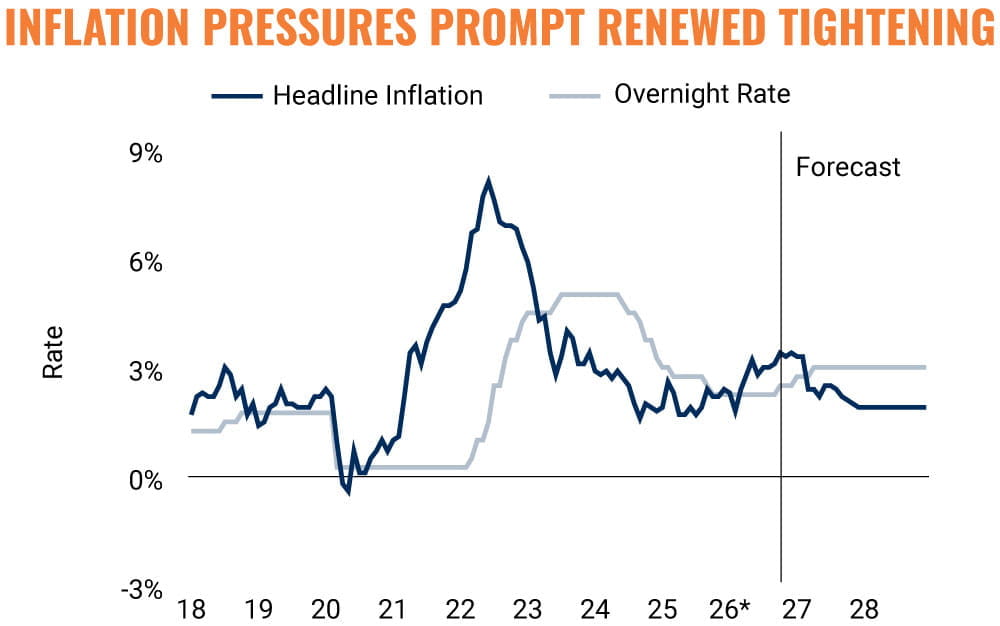
Persistent inflation risks prompt first rate hike in three years. The Bank of Canada raised its overnight rate by 25 basis points to 2.5 per cent in October, ending a year of steady policy rates. Stronger-than-expected economic growth and persistently elevated energy prices increased concerns that inflation could become more entrenched. While inflation excluding gasoline remained near the Bank’s 2 percent target, higher fuel costs are raising production and transportation expenses, and businesses are expected to pass more of these increases on to consumers over the coming year. Near-term inflation expectations have also risen. Together, these developments prompted the Bank to tighten policy despite lingering excess supply, weakness in tariff-exposed industries, and continued uncertainty surrounding Canada-U.S. trade relations.
Limited room for policy relief in the near-term. Following 3.3 per cent GDP growth in the second quarter, the Bank estimates the economy expanded by roughly 2 per cent in the third, exceeding its July expectations. New U.S. tariffs are expected to slow activity through year-end, before business investment, exports, and fiscal measures support a recovery in 2027. Consumer spending growth should moderate, however, while housing activity remains relatively weak. Annual GDP growth is forecast at 1 per cent in 2026 and 2 per cent next year. Meanwhile, inflation is projected to reach roughly 3.5 per cent by December and average 3 per cent in 2027. With stronger growth expected to absorb remaining economic slack — putting additional pressure on nonenergy prices — further rate hikes are possible, although the Bank’s cautious guidance points to a measured approach amid lingering trade-related risks.
Commercial Real Estate Outlook
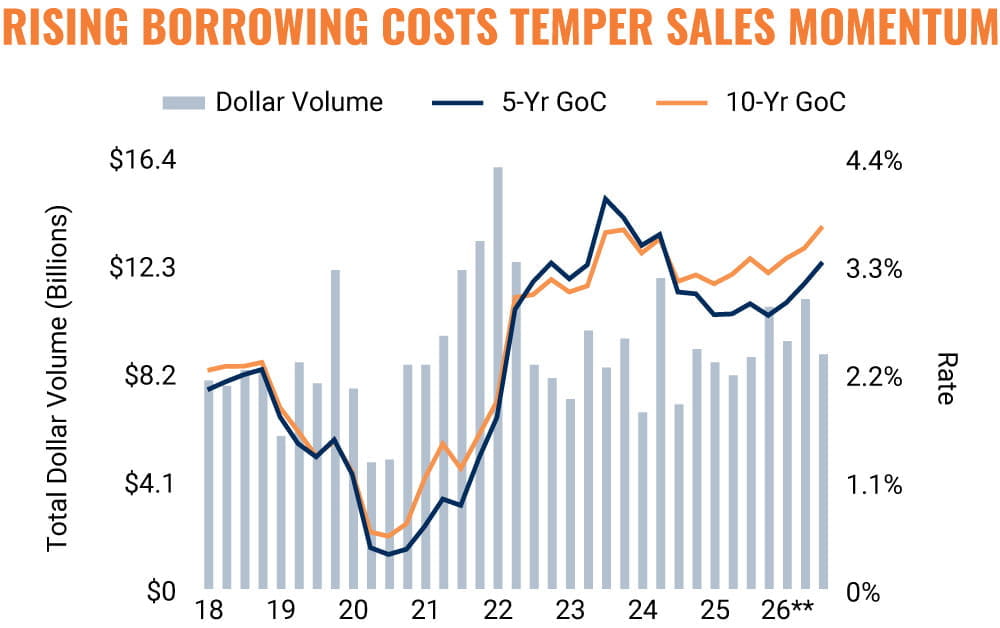
Bond yields show limited reaction. Despite the rate hike, five- and 10-year Canada bond yields moved little, as markets had already priced in a near-80 per cent probability of an increase. Tariffs, elevated energy prices, large government deficits, and financing needs tied to the AI buildout could limit meaningful yield declines over the short to medium term. A repeat of the rapid increases seen during the previous tightening cycle nevertheless appears less likely, with two, maybe three more hikes anticipated over the coming year. Core inflation remains near target, longer-term inflation expectations are anchored, and the economy retains excess capacity. Policy rates are also starting closer to more neutral levels, reducing the likely scale of adjustment required.
Higher borrowing costs begin to temper investment momentum. Canadian commercial real estate dollar volume has generally trended higher since 2024 as borrowing costs declined and then stabilized. However, preliminary third-quarter volume eased to $8.9 billion from just below $11 billion in the second quarter, suggesting rising bond yields began to weigh on activity. Interest rate uncertainty is likely to sustain this friction, slowing decisions and prolonging negotiations. That said, activity is still roughly double the pandemic trough. Property values have already adjusted, while the anticipated scale of rate increases remains more contained than during the previous tightening cycle, supporting transactions where pricing and income align with financing costs.
* Through September; ** Through 3Q | Sources: Altus Data Solutions; Capital Economics;
CoStar Group, Inc.; Oxford Economics; Statistics Canada
TO READ THE FULL ARTICLE