Research Brief
Canada Inflation
October 2026
Contained Inflation Battles Higher Energy Costs Amid Upcoming Rate Decision
Energy costs lift inflation as broader pressures ease. Canada’s headline inflation rate edged up 10 basis points in September to 3.1 per cent, with consumer prices rising 0.4 per cent on a monthly basis. The increase largely reflected a 6 per cent monthly jump in gasoline prices — which on an annual basis equates to a 27.8 per cent increase — as renewed crude oil pressures raised fuel costs. Excluding gasoline, annual inflation slowed by 20 basis points to 2.2 per cent, highlighting more subdued pressures across the broader basket. Food prices declined 0.1 per cent monthly, while lower auto rental and travel service costs helped offset increases in shelter and household goods. Together, these movements suggest that September’s headline acceleration primarily reflected energy volatility rather than a broad strengthening in inflation.
Softer core inflation favours an October rate hold. The average of the Bank of Canada’s preferred measures, CPI-trim and CPI-median, rose approximately 0.18 per cent monthly, a pace broadly consistent with its inflation target. The annual core rate held at 1.9 per cent. Combined with recently weak job reports that point to a year-to-date employment contraction, this could favour unchanged interest rates at next week’s meeting despite money markets pricing in a 25-basis-point hike. Looking further ahead, spare economic capacity and uncertainty surrounding the USMCA are likely to constrain business investment, hiring, and pricing power. These conditions suggest the Bank may tighten policy less than financial markets currently anticipate over the next year. However, persistent energy inflation and potential tariff-related cost increases remain key risks to the interest rate outlook
Commercial Real Estate Outlook
Financing risks influence investment decisions. Easing underlying inflation may prevent the immediate risk of further monetary tightening next week and reassures potential investors considering property acquisitions. However, holding the policy rate steady would not automatically lower borrowing costs, as longer-term bond yields also reflect global inflation and debt developments. If the Bank ultimately raises rates less than markets anticipate, financing could become more supportive than currently priced. Until that outlook becomes clearer, elevated borrowing costs are likely to constrain acquisition budgets, keeping investment activity sensitive to pricing and limiting the scope for buyers to underwrite aggressive capitalization rate compression.
Expenses and budgets shape property performance. Shelter prices rose 0.3 per cent monthly in September, underscoring continued pressure on select housing costs. For apartment owners, higher energy expenses could weigh on operating margins, particularly where rents include utilities. Meanwhile, declining mortgage interest costs in the CPI should not be interpreted as immediate financing relief, given the delayed effect of variable-rate mortgage renewals on the index. Across retail properties, softer food prices offer some support to household purchasing power, although higher gasoline costs absorb part of that benefit. These conditions favour investment decisions grounded in sustainable tenant demand, realistic expense growth, and existing property cash flow.

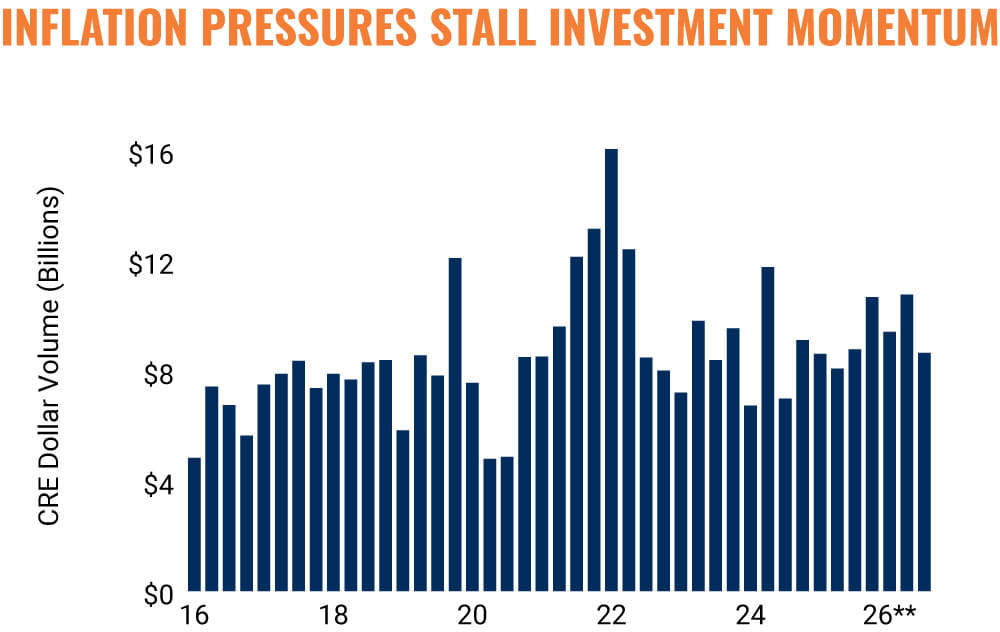
* Through October 2026, forecast thereafter; ** Preliminary estimates through 3Q | Sources: Altus Data Solutions; Capital Economics; CoStar Group, Inc.; Oxford Economics; Statistics Canada
TO READ THE FULL ARTICLE