Research Brief
Canada Housing
October 2026
Rising Mortgage Rates Stall Canada’s Housing Market Momentum
Higher borrowing costs interrupt housing recovery. Canadian home sales fell 2.3 per cent in September as rising fixed mortgage rates weakened purchasing power and pushed some buyers back to the sidelines. The seasonally adjusted single-family benchmark price declined 0.5 per cent, leaving it 3.4 per cent below a year earlier. New listings also decreased, limiting deterioration in market balance, although the sales-to-new-listings ratio eased to 48.8 per cent. Higher financing costs are likely to constrain activity and maintain near-term downward pressure on prices. Nevertheless, monetary tightening is likely to be less than what futures markets anticipate, potentially allowing mortgage rates to retreat and housing conditions to improve around the middle of next year.
Expensive markets face greater affordability constraints. Toronto and Vancouver posted larger September sales declines than the national average, reflecting their heightened sensitivity to higher mortgage rates. Larger borrowing requirements amplify payment increases and mortgage stress-test constraints, reducing purchasing budgets even as home values decline. Toronto’s singlefamily benchmark fell 5.2 per cent annually to $1,124,700, while Vancouver’s edged down 7.1 per cent to $1,798,400, underscoring more pronounced price corrections. In contrast, Calgary and Edmonton recorded modest monthly increases, bringing their benchmarks to $681,400 and $504,000. Montreal and Ottawa also weakened in September, although their respective benchmarks of $690,200 and $707,300 remained much closer to year-earlier levels.
Commercial Real Estate Outlook
Apartments lift construction despite challenges. Housing starts rebounded to just under 250,000 units annualized in September, supported by apartment construction. Urban apartment starts reached approximately 154,000 units annualized, a three-month high, although below the roughly 195,000 reached earlier this year. Upward revisions to summer activity and pickup in building permitting suggests a firmer near-term pipeline than previously reported. However, higher financing costs and declining asking rents constrain development returns, while weaker resale conditions complicate condominium presales. Starts could trend lower over the coming year, with purpose-built rental also showing signs of moderation, despite the need for more housing.
Rental softness accompanies substantial investment activity. Elevated homeownership costs could support tenant retention, but additional supply continues to pressure asking rents. This is especially true in newer builds, where rents are falling in some cases. As a result, owners will likely prioritize occupancy as opportunities for rent increases narrow. That said, multifamily investment remained substantial, with $4.5 billion recorded in the second quarter. However, nearly half of that amount reflected Welltower’s Amica Senior Lifestyles acquisition, overstating the breadth of conventional apartment investment demand. Higher borrowing costs and softer leasing assumptions could temper bidding and transaction momentum over the near term.

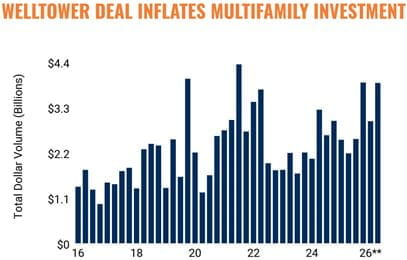
* As of September 2026; ** Through 2Q | Sources: Altus Data Solutions; Capital Economics;
CMHC; CoStar Group, Inc.; CREA; Oxford Economics; Statistics Canada
TO READ THE FULL ARTICLE