Research Brief
Canada Employment
October 2026

Job Losses Temper Rate Expectations as CRE Faces Financing Headwinds
Public-sector losses reverse summer employment gains. Canada shed 68,000 jobs in September, following a 42,000-job decline in August, leaving total employment down approximately 41,000 year to date. Educational services and healthcare accounted for most of the pullback, while youth employment fell by 48,000 as the reversal of strong summer hiring continued amid the start of the school year. Losses were split between full-time and part-time positions. Manufacturing also shed approximately 13,000 jobs amid renewed U.S. tariff pressures. That said, the private-sector headcount increased, suggesting the headline decline overstates the breadth of weakness. The unemployment rate edged up 10 basis points to 6.5 per cent, but remained below April’s 6.9 per cent yearly peak and last year’s 7.1 per cent level.
Weaker employment supports near-term pause in monetary policy. Back-to-back job losses reduce the likelihood of an October interest rate hike, and a significant upside surprise in September inflation would likely be needed to shift the Bank of Canada toward tightening. Annual wage growth of 2.3 per cent also suggests limited pressure for higher energy and food costs to translate into sustained wage-driven inflation. Continued labour market slack should help contain these second-round effects. Nevertheless, those price risks leave eventual policy normalization in play. The timing will depend on upcoming inflation readings, with the latest employment figures strengthening the case for the Bank to wait until early 2027 before considering an interest rate hike.
Commercial Real Estate Outlook
Bond yields remain a key constraint on investment activity. Softer employment could temper upward pressure on shorter-term bond yields. However, longer-term borrowing costs may remain elevated if investors continue to anticipate multiple rate hikes through the end of 2027. For commercial real estate, this creates a mixed backdrop. A delayed policy increase does provide some near-term stability, but financing costs tied to government bond yields could remain restrictive, particularly for acquisitions and upcoming mortgage renewals. Higher debt costs would limit acquisition leverage and weigh on achievable pricing, making income growth and the gap between buyer and seller expectations increasingly important for transaction execution.
Strong first-half dollar volume faces financing headwinds. Investment dollar volume rose 14 per cent in the first half of 2026 compared with a year earlier. Deal count increased by just 3 per cent, indicating that higher-value transactions were once again gaining traction. However, higher interest rates could curb momentum in the second half as borrowing costs constrain purchasing power and investors reassess underwriting assumptions. These pressures could lengthen negotiations and delay some acquisitions. While investor demand remains, sustaining the first-half pace will increasingly depend on sellers adjusting pricing expectations and properties offering sufficient income growth to offset more expensive financing.

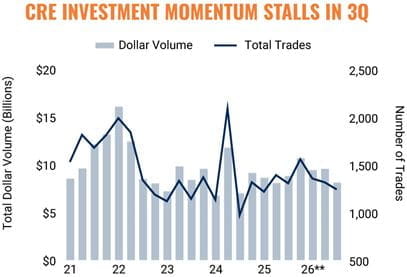
* Through September; ** Preliminary estimates through 3Q | Sources: Altus Data Solutions;
Capital Economics; CoStar Group, Inc.; Oxford Economics; Statistics Canada
TO READ THE FULL ARTICLE