Research Brief
Canada Business Outlook
October 2026
Weaker Business Sentiment Creates Near-Term Challenges
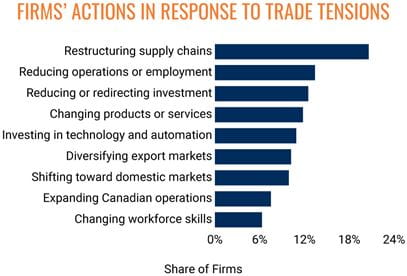
Trade tensions dented confidence, raised inflation expectations. The Bank of Canada’s third-quarter Business Outlook Survey pointed to deteriorating business conditions after Canada-U.S. trade talks broke down and new counter-tariffs were announced. The Business Outlook Survey Indicator fell 33 per cent, while export growth expectations over the next 12 months dropped sharply from 5.8 per cent to 1.6 per cent, indicating that escalating trade tensions weighed heavily on firms’ short-term outlooks. Meanwhile, inflation expectations rose notably after the breakdown in trade talks and the recent increase in oil prices. In particular, firms’ two-year inflation expectations rose to 3.1 per cent in September, reaching their highest level since December 2022.
Economic conditions still support an October rate hold. While the Business Outlook Survey points to a stagflationary backdrop, recent economic data indicate that underlying conditions continue to support a rate hold in October. The rise in businesses’ inflation expectations was driven largely by higher energy costs, while actual year-over-year price growth excluding gasoline slowed to just 2.2 per cent in September. Labour market conditions have also weakened, with consecutive employment declines in August and September leaving total employment roughly 41,000 lower year to date. With persistent trade and geopolitical tensions likely to remain a drag on domestic activity, downside risks to growth should help counterbalance lingering inflation concerns. Taken together, these conditions continue to support unchanged interest rates at the BoC’s October meeting, despite market pricing suggesting the possibility of a rate hike.
Commercial Real Estate Outlook
Leasing momentum to remain resilient. Renewed trade tensions may create a near-term setback for space demand across commercial real estate sectors, as heightened uncertainty weighs on business confidence and consumer activity. However, the impact should be a temporary interruption rather than a material shift in the broader recovery path. Industrial demand may soften as businesses take a more cautious approach to inventories, expansion, and leasing decisions. Over time, however, continued efforts to diversify export markets and optimize supply chains should reduce the sector’s exposure to trade disruptions. Similarly, retail leasing could face some pressure as trade uncertainty weighs on consumer confidence and discretionary spending. However, resilient demand for well-located space and limited new supply should help support operating conditions.
Investors may turn more cautious amid short-term headwinds. Investment activity could face another near-term setback as renewed trade tensions weigh on investor confidence and the recent rise in long-term Treasury yields pressures financing conditions. Higher borrowing costs could also prolong the adjustment in pricing expectations between buyers and sellers. While these factors may slow the recovery in transaction volumes, they are unlikely to materially alter the longer-term improvement in investment conditions, given sound sector fundamentals and a supportive, pro-growth government policy environment.

* Percentage of firms reporting positive sentiment minus the percentage reporting negative sentiment, year-over-year growth for export growth expectations | Sources: Altus Data Solutions; CoStar Group, Inc.; Bank of Canada; Capital Economics; Oxford Economics
TO READ THE FULL ARTICLE