Research Brief
Retail Sales Implications
September 2026

Retail Sales Growth Supports Economy and Commercial Real Estate
- Consumer spending remains a key economic driver, accounting for nearly 70 percent of U.S. GDP.
- Retail sales have exceeded expectations in 2026, rising 6 percent year-over-year in August, while the year-to-date measure averaged a robust 5.2 percent.
- Outside of post-recession recoveries, retail sales growth of this magnitude is historically uncommon.
- Adjusted for inflation, retail sales increased 2.5 percent in August and have averaged 1.7 percent growth year-to-date.
- Core retail sales, excluding autos and gasoline, rose 5.6 percent nominally in August, or 2.4 percent in real terms.
- Despite slower job creation, weak consumer sentiment, and elevated inflation, consumer spending remains a key source of economic support.
Households remain well positioned. Underlying financial strength continues to support purchases across traditional and experiential categories despite historically elevated borrowing levels.
- Consumer spending has been supported, in part, by borrowing, with auto, credit card, and total household debt at or near
record highs as of June. - However, incomes have also been rising, placing downward pressure on debt as a percentage of income.
- Consumer savings, including money market mutual funds, remain at all-time highs despite economic headwinds and have risen 4.5 percent in the past year
- Taken together, household debt, income and savings trends suggest that U.S. consumers remain financially healthy overall.
- Among retail categories, sporting goods, restaurants and bars, and building materials have recorded some of the strongest gains outside of e-commerce.
- Experiential retail, including fitness, entertainment, beauty, and spa categories, has outperformed in the post-pandemic years.
Benefits extend across property types. Resilient household activity is driving healthy space demand, rent gains, and capital deployment across the broader commercial real estate landscape.
- Strong retail sales are supporting retail and industrial real estate, while broader economic growth and proximity to consumer amenities also benefit apartment and office space demand.
- Industrial net absorption exceeded 86 million square feet in the first half of 2026, more than four times the volume recorded during the same period last year.
- Despite slowing construction, industrial supply continues to outpace demand, sustaining a national vacancy rate of 7.8
percent as of the second quarter - Multi-tenant retail vacancy remains steady at 5.8 percent, including a 9 percent vacancy rate for shopping mallsFor investors with available capital, refinancing pressures may create attractive acquisition opportunities while placing additional upward pressure on cap rates.
- Excluding malls, vacancy across grocery-anchored, unanchored, lifestyle, and power centers is tighter at 4.9 percent.
- Tight multi-tenant retail vacancy continues to support rent growth, which stood at 2.2 percent year-over-year in June.
- Retail investment activity remains strong, with multi-tenant deal volume 4 percent below the 2022 peak, while trailing 12-month single-tenant transaction velocity reached a record high.
- Despite persistent economic headwinds, positive retail sales and consumption continue to support commercial real estate performance and broader economic growth.
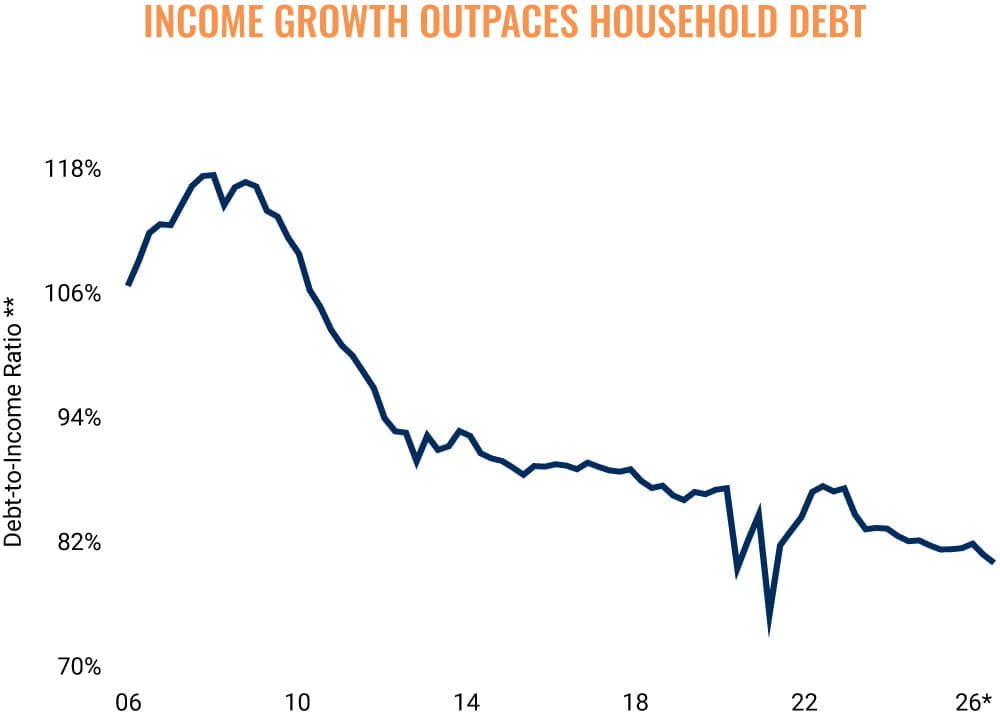
* Through 2Q ** Total Household Debt as a Percent of Disposable Personal Income
Sources: Marcus & Millichap Research Services; Bureau of Economic Analysis; Bureau of Labor
Statistics; CoStar Group, Inc.; Federal Reserve; New York Federal Reserve; Office of Financial
Research; Placer.ai; Real Capital Analytics; U.S. Census Bureau; University of Michigan
TO READ THE FULL ARTICLE