Research Brief
Retail Sales
September 2026

Record Core Retail Sales Ease Some Concerns Surrounding Consumers’ Resiliency
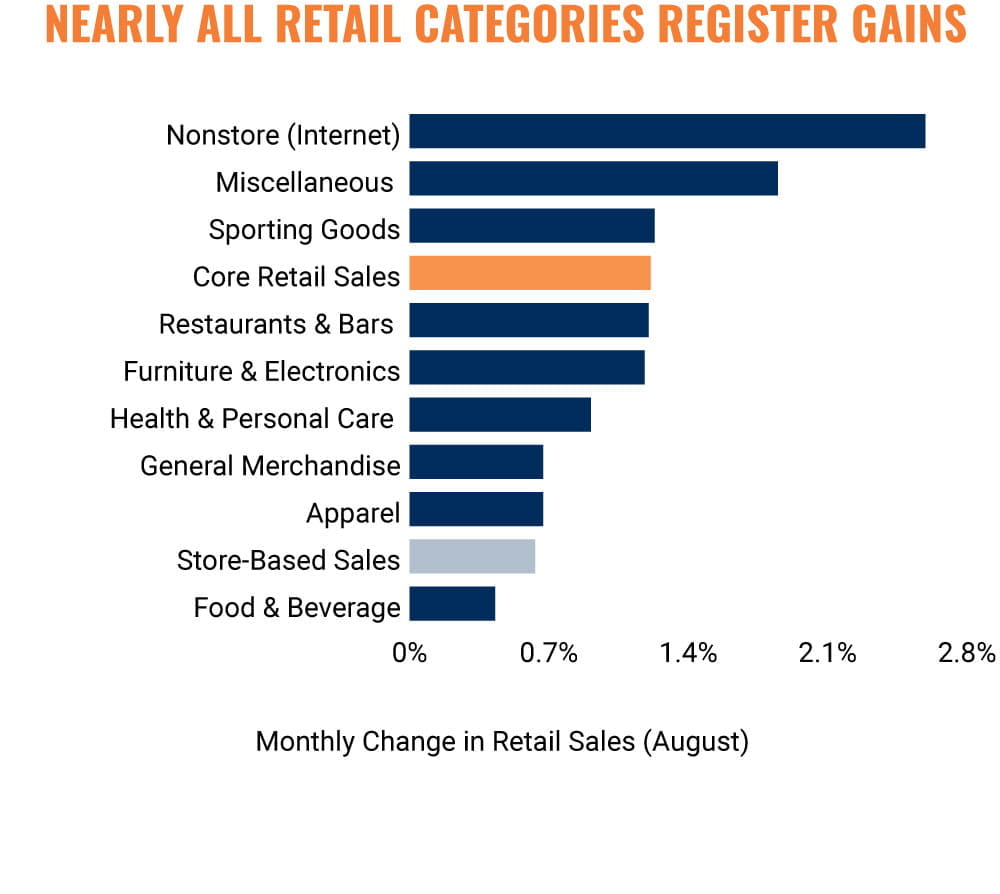
Spending improved broadly. Core retail sales rebounded last month after a moderate drop in spending in July, largely due to a pullback in online sales. Supported by gains across nine of 10 major retail categories, core spending rose 1.2 percent in August and 5.6 percent year-over-year. Wide-ranging sales growth indicates that while many households are prioritizing necessities, many are also setting aside part of their budgets for experiences and dining out, aiding a diverse mix of retailers. Still, recent headwinds will test these households’ purchasing power. The 25-basis-point interest rate hike announced at the Federal Reserve’s September meeting will raise most credit card interest rates, affecting existing balances and future purchases. Inflation outpacing wage growth on an annual basis in August, along with an average national gas price above $4 a gallon, will also test consumers’ spending power. Fortunately, U.S. employers added an estimated 162,000 jobs in August, and quarterly household debt among people with a credit score sits at its lowest level since 2013. This job-growth reading, however, will be revised, and it remains unclear whether a similar hiring rate will carry into future months.
Brick-and-mortar sales also reached a record. While the link between online purchasing and overall sales momentum is growing, consumers still spend at physical retail locations. Store-based sales, which exclude online purchases and sales at restaurants and bars, rose 0.6 percent in August — ahead of headline inflation and the second-largest increase in the last 14 months. Categories including health and personal care, apparel, sporting goods, and general merchandise all notched record sales totals last month, which has positive implications for retail demand among tenants should new benchmarks be set in the coming months. Preliminary data from the third quarter of 2026 show positive net absorption across both the single- and multi-tenant sectors that is in line with new supply. This, along with a favorable ratio of store openings to closings, should result in limited overall vacancy movement for the rest of this year.
Stores adopt cost-cutting strategy. In a positive development for households’ budgets, select retailers, including Walmart, Burlington, Tractor Supply, and e.l.f. Beauty, are using their tariff refunds to lower prices. While cost cuts will largely apply to essentials, these reductions may be significant enough to increase foot traffic in these retailers’ stores. Should this materialize, the increased traffic could extend to ancillary stores within the shopping centers these larger retailers anchor.
Key Takeaways
- Core retail sales, which excludes motor vehicle and gas sales, fell 0.2 percent in July yet still rose 4.8 percent on a year-over-year basis. Last month’s decline coincided with a 0.1 percent dip in core CPI, indicating spending was down slightly in real terms.
- Nine of 10 retail categories notched monthly gains of 0.4 percent to 2.6 percent.
- Broad-based sales growth suggests that many households are prioritizing necessities, while also setting aside some of their budget for experiences and dining out.
- Store-based sales, which exclude purchases made online and at restaurants and bars, rose 0.6 percent in August — the second-largest increase over the past 14 months.
1.2% |
5.6% |
|
Rise in Core Retail Sales (Monthly) |
Rise in Core Retail Sales (Year-Over-Year) |
Note: Store-based sales exclude all purchases made online and at restaurants and bars Sources: Marcus & Millichap Research Services; Bureau of Labor Statistics; Census Bureau; CoStar Group, Inc.; Federal Reserve Bank of New York; various companies’ earnings reports
TO READ THE FULL ARTICLE