Research Brief
Market Share Trends
September 2026

Capital Continues to Move Down-Market, Supported by Demographics and Pricing
Capital flowing into smaller markets. Commercial real estate activity across the main property types is increasingly occurring outside the nation’s largest metros.
- Primary markets accounted for 46.5 percent of CRE transactions in 2010, while tertiary markets captured about 35 percent.
- Over the past 15 years, transaction activity has steadily migrated toward smaller metropolitan areas.
- In the trailing 12 months through June 2026, more than 50 percent of transactions across the four major property types were in tertiary markets, while primary markets accounted for approximately 34 percent of total transaction velocity
- Deal flow in smaller metros has increased across office, retail, and apartment properties since 2017, with tertiary market share rising from between 28 percent and 48 percent to between 40 percent and 58 percent as of June 2026.
- Industrial properties have experienced the largest shift, with tertiary market deal share increasing from 37 percent in 2017 to 51 percent in the year ended June.
Trends in population redistribution favor tertiary markets. The country’s largest urban centers are no longer the epicenters of population growth, with momentum picking up in smaller settings.
- Historically, primary markets were viewed as safer investments due to stronger job growth, population gains, and more liquidity.
- Beginning in 2013, domestic migration to large counties and major metros began to slow, while migration to smaller regions started to accelerate.
- The trend intensified during the pandemic as remote work enabled households to relocate to smaller communities.
- Although migration flows have moderated since 2021, demand for lower-cost markets and greater workplace flexibility continues to support the decentralization of population growth.
- As a result, many smaller metros have sustained stronger population growth since 2020, increasing their appeal to investors.
Investment dynamics evolve. Shifts in pricing relationships and market depth have made many smaller metropolitan areas more attractive to commercial real estate investors.
- Beyond demographic trends, the yield premium available in smaller metros has fueled investor interest.
- Before 2020, tertiary markets offered significantly higher cap rates than primary markets, especially in the office, apartment, and industrial sectors.
- Since the pandemic, cap rate spreads have narrowed across most property types as pricing adjusted and investors have allocated more capital to smaller markets.
- Apartment yield spreads declined from roughly 210 basis points in 2015 to about 70 basis points in the year ended June.
- The industrial spread narrowed to roughly 100 basis points over the past year, after peaking near 140 basis points in 2021.
- At the same time, rising transaction activity has improved liquidity in many smaller metros, reducing one of the traditional risks associated with these markets.
- Cumulative tertiary market transaction volume across the four main property types increased from approximately 7,700 sales in 2010 to more than 44,000 over the past year, underscoring the growing maturity of these markets.
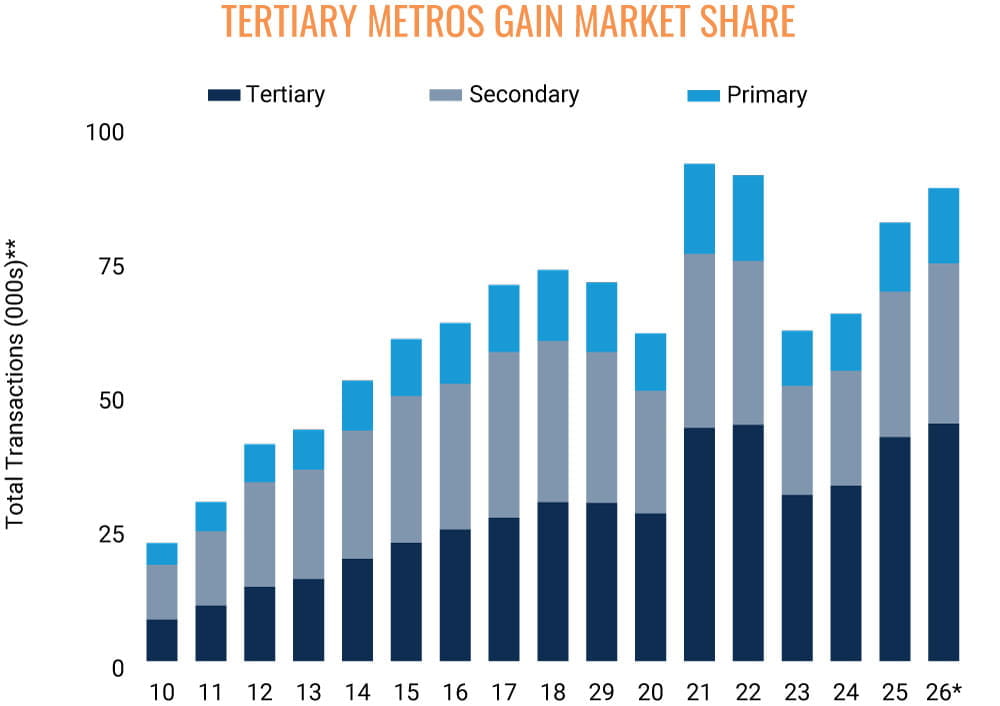
* Year ended 2Q ** Sales $1M and greater Sources: Marcus & Millichap Research Services; CoStar Group, Inc.; Real Capital Analytics
TO READ THE FULL ARTICLE