Research Brief
Interest Rate Trends
September 2026

Federal Reserve Rate Hike Shifts the CRE Landscape
Higher rates remain likely. Market expectations and underlying economic conditions suggest that additional interest rate increases remain a meaningful possibility.
- The Federal Reserve unanimously raised its policy rate by 25 basis points this month, underscoring its commitment to data-driven monetary policy.
- Financial markets continue to assign meaningful odds to further rate increases before year-end, with only a 10 percent to 15 percent chance that the overnight rate will remain unchanged.
- Core PCE remains well above the Federal Reserve’s 2 percent target, signaling persistent underlying inflation.
- Elevated energy, fuel, and transportation costs continue to contribute significantly to broader inflationary trends.
- Record Treasury issuance is increasing the supply of debt and putting upward pressure on interest rates.
- Rising sovereign debt yields, combined with persistent inflation, suggest the risk of higher interest rates remains elevated.
- While easing geopolitical tensions or tariff reductions could moderate inflation and reduce interest rate risk, neither outcome appears likely in the near term.
Despite being elevated, today’s borrowing costs are not unusual. Relative to previous commercial real estate cycles, current Treasury yields remain broadly consistent with long-term averages.
- Investors’ views of today’s rate environment are heavily influenced by when they entered the market.
- The post-financial-crisis era featured unusually low interest rates, with the 10-year Treasury averaging roughly 2.25 percent.
- Prior real estate cycles operated with Treasury yields ranging from roughly 4.5 percent to 9.0 percent.
- The 70-year-average 10-year Treasury yield is approximately 5.6 percent, placing current rates near historical norms.
- While today’s rates are not abnormal by historical standards, rising borrowing costs are posing significant challenges for some property owners.
- Higher rates may pressure some investors while creating attractive acquisition opportunities for well-capitalized buyers.
Refinancing risk creates openings. A wave of maturing debt and higher debt costs is increasing pressure on existing owners while creating acquisition opportunities for buyers with available capital.
- Approximately $865 billion of commercial real estate debt is maturing in 2026, followed by another $645 billion in 2027.
- Many of these loans were originated when borrowing costs were 3 percent to 4 percent, creating significant refinancing challenges in today’s 6 percent to 7 percent debt environment.
- Higher financing costs are forcing some owners to inject additional equity, sell assets, or risk default as loans near maturity.
- Lenders are increasingly reluctant to extend troubled loans, increasing pressure on borrowers to resolve refinancing challenges before loan maturity.
- For investors with available capital, refinancing pressures may create attractive acquisition opportunities while placing additional upward pressure on cap rates.
- Demand remains positive across many markets, and constrained supply could tighten vacancy rates and support the next cycle of rent growth.
- Despite near-term headwinds, declining new supply and pent-up demand continue to support the long-term outlook for commercial real estate fundamentals.
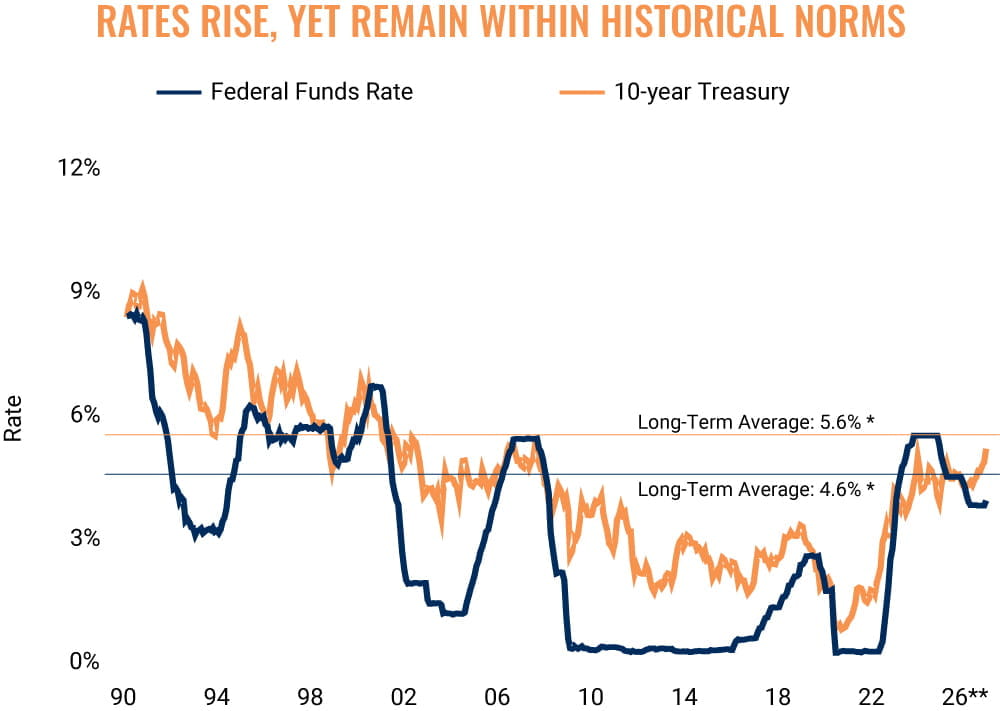
* Long-term average, 1956-present ** As of Sept. 16
Sources: Marcus & Millichap Research Services; Bureau of Economic Analysis; Bureau of Labor
Statistics; CME Group; CoStar Group, Inc.; Federal Reserve; IMF PortWatch; Mortgage Bankers
Association; Preqin; Real Capital Analytics
TO READ THE FULL ARTICLE