Research Brief
Housing
September 2026
Fewer Completions but Lower Migration Steady the Multifamily Outlook
Higher rates create competing multifamily effects. Seasonally adjusted home sales remained weak in July, with new homes the primary pain point. With benchmark interest and mortgage rates remaining elevated in August, financing costs may need to move materially closer to the low coupons held by existing owners before sales activity can meaningfully accelerate. For multifamily assets, higher rates create a mixed environment. The lock-in effect can support longer renter tenure, but higher debt costs reduce acquisition leverage and can complicate refinancing. Well-capitalized buyers and properties with durable cash flow are likely best positioned. Across segments, Class B properties, which noted the strongest improvement in annual transaction velocity over the year ended in August, may remain favorable. In this tier, a lower cost basis relative to Class A, paired with a generally more financially resilient renter base than Class C properties, may provide greater underwriting flexibility.
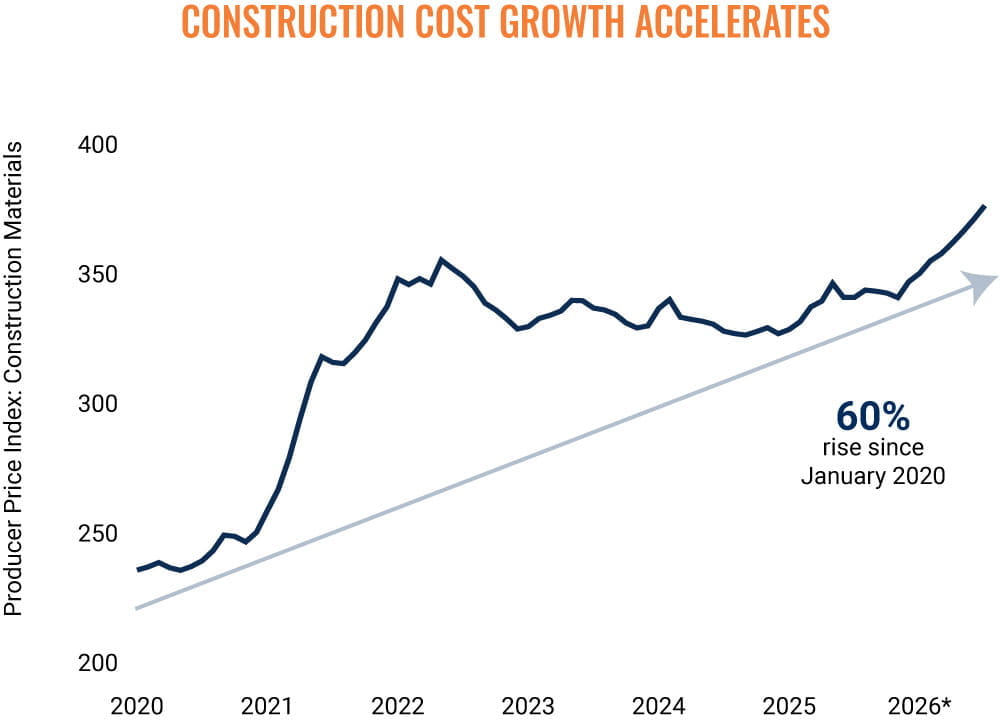
Construction costs rise. Seasonally adjusted residential completions declined 16.8 percent year-over-year in July, largely due to a more than 25 percent pullback in multifamily deliveries. The apartment development slowdown should persist, as units under construction at the end of June had fallen to roughly half of early 2023’s total of over 1.1 million. Rebuilding the pipeline will take time, especially with the producer price index for construction materials up roughly 7.5 percent in the first half of 2026, outpacing the decade’s average annual increase of approximately 5 percent. Tapering deliveries are gradually easing competition in many markets, reinforcing the recent decline in concession use. The share of units offering incentives fell to 15.8 percent in July, down from a five-year high of 17 percent in March and May.
Key Takeaways
- Softer hiring and sharply lower net international migration could slow household formation and temper
apartment absorption in the coming quarters. - Home sales remained subdued in July as elevated mortgage rates continued to reinforce the lock-in effect, supporting longer renter tenure.
- Higher debt costs can constrain multifamily acquisition leverage and refinancing, favoring lower-leverage buyers and stabilized properties with durable cash flow
- Multifamily completions fell sharply in July, while elevated material costs may prolong the development slowdown and further reduce concession pressure as existing supply is absorbed.
4.64% |
6.65% |
|
10-Year U.S. Treasury Rate as of Aug. 25, 2026 |
30-Year Mortgage Rate as of Aug. 20, 2026 |
* Through June
Sources: Marcus & Millichap Research Services; Moody’s Analytics; National Association of
Realtors; RealPage, Inc.; Freddie Mac; Mortgage Bankers Association; National Association of
Home Builders; U.S. Census Bureau; U.S. Bureau of Economic Analysis
TO READ THE FULL ARTICLE