Research Brief
Financial Markets
September 2026

Fed Raises the Overnight Rate, Reinforcing a High-Cost CRE Environment
Unified committee voted to raise the federal funds rate. After a stronger job-creation reading and persistent inflation above the 2 percent target, the Federal Open Market Committee voted unanimously to raise the target range for the overnight lending rate by 25 basis points to a lower bound of 3.75 percent. The FOMC maintains that the current rate aligns with its dual mandate of low inflation and high employment but remains open to data-driven adjustments. Before the meeting, markets priced a roughly 90 percent chance of a 25-basis-point hike in September; Wall Street now expects a 53 percent chance of another hike in October.
Economic resilience gives the Fed room to address inflation. Federal Reserve Chairman Kevin Warsh identified three changes since the committee’s last meeting that supported a rate hike: stronger economic activity, insufficient progress on inflation, and heightened geopolitical risk. The economy added a net 643,000 jobs through August, while unemployment held at 4.1 percent. The Fed also raised its real GDP growth projections to 2.3 percent for 2026 and 2.4 percent for 2027, indicating the FOMC views the current underlying momentum as durable. At the same time, inflation has not improved sufficiently. Headline PCE and core PCE were running at approximately 3.7 percent and 3.3 percent yearover-year in July, respectively, as too many spending categories continued to register price increases above 3 percent over both the trailing six- and 12-month periods. Geopolitical disruptions are adding to that pressure by constraining energy and commodity flows through the Strait of Hormuz and threatening alternative shipping routes near the Bab el-Mandeb Strait. With Brent crude near $104 per barrel on Sept. 17 and the average U.S. diesel price up nearly 17 percent over the past month to a record $6.40 per gallon, elevated transportation and production costs could broaden inflation and weigh on economic growth.
 Projections reinforce a higher long-term yield. Historically, the Fed does not stop at one rate hike in a cycle. Updated projections show that 16 of 18 policymakers anticipate at least one additional quarter-point hike before year-end, placing the rate at a lower bound of 4 percent by December and holding it there through 2027. Warsh reinforced that trajectory, noting he would be hardpressed to describe broad financial conditions as restrictive and characterized the action as removing a dose of accommodation. Treasuries had largely priced the decision in advance, with the 10- year closing at 4.94 percent as of Sept. 17, the highest yield since 2007. Attention now shifts to whether the Fed follows through with additional tightening. Elevated Treasury issuance could place additional upward pressure on longer-term yields
Commercial Real Estate Outlook
Elevated rates limit near-term financing relief. After the meeting, the 10-Year Treasury held at 4.94 percent as of Sept. 17, sustaining elevated borrowing costs. The Fed’s projected rate path also reduces the likelihood of near-term relief for borrowers, maintaining pressure on acquisition financing and loans approaching maturity. For investors waiting for lower rates, diminished prospects for near-term relief could encourage capital deployment. While lender liquidity remains strong, higher rates may widen the expectation gap between buyers and sellers.
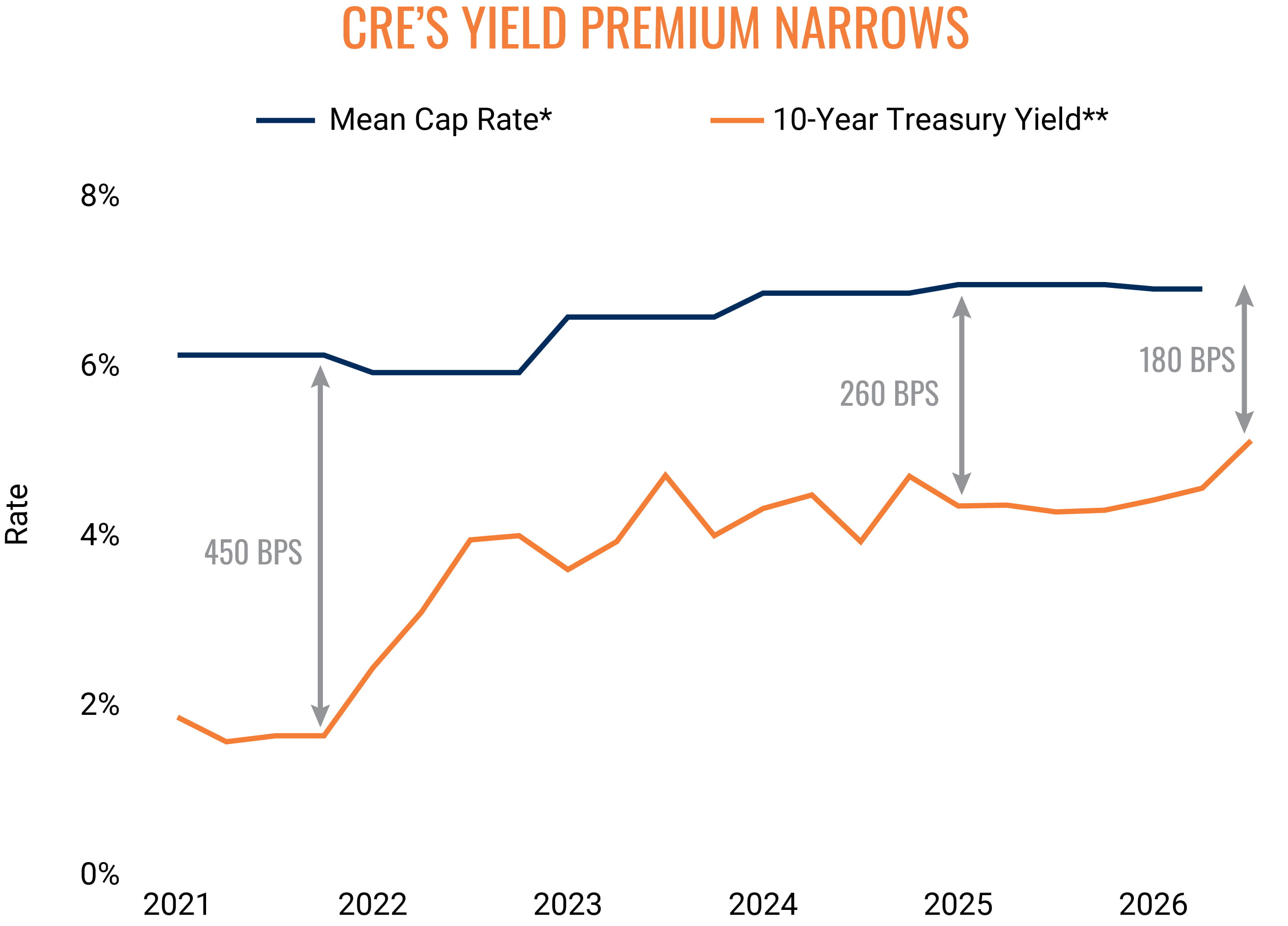
Higher 10-year narrows the CRE yield premium. The average cap rate across major property types remained in the upper-6 percent range in the second quarter. With the 10-year Treasury at 4.94 percent, the implied spread narrowed to about 180 basis points. A persistently narrow premium could reduce the relative return offered by commercial real estate, limiting the benefits of leverage and placing greater emphasis on assets with potential for high income growth. However, elevated construction financing costs could slow development, limiting new supply and supporting the vacancy and income outlook for existing properties.
4.94% |
3.75% |
|
10-Year Treasury Yield on Sept. 17 |
Federal Funds Rate Lower Bound |
*As of 2Q 2026 **As of Sept. 17 | Sources: Marcus & Millichap Research Services; AAA Fuel
Prices; CME Group; CoStar Group, Inc.; Federal Reserve; U.S. Bureau of Economic Analysis; U.S.
Bureau of Labor Statistics; U.S. Department of the Treasury
TO READ THE FULL ARTICLE