Research Brief
Employment
September 2026

Strong Job Gains Despite Labor Headwinds; Manufacturing Demand Strengthens
Hiring swings continue. In a surprise to the upside, August’s employment report showed a gain of 162,000 roles, while the prior two months were revised up by a combined 55,000 jobs. The rebound extends an unusually volatile stretch, with the dispersion of monthly job gains through August roughly twice that of the same period in 2025. This warrants caution against reading too much into one month. Hiring also remained concentrated, as food services, local government, and health care accounted for roughly 80 percent of August’s net gain. Even so, as long as employment holds near current levels rather than contracting, commercial real estate fundamentals should remain relatively resilient.
Factory growth begins adding jobs. The manufacturing build-out may be gaining momentum, as the sector added 16,000 jobs in August, marking a third straight monthly gain. After construction of manufacturing space peaked near 115 million square feet in 2024, more projects are now coming online, with second-quarter net absorption the strongest since 2022. Manufacturing job openings also rose by 79,000 in July, the largest gain among major sectors. Still, labor availability is likely to remain a headwind, as many manufacturers continue to report difficulty finding skilled workers.
Lower immigration may have a delayed housing impact. The labor force rose by 683,000 in August, and participation edged up to 61.6 percent, indicating improved labor supply. Yet aging demographics and slower immigration remain longer-term constraints. A recent Harvard study also suggests that the housing impact of fewer foreign arrivals may emerge with a lag, as immigrants typically form households one to two years after entry. The 2025 immigration pullback was estimated to reduce household growth by only about 75,000 that year, but the shortfall could approach 500,000 households annually by 2027 relative to 2024. For multifamily investors, the effect may surface as slower absorption rather than immediate vacancy pressure, placing greater emphasis on durable in-place income and adding risk to aggressive lease-up strategies.
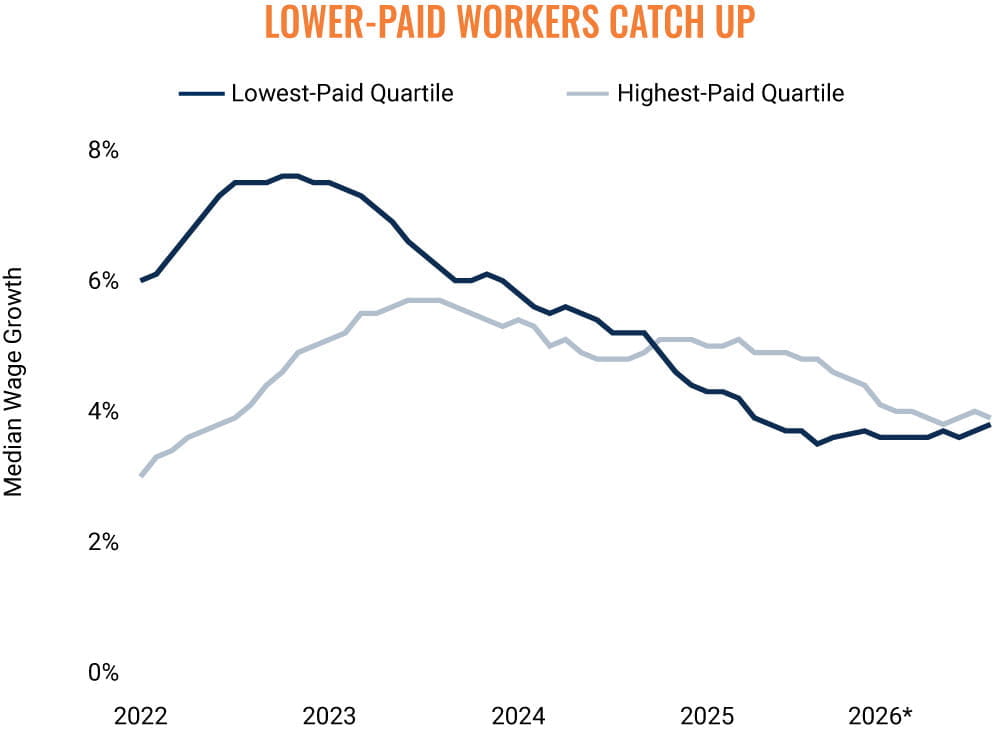
Domestic wage gains support renewals. Slower immigration could reinforce wage pressure among lower-paid workers, as foreignborn workers are overrepresented in traditionally lower-paying occupations. Atlanta Fed data show that wage growth among the lowest-paid workers has largely closed the gap with the highestpaid quartile. At the same time, Bank of America reports that lower-income households now have the strongest wage gains of any income group. This may be helping Class C apartments, where rent growth at renewal remained near 3 percent in July and renewal conversion reached roughly 60 percent, its highest level since 2022.
Key Takeaways
- Hiring remained volatile and concentrated despite August’s rebound, making the broader trend less convincing than the headline suggests.
- As more manufacturing facilities come online, hiring is starting to pick up, but skilled-worker shortages remain a key hurdle.
- Fewer immigrant arrivals may only now be translating into slower household formation, posing a headwind to apartment absorption.
- Tighter labor supply in lower-wage jobs could be helping lower-paid workers close the wage-growth gap, supporting renewal performance among existing renters.
643,000 |
107,000 |
|
Jobs Added Year to Date Through August |
Average Monthly Job Gain, Past Six Months |
* Through July
Sources: Marcus & Millichap Research Services; Atlanta Fed Wage Growth Tracker; Bank of
America Institute; Bureau of Labor Statistics; CoStar Group, Inc.; Harvard JCHS; RealPage, Inc
TO READ THE FULL ARTICLE