Research Brief
Canada Monetary Policy
September 2026

Interest Rate Outlook Could Shift as Economic Risks Persist
Central bank maintains cautious stance. The Bank of Canada held its overnight rate at 2.25 per cent for the seventh consecutive meeting in September. The decision followed a notable improvement in domestic conditions, with second-quarter GDP growth surpassing expectations at a 3.3 per cent annualized growth rate and proving broad-based. Labour market conditions also strengthened with the unemployment rate falling to a two-year low of 6.4 per cent. At the same time, excess capacity remains in the economy, and trade uncertainty continues to cloud the outlook, limiting the need for immediate tightening. However, the Bank adopted a more hawkish tone, emphasizing that upside risks to inflation have increased and signalling a greater willingness to adjust policy should price pressures or economic activity prove stronger than anticipated.
Rate outlook tilted toward tightening. The path forward will require policymakers to balance an improving domestic economy against competing inflationary and trade-related risks. Stronger GDP growth and improving employment have reduced the need for further monetary support. At the same time, elevated oil prices increase the risk that headline inflation stays above target or begins feeding more broadly into consumer prices. Conversely, escalating U.S. tariffs and ongoing trade uncertainty could weaken exports, business investment, and hiring, particularly in trade-sensitive industries. With these forces pulling policy in opposite directions, rates are likely to remain unchanged in the near term. However, the balance of risks has shifted toward an earlier increase if economic momentum persists and inflation remains elevated.
Commercial Real Estate Outlook
Bond markets face upward pressure. Rising inflation concerns have pushed bond yields higher in recent months, so borrowing costs have not fully benefited from the earlier monetary-easing cycle. This matters for commercial real estate, where longerterm yields influence mortgage rates, refinancing costs, and return requirements. Elevated yields could slow further cap-rate compression and create challenges for highly leveraged assets approaching refinancing. Nevertheless, investors continue to adjust to the higher-rate environment, with dollar volume nearing $19 billion in the first half of 2026, up 14 per cent from last year.
Commercial real estate continues to attract capital. Despite higher financing costs, the investment environment has improved as asset values have repriced and greater price discovery has narrowed bid-ask spreads. Commercial real estate also retains defensive characteristics that remain attractive amid elevated geopolitical, trade, and financial-market uncertainty, including durable income streams and the potential for long-term appreciation. These factors are translating into increased transaction activity, with trailing 12-month investment volume nearing $40 billion through the second quarter, up 17 per cent annually. Combined with sound property fundamentals and yields that remain materially above pre-tightening-cycle lows, commercial real estate could remain an attractive allocation even if interest rates stay higher for longer.

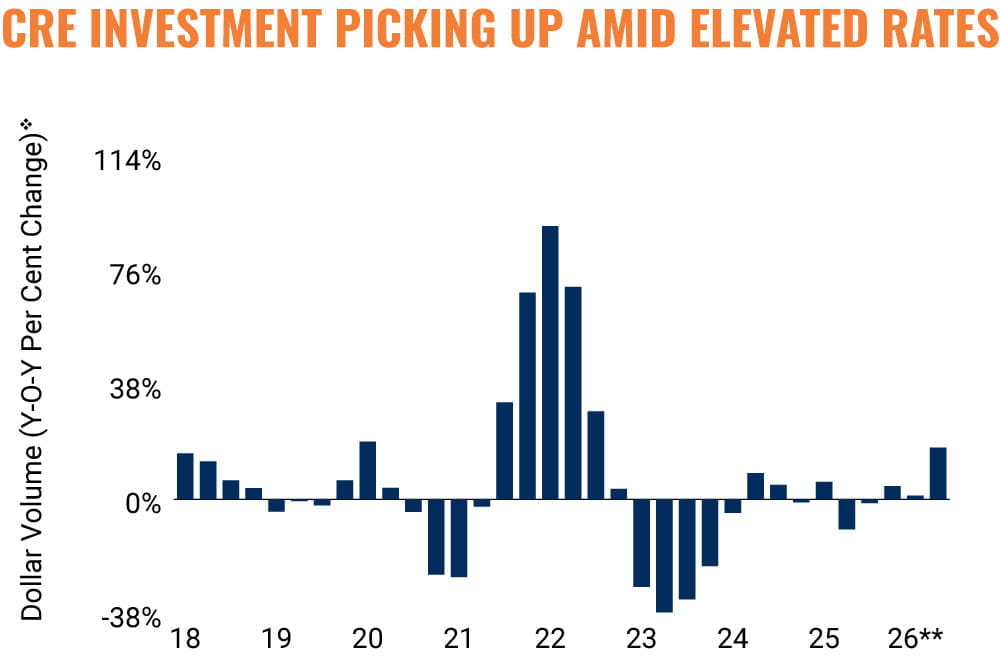
* Forecast; ** Through 2Q; v Trailing 12-month total | Sources: Altus Data Solutions; Capital
Economics; CoStar Group, Inc.; Oxford Economics; Statistics Canada
TO READ THE FULL ARTICLE