Research Brief
Canada Housing
September 2026

Higher Borrowing Costs Stall Canada’s Housing Recovery
Housing recovery loses momentum. Canada’s resale housing market softened in August, with home sales down 0.7 per cent month-over-month and remaining 6.9 per cent below year ago levels. Activity has changed little since May, suggesting the recovery that emerged earlier this year has begun to stall. Meanwhile, new listings increased 3.3 per cent, reversing three consecutive monthly declines as sellers moved ahead of the fall market. This pushed the sales-to-new-listings ratio down from 51.1 per cent to 49.1 per cent, below its long-term average but still consistent with balanced conditions. National inventory remained stable at 4.8 months, while the number of homes listed for sale stood just 1.4 per cent above August 2025.
Higher borrowing costs threaten the recovery. The recent rise in government bond yields has already pushed up fixed mortgage rates, and renewed inflation concerns have raised the prospect of further Bank of Canada tightening. These developments are eroding the affordability gains from earlier interest-rate cuts and could keep more prospective buyers on the sidelines through the rest of 2026. At the same time, uncertainty about the durability of economic growth and a weakening labour market is likely to weigh on household confidence. Although pent-up demand and stable employment among core home-buying cohorts may prevent a sharp correction, elevated prices and rising financing costs will likely limit any meaningful acceleration in sales heading into 2027.
Commercial Real Estate Outlook
Price conditions continue to stabilize. The median price of a single-family home was unchanged in August and has moved sideways since the spring. That has narrowed the price decline from year-ago levels to its narrowest margin in 10 months, although that still leaves prices down 3 per cent year-over-year. Balanced inventory levels should help contain further price declines nationally, but regional differences will remain pronounced. More affordable markets are comparatively well positioned, while elevated ownership costs and greater supply will continue to restrain conditions in Ontario and British Columbia, particularly within the condominium segment.
Weaker ownership demand supports the rental market. A slower resale recovery will keep some prospective homebuyers in rentals for longer, supporting apartment demand despite weaker population growth. However, rising completions and softer immigration are improving availability, moderating rent growth from recent highs. These conditions are creating a more competitive leasing environment, particularly in cities with large construction pipelines. Purpose-built rental fundamentals should remain comparatively resilient, however, as homeownership affordability remains stretched. For multifamily investors, easing rent growth will place greater emphasis on asset quality and operating efficiency. At the same time, higher bond yields could delay further cap-rate compression and slow the recovery in transaction activity.

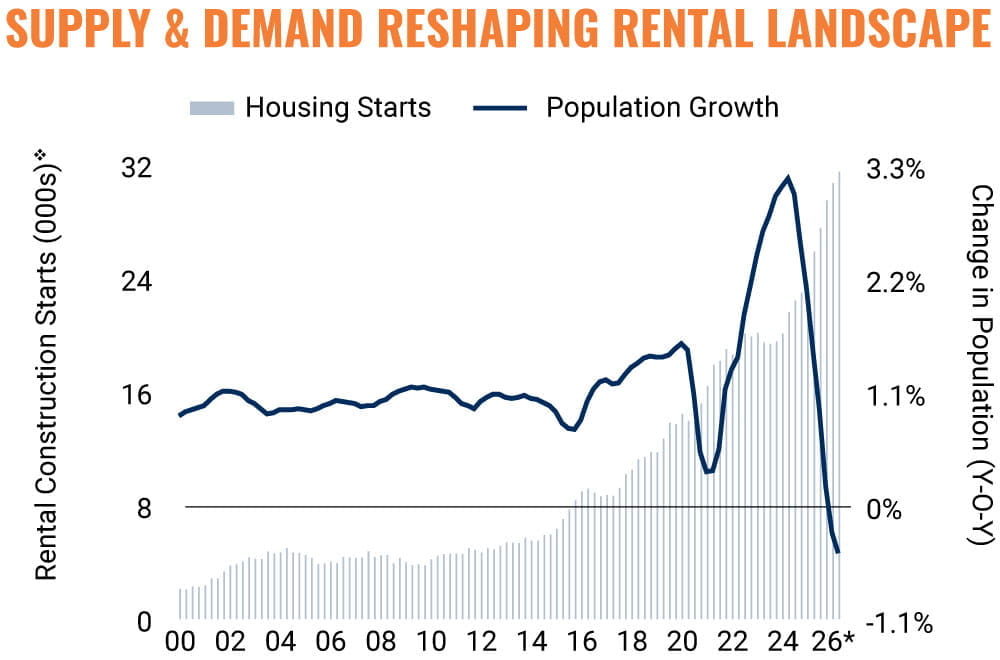
* Through August; ** Seasonally adjusted aggregate composite; v Trailing 12-month average
Sources: Capital Economics; CMHC; CREA; Oxford Economics; Statistics Canada
TO READ THE FULL ARTICLE