Research Brief
Canada GDP
September 2026

Retail and Industrial Poised to Benefit from Key Economic Tailwinds
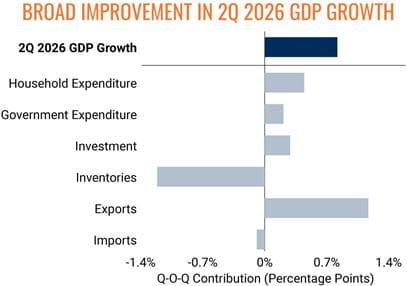
GDP staged a strong comeback. Canada’s economy rebounded sharply in the second quarter, with growth accelerating to an annualized pace of 3.3 per cent. Goods exports, surging 21 per cent, were the primary driver of this momentum, led largely by the auto sector as vehicle production recovered. The strengthening economic performance was not limited to trade. Business investment expanded at a solid 5.3 per cent annualized pace, supported by a 23 per cent increase in machinery and equipment spending. Residential investment also rose 10 per cent, driven mainly by stronger home resale activity in Ontario, Quebec, and British Columbia. Meanwhile, household consumption increased 3.5 per cent, underpinned by a 3.3 per cent rise in household expenditures and a 3.9 per cent increase in government spending, highlighting broad-based strength across the economy
Bank of Canada holds steady as trade headwinds reemerge. The economy’s strong second-quarter performance is unlikely to be repeated in the third quarter. July’s preliminary GDP estimate points to softer activity, and renewed U.S. tariffs imposed in late August are expected to weigh on trade in the third quarter. However, with roughly 80 per cent of Canadian exports to the U.S. continuing to qualify for duty-free treatment under the USMCA, growth should remain positive, albeit at a more moderate pace through the remainder of 2026. Escalating trade tensions have increased both downside risks to growth and upside risks to inflation, suggesting the Bank of Canada will likely remain patient as it assesses the economic impact of these trade headwinds and any accompanying fiscal measures
Commercial Real Estate Outlook
Resilient consumers support near-term retail outlook. The economy’s strong second-quarter performance was also reflected in household finances, with employee compensation rising at a 6.0 per cent annualized pace. As disposable income grew faster than consumer spending, the household saving rate increased to 3.7 per cent. This combination of rising incomes and higher savings provides consumers with a stronger buffer against renewed trade-related headwinds, supporting retail spending and leasing activity through year-end. While retailers may remain cautious amid economic uncertainty and shifting demographic trends, resilient household finances should help sustain consumer demand, supporting store expansion plans and limiting downside risks to leasing activity in the near term.
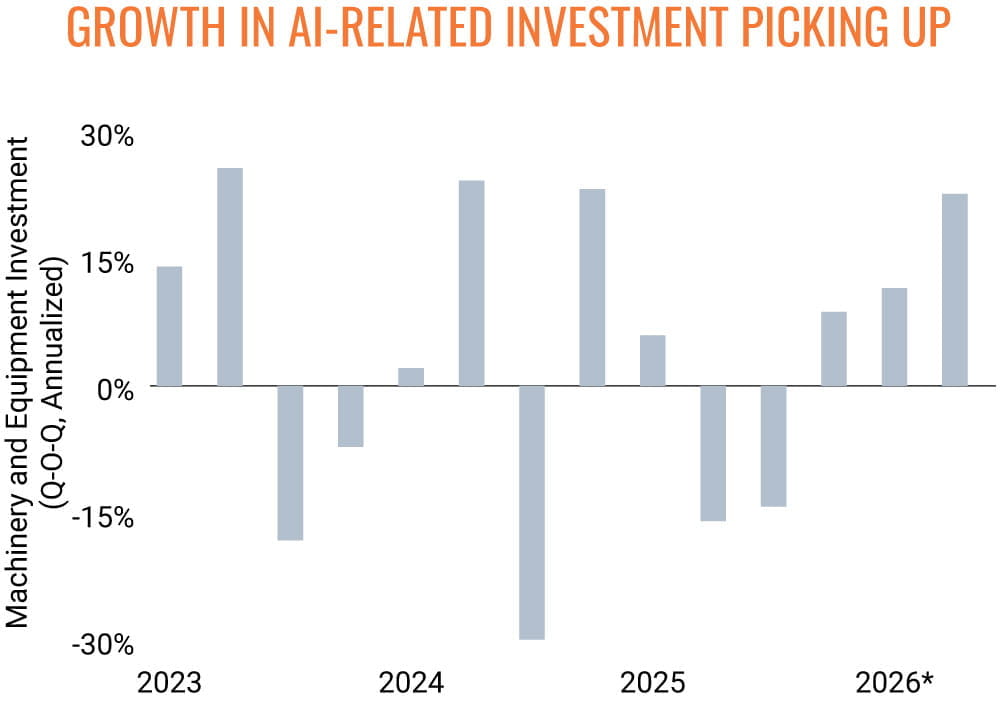
AI investment can power future industrial sector expansion. Since late 2025, business investment in machinery and equipment has accelerated markedly, reaching a 23 per cent annualized growth rate in the second quarter of 2026. Much of this latest momentum was driven by increased spending on computers and computer peripherals, reflecting a surge in imports of advanced processors and other equipment used in AI infrastructure. If sustained, this investment could meaningfully generate demand for industrial space through data centre development, equipment manufacturing, warehousing, and logistics activities, emerging as a key driver of industrial leasing demand in the years ahead.
Follow us on Linkedin * Through 2Q | Sources: Capital Economics; Oxford Economics; Statistics Canada
TO READ THE FULL ARTICLE