Research Brief
Canada Employment
September 2026

Job Losses Challenge Canada’s Growth Narrative
Jobs market logs unexpected setback. Canada’s labour market weakened in August, with employment falling by 42,000 positions, partially offsetting the 181,000 jobs added between May and July. Losses were concentrated in full-time employment and the services sector. At the same time, the unemployment rate held at 6.4 per cent as labour force participation fell to 65 per cent. Annual wage growth also slowed considerably to 2 per cent, down from 2.8 per cent in July. Despite the disappointing headline, employment remains higher year to date and total hours worked increased another 0.6 per cent in August. Slower population growth and rising retirements are also constraining labour force expansion, suggesting job growth will likely remain modest even as broader economic conditions improve.
Labour conditions temper the case for tighter policy. August’s employment decline counters stronger economic signals from second-quarter GDP and the Bank of Canada’s more hawkish recent messaging. The combination of weaker hiring, excess labour supply, and slowing wage growth presents little evidence of emerging inflationary pressure from the labour market. It also lessens the urgency of normalizing monetary policy. At the same time, the latest round of U.S. tariffs was implemented too late to materially impact August’s results, leaving downside risks to employment and business investment heading into the fall. With domestic demand rising but trade uncertainties high, the Bank is likely to keep its overnight rate unchanged through 2026.
Commercial Real Estate Outlook
Regional performance remains uneven. Employment losses were concentrated in Canada’s two largest provinces, with Quebec shedding 19,000 positions in August and Ontario losing another 18,000. Quebec was also the only province to record a year-overyear employment decline, while Ontario’s unemployment rate edged up to 6.9 per cent. Alberta and British Columbia saw more modest employment declines, though B.C.’s unemployment rate increased to 6.5 per cent. These regional differences will continue to influence commercial real estate performance. Softer labour conditions and greater tariff-related exposure will create greater near-term leasing headwinds in parts of Central Canada. In contrast, stronger economic and population dynamics are likely to better support space demand across Western Canadian markets.
Industrial fundamentals improving. Goods-producing employment strengthened in August, led by a 22,000-job increase in manufacturing. The improvement coincides with encouraging industrial property fundamentals. National vacancy fell 20 basis points to 3.4 per cent in the second quarter, while positive net absorption surpassed 10 million square feet in the first half of the year. Manufacturing momentum could provide additional support for industrial space demand, although the latest U.S. tariffs remain a meaningful risk. Export-dependent industries already recorded a higher layoff rate in August, suggesting trade-sensitive markets could face greater pressure in the months ahead.

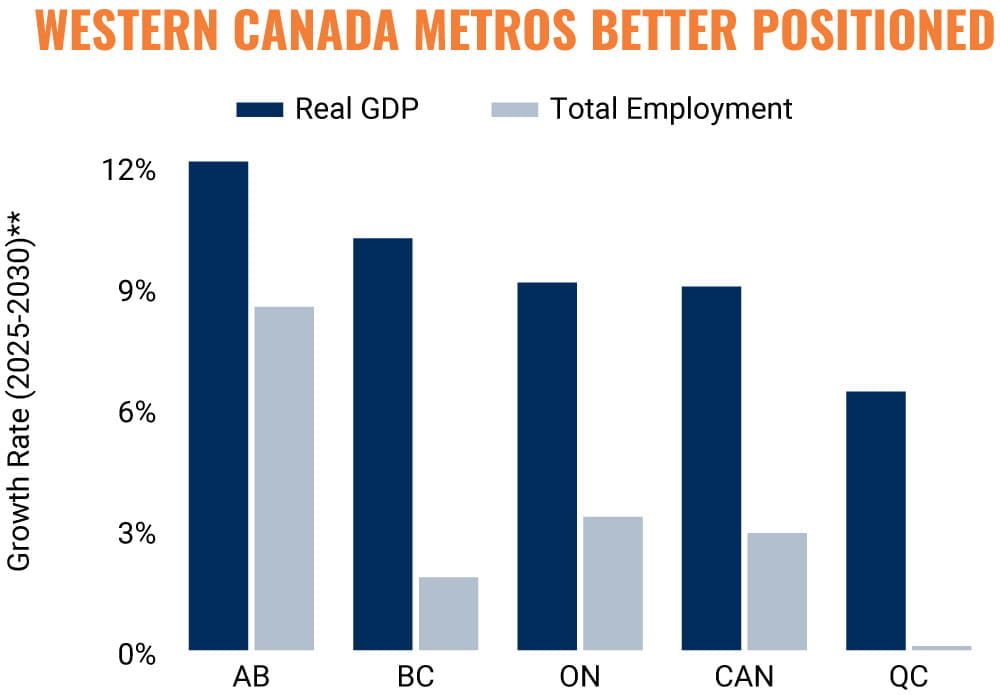
* Through August; ** Forecast provided by Oxford Economics | Sources: Altus Data Solutions;
Capital Economics; CoStar Group, Inc.; Oxford Economics; Statistics Canada
TO READ THE FULL ARTICLE