Research Brief
Office Investment Trends
August 2026
Office Sector’s Steady Improvement
Raises Potential Opportunities
Momentum continues to build. Rising workplace utilization has bolstered tenant demand in recent quarters, although performance remains uneven across the office landscape.
- Office demand recorded positive net absorption for a ninth consecutive quarter, extending the sector’s gradual recovery.
- The national vacancy rate fell to 15.9 percent in the second quarter of 2026, a 10-basis-point reduction from the prior quarter and well below the 17.2 percent peak in mid-2024.
- Recovery remains fragmented, with older, larger, and downtown office properties continuing to face elevated vacancy rates ranging from roughly 17 percent to the mid-18 percent band.
- Smaller, newer offices, particularly those in suburban markets, have generally outperformed the broader sector.
- Performance varies widely across assets, with some older buildings remaining fully vacant while premier properties achieve full occupancy and strong rent growth.
- Return-to-office trends continue to strengthen, providing a durable source of demand despite limited growth in traditional office-using employment.
- Office attendance has rebounded to roughly 76 percent of pre-pandemic levels, with midweek attendance exceeding 90 percent in several major U.S. metros.
Opportunity emerges from distress. While select markets post strong demand, ongoing challenges among older office properties are expanding the universe of value-add investments.
- Miami, West Palm Beach, Las Vegas, and the Inland Empire have vacancy rates below pre-pandemic levels as of June.
- Several major metros, including the Bay Area, Austin, Nashville, New York, and Boston, have recorded strong space demand over the past year.
- Many older office towers continue to face headwinds, contributing to an elevated office delinquency rate of about 12 percent.
- Distressed assets continue to trade at substantial discounts, creating opportunities for investors pursuing redevelopment, repositioning, or operational turnarounds.
Deal flow remains firm. Investment activity has maintained a durable pace as cap rates have largely stabilized, though valuation and performance gaps remain significant across asset quality tiers.
- Office transaction velocity through the second quarter remained near pre-pandemic norms, reflecting sustained investor interest in the sector.
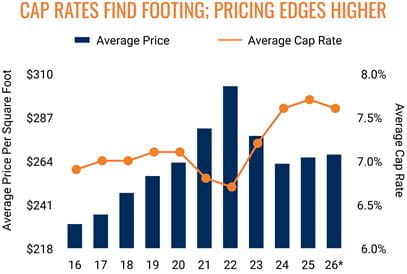
- Average office cap rates have stabilized in the mid-7 percent band, approximately 100 basis points above 2022 market lows.
- Pricing and performance remain segmented, with a substantial spread between best-in-class assets and lower-tier properties.
- The ongoing return-to-office trend is expected to support further gains in space demand and occupancy.
- Office investment increasingly depends on asset-specific analysis and hands-on expertise, especially when pursuing value-add and repositioning opportunities.
18.1% |
8.1% |
|
2Q Vacancy Rate Among |
2Q Vacancy Rate Among |
* Through 2Q | Sources: Marcus & Millichap Research Services; Bureau of Labor Statistics; CoStar
Group, Inc; Placer.ai, Real Capital Analytics; Trepp
TO READ THE FULL ARTICLE