Research Brief
Midyear Retail Outlook
August 2026
Space Demand Grows Amid Tailwinds
as Capital Continues to Deploy
Retail sales continue to outperform. Consumer spending remains resilient despite economic hurdles, supporting healthy tenant demand for retail space.
- Retail receipts continued to exceed expectations despite headwinds including inflation concerns, tariffs, higher fuel costs, and weak consumer sentiment.
- Total retail sales increased 6.7 percent year-over-year in June, with inflation-adjusted figures up a solid 3.5 percent.
- Core retail sales, excluding auto and gasoline, rose 5.7 percent from a year ago and 2.5 percent after adjusting for inflation.
- E-commerce, sporting goods, and electronics retailers posted the strongest spending growth during the first half of the year.
- Health and personal care, food and beverage, and building and garden supply retailers posted the slowest sales growth.
- Consumer spending on fitness-related services reached a record high after rising 4.3 percent last year, reinforcing fitness as a prominent source of retail-space demand.
- A rising volume of sales in real terms continues to support healthy demand for retail space.
Retail fundamentals remain stable. Space absorption improved in the second quarter, helping stabilize occupancy levels across most retail formats while supporting continued rent growth.
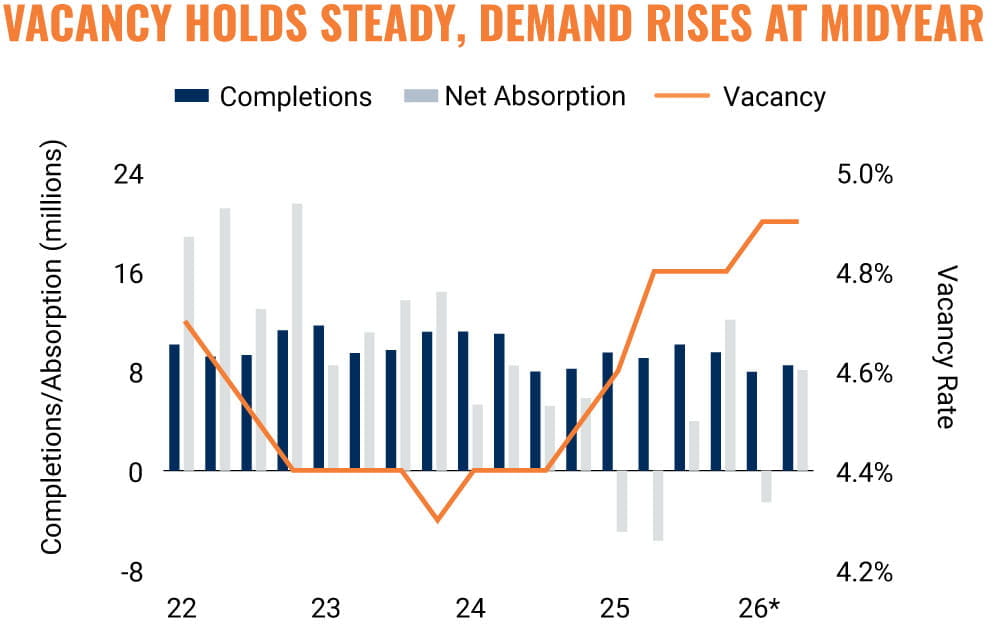
- Retail net absorption regained momentum in the second quarter, reversing the negative reading posted in early 2026.
- Modest space demand largely matched the limited pace of new supply, helping keep vacancy rates stable across the sector.
- The blended retail vacancy rate held at 4.9 percent quarter-over-quarter, with single-tenant vacancy at 4.6 percent and multi-tenant vacancy at 5.8 percent.
- Shopping malls continued to lag other retail formats, with a 9.0 percent vacancy rate, while lifestyle centers and strip centers remained near 4.9 percent.
- Stable occupancy supported rent growth, with average multitenant rents increasing 2.2 percent year-over-year.
- Phoenix, Minneapolis-St. Paul, Nashville, Raleigh, and Orange County ranked among the strongest markets for rent growth.
Long-term drivers remain intact. Demographic tailwinds, evolving consumer preferences, and a constrained supply pipeline continue to support the sector’s outlook.
- Retail remains one of the most actively traded property sectors, with transaction velocity over the past year roughly matching the record pace established in 2022.
- Multi-tenant retail sales over the last 12 months were just 4 percent below the peak 2022 levels, while single-tenant transaction activity reached a record high.
- Single-tenant retail cap rates have stabilized near 6.6 percent, though rates vary materially based on remaining lease term.
- Average cap rates are around 7.4 percent for leases with five years or less remaining, 6.7 percent for five- to 15-year terms, and 5.9 percent for terms exceeding 15 years.
- Multi-tenant retail properties have traded over the past year at an average cap rate of 7.3 percent and remain favored for their healthy fundamentals and durable returns.
- Limited new development, healthy retail sales, and stable occupancy levels are expected to support favorable investment fundamentals going forward.
- Single-tenant assets should remain favored as defensive investments, particularly among aging property owners seeking to reduce management responsibilities.
- While inflation and borrowing costs may create near-term headwinds, long-term demand should benefit from aging millennials entering prime spending years and the continued shift toward service-oriented and experiential retail formats.
* Through June | Sources: Marcus & Millichap Research Services; Bureau of Economic Analysis;
Bureau of Labor Statistics; CoStar Group, Inc.; MNet; Real Capital Analytics; U.S. Census Bureau
TO READ THE FULL ARTICLE