Research Brief
Economic Outlook
August 2026

The Fed’s Dual Mandate Faces Pressure
Despite Ongoing Economic Growth
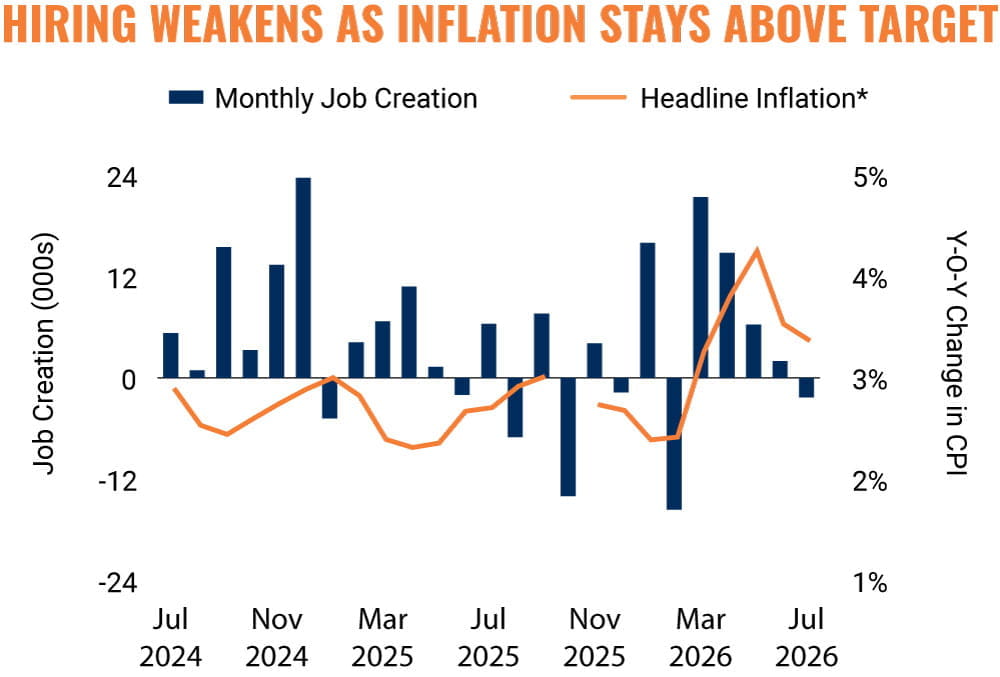
Labor market momentum weakens. Hiring has softened amid significant payroll revisions and a negative preliminary July reading, though broader economic growth remains durable.
- The economy remains resilient, with GDP growth tracking near 2 percent and supporting demand for commercial real estate.
- Recent employment revisions reduced year-to-date job creation from 550,000 to 426,000 positions.
- As a result, mean monthly hiring has slowed roughly 50 percent to 61,000 jobs while the three-month average has fallen to just 20,000 positions, signaling labor market fragility.
- Large payroll revisions, including the nearly 70 percent downward adjustment to May job growth, continue to cloud employment market conditions and complicate economic assessment.
- Although the unemployment rate declined to 4.1 percent, labor force participation fell to 61.4 percent amid increased retirements, reflecting aging rather than broad discouragement.
- Current hiring trends, if sustained, would result in year-end job growth of 750,000 positions, potentially tempering demand for
CRE space through the second half of 2026.
Inflation risks persist. Recent moderation in the CPI may prove temporary as energy market disruptions continue to weigh on the price outlook, keeping inflation above target.
- The year-over-year change to headline CPI declined 10 basis points to 3.4 percent while the change in core CPI — which excludes food and energy — fell 10 basis points to 2.5 percent.
- Lower inflation was partially due to reduced energy costs following the temporary reopening of the Strait of Hormuz.
- Since early July, renewed shipping disruptions have contributed to higher fuel prices and inflation risk.
- Despite recent improvement, inflation remains well above the Federal Reserve’s 2 percent target.
- Persistent inflation pressures continue to present a difficult policy dilemma for the Fed.
- Although labor market conditions have softened, policymakers remain more focused on inflation risks, increasing the likelihood of additional tightening by year-end.
Markets adapt to a hawkish climate. While additional policy tightening remains likely, debt costs already reflect much of the expected policy adjustment.
- Financial markets expect a single 25-basis-point rate increase for the remainder of 2026.
- Despite tightening expectations, interest rates appear to have largely priced in the anticipated policy move.
- The 10-year Treasury has remained near 4.7 percent, while the 5-year Treasury has held in the low-to-mid 4 percent range.
- Average cap rates are around 7.4 percent for leases with five years or less remaining, 6.7 percent for five- to 15-year terms, and 5.9 percent for terms exceeding 15 years.
- Treasury yields could drift higher if inflation accelerates, though the prevailing consensus calls for relatively stable borrowing costs through year-end.
- Significant geopolitical and policy uncertainty continues to create a fluid and potentially mercurial economic environment.
- Near-term volatility should not overshadow the numerous long-term drivers supporting the CRE outlook.
23,000 |
750,000 |
|
Preliminary July Payroll Decline |
Implied 2026 Job Growth; |
* No October Data | Sources: Marcus & Millichap Research Services; Blue Chip Economic
Indicators; Bureau of Economic Analysis; Bureau of Labor Statistics; CME Group; Federal Reserve
TO READ THE FULL ARTICLE