Research Brief
Retail Sales
August 2026

Online Dip Disguises Gains in Key Brick-and-Mortar Categories
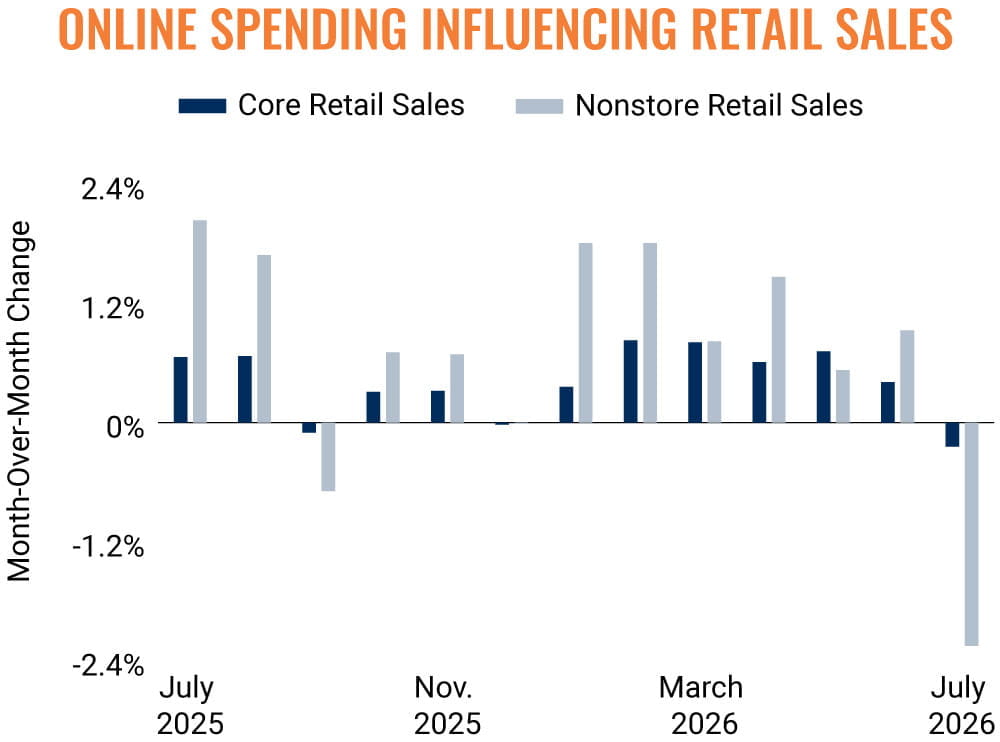
Stretch of upward sales momentum halted. Core retail spending rose 4.8 percent year-over-year in July despite falling 0.2 percent on a monthly basis, the first drop this year. Much of the decline was due to a 2.3 percent pullback in online sales. Still, on a yearover-year basis, that segment was one of five retail categories to post growth of at least 5.0 percent. While gains across multiple categories may quell some concerns about consumers’ resiliency, additional headwinds will test households’ purchasing power in the coming months. Real average hourly earnings fell 0.1 percent in July, and the recent jobs report reflected a precarious labor market in which employers across sectors are reluctant to add staff. Additionally, the personal savings rate hovers near a four-year low, leaving households with less capacity to absorb price or income shocks going forward. Fortunately, core CPI dipped 0.1 percent last month and gas prices fell 2.9 percent. These readings indicate that inflationary pressures remain contained for now. The impact of renewed conflict in the Persian Gulf, however, has yet to fully filter through supply chains, and it remains unclear how much retailers will pass costs on to consumers.
Online sales prominence reinforces industrial outlook. Since last July, non-store retail sales have declined three times on a monthly basis. Each time a decrease was recorded, core retail sales also declined, highlighting the growing relationship between online spending and overall sales momentum. Last month’s decrease in non-store spending, the largest since January 2025, may be partially tied to consumers curtailing purchases after Amazon Prime Day in June. However, in the month following last year’s four-day event, online sales increased by 1.7 percent. This contrast is generating concerns about consumers’ discretionary spending power. Still, one in every four dollars spent in core retail categories was spent online each month this year, which bolsters the demand outlook for warehouse and distribution center spaces.
Spending on clothing reaches record mark. Seven of 10 retail categories posted modest to moderate monthly sales gains in July, led by the apparel segment’s 1.9 percent rise. As households push back-to-school purchases closer to the start of the school year, August may be another historically strong month for the sector. This would have positive implications for off-price apparel retailers, including expansion-minded Burlington, Ross, Goodwill, and TJ Maxx. Collectively, these companies executed more than 100 new leases totaling roughly 3 million square feet over the 12-month period ended in July.
Key Takeaways
- Core retail sales, which excludes motor vehicle and gas sales, fell 0.2 percent in July yet still rose 4.8 percent on a year-over-year basis. Last month’s decline coincided with a 0.1 percent dip in core CPI, indicating spending was down slightly in real terms.
- Nominal changes in hourly earnings, a precarious labor market, and many consumers’ reliance on savings will continue to test households’ purchasing power.
- Seven of 10 retail categories notched modest to moderate monthly gains, led by the apparel sector.
- Online spending fell 2.3 percent in July, the largest monthly decline since January 2025.
0.2% |
4.8% |
|
Decline in Core Retail |
Rise in Core Retail Sales |
Sources: Marcus & Millichap Research Services; Bureau of Labor Statistics; Bureau of Economic
Analysis; Census Bureau; CoStar Group, Inc.
TO READ THE FULL ARTICLE