Research Brief
Financial Markets
August 2026

Fed Holds the Overnight Rate, But Uncertainty Keeps All-In CRE Debt Costs High
A divided committee holds, with three dissents favoring a hike. Despite a resurgence of inflation-driven uncertainty and 552,000 jobs created in the first half of 2026, the Federal Open Market Committee agreed to hold the overnight lending rate at the lower bound of 3.5 percent, with three regional bank presidents dissenting. The FOMC maintains that the current rate aligns with its dual mandate but remains open to data-driven adjustments. Ahead of the meeting, markets priced a 30 percent chance of a 25-basispoint hike in July; Wall Street participants now expect a 57 percent chance of that move in September.
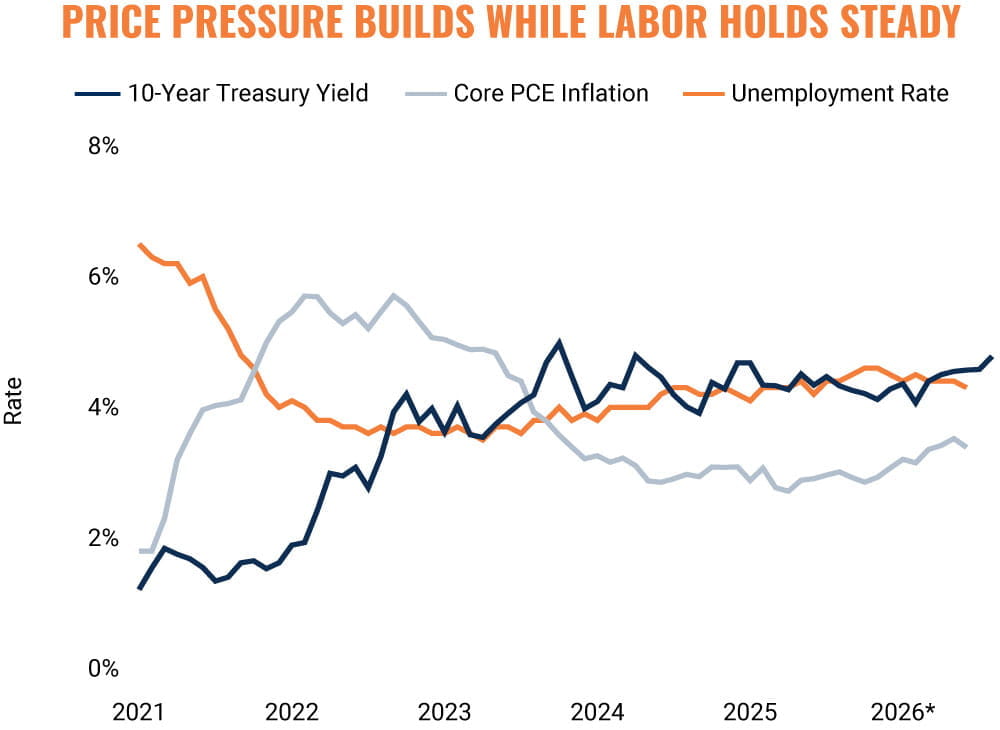
Policymakers consider forces behind inflation. FOMC members are examining monetary policy tools and strategies to address underlying causes and implications of inflation over the past five years. The Personal Consumption Expenditures price index rose 22 percent over that period, largely driven by pandemic supply shocks, war, tariffs, and the AI capex boom. At the Fed’s 2 percent target, cumulative inflation would have totaled 10 percent. The Ukraine and Iran wars continue to pressure energy prices, as Brent crude rose by 24 percent in July. Tariffs are also likely to persist, which could shift more costs to consumers. Meanwhile, surging AI capex drove a 20 percent growth in high-tech equipment and software costs over the past four quarters. Nominal and real yields both moved higher across the Treasury, registering some of the largest between-meeting moves in two decades, as renewed fighting in the Iran conflict reignited inflation concerns. Thinner forward guidance amplified the move, leaving investors to price information in real time and carry more of the research burden.
 Warsh established five external task forces. Each team will reassess a core operating assumption. The Communications group is reviewing how the Fed conveys its deliberations and decisions amid uncertainty; the Balance Sheet Policy group is examining the costs, benefits, and institutional implications of the current balance-sheet regime; and the Data group aims to improve the quality and timeliness of the real economic signals informing policy. The Productivity and Jobs group is tasked with assessing how new general-purpose technologies — artificial intelligence, chief among them — will reshape the economy, while the Inflation Frameworks task force is revisiting how the Fed understands and responds to inflation drivers. Across all five, membership skews heavily toward academic economists — largely from Harvard, Chicago, Stanford, and NYU — alongside former Fed governors and senior Treasury officials. A handful of private-sector and technology executives round out the group.
Commercial Real Estate Outlook
Inflation expectations widen the cost of capital. Treasury yields have risen materially — the 10-year at 4.63 percent as of Aug. 4, up 19 basis points since the start of July. With a September hike more probable in market pricing, borrowing costs remain elevated. This sustains refinancing risk on loans underwritten in the prior low-rate cycle and creates an acquisition hurdle as buyers and sellers may wait for financing conditions to stabilize. Thinner forward guidance could compound this, possibly widening Treasury yield volatility, particularly near Fed meetings.
Transaction activity continues amid uncertainty. Despite fluctuations in Treasuries, sales and financing activity continue to climb. More buyers and sellers are aligning on expectations, and owners who cannot refinance under current conditions could be pushed to trade. CRE transaction activity rose roughly 20 percent over the 12 months ended June 2026, while institutional dry powder remains elevated. Most property types underwent a price correction in 2023, creating more favorable pricing in some cases. While borrowing costs are a consideration, buyers remain focused on the demand outlook and rent growth prospects.
4.63% |
57% |
|
10-Year Treasury Yield on Aug. 4, 2026 |
Probability of a September Hike as of Aug. 4, 2026 |
* As of Aug. 4, 2026 | Sources: Marcus & Millichap Research Services; CME Group; Federal Reserve; MSCI Inc.; Moody’s Analytics;
Mortgage Bankers Association; U.S. Bureau of Economic Analysis; U.S. Department of the Treasury
TO READ THE FULL ARTICLE