Research Brief
Employment
August 2026

Relationship Between Jobs and Space Demand Shifts Amid Pullback in Hiring
Labor softness complicates Fed outlook. July’s job report showed the labor market remains in a precarious position, as employers shed 23,000 jobs, while May and June job gains were revised down by a combined 103,000. Leisure and hospitality and government posted the largest declines, losing 40,000 and 53,000 jobs last month, respectively. Some of this weakness may reflect education seasonality and the end of temporary FIFA World Cup hiring. Still, retail trade shed roughly 20,000 jobs, financial activities lost 14,000 positions, and health care added a modest 23,000 roles. These trends indicate employers across sectors are reluctant to add staff, keeping labor conditions in focus for the Federal Reserve.
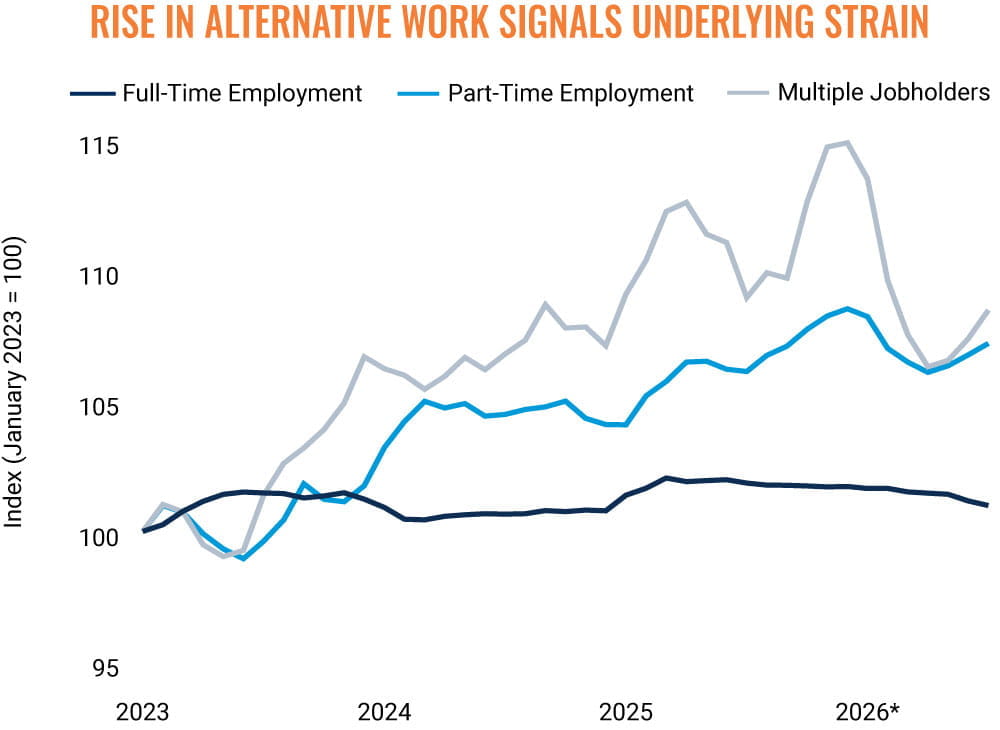
Nontraditional work tempers space needs. The unemployment rate holding at 4.1 percent may mask weaker underlying conditions. Labor force participation declined again in July, suggesting some workers are leaving the workforce rather than continuing unsuccessful job searches, helping keep unemployment low. Meanwhile, part-time employment, self-employment, and multiple jobholders each rose by more than 130,000 in July, pointing to greater reliance on supplemental or less stable work. That shift aligns with growing use of gig platforms, where active workers across several major apps were up about 19 percent year-over-year this spring. Supplemental income can support retail spending. Yet a shift toward part-time, self-employed, and gig work may generate less space demand than full-time employees, particularly when gig workers such as Uber drivers require no dedicated workspace.
Rental demand requires fewer jobs. Multifamily demand has held firm despite softer hiring, with roughly 280,000 units absorbed on net in the first half of 2026, trailing only last year for the strongest first-half total on record. Demand was also widespread, as vacancy fell in 49 of 50 major markets during that period. High borrowing costs and cost-of-living pressures continue to steer households and workers toward rentals. Over the past year, one unit was absorbed on net for roughly every two jobs added, versus about one for every six historically. Nevertheless, average hourly earnings were nearly flat in July, which may continue to restrain rent growth.
Industrial momentum builds. The manufacturing sector added 5,000 jobs in July, while transportation and warehousing gained nearly 10,000. Meanwhile, ISM’s manufacturing employment index recorded its first expansionary reading in 33 months in July, and second-quarter industrial leasing hit its highest level since 2022, suggesting hiring could strengthen further. Customer inventories have also remained in “too low” territory, leaving room for stronger production and logistics activity if firms begin restocking.
Key Takeaways
- Hiring slowed in July and prior months were revised lower, reinforcing the Federal Reserve’s focus on labor conditions when setting monetary policy.
- Rising part-time, self-employed, and gig work may help keep unemployment low while generating less business expansion and traditional commercial space demand.
- Multifamily demand remains strong, as elevated interest rates and inflation steer households into rentals, reducing the number of jobs needed to support absorption.
- Improving manufacturing employment, stronger industrial leasing, and lean customer inventories point to potential upside for production and logistics activity.
426,000 |
44,000 |
|
Jobs Added Year to Date |
Average Monthly Job Gain, |
* Through July
Sources: Marcus & Millichap Research Services; Apptopia; Bureau of Labor Statistics; CoStar
Group, Inc.; Institute for Supply Management; RealPage, Inc.
TO READ THE FULL ARTICLE