Research Brief
Canada Inflation
August 2026

Underlying Inflation Trend Supports Stable Rate Outlook and CRE Recovery
Commercial Real Estate Outlook
Improving capital market conditions support investment activity. Greater interest rate stability, improved price discovery, and sound fundamentals are helping bring investors back to Canada’s commercial real estate market. On a trailing 12-month basis, investment volume reached $38.4 billion, approximately 17 per cent above the comparable period a year earlier and the strongest pace since 2022. While borrowing costs remain elevated and bond yields have experienced periodic volatility, greater clarity on valuations, along with commercial real estate’s income-producing and defensive characteristics, should support continued improvement in transaction activity.
Hospitality benefitting from strong operating fundamentals. Hotels entered the second half of 2026 on solid footing, supported by limited supply growth and continued pricing power. RevPAR increased 6.5 per cent during the first half of the year, driven primarily by a 6.2 per cent jump in average daily rates. Occupancy also improved as supply grew by just 0.6 per cent. Strong performance and a restrained development pipeline continue to attract capital, with approximately $1.1 billion of hotel assets trading over the past 12 months and cap rates stabilizing in the high-8 per cent range. Despite elevated financing costs, healthy domestic travel demand, limited new supply, and improving capital market conditions should support both operating performance and hotel investment activity throughout the rest of the year.

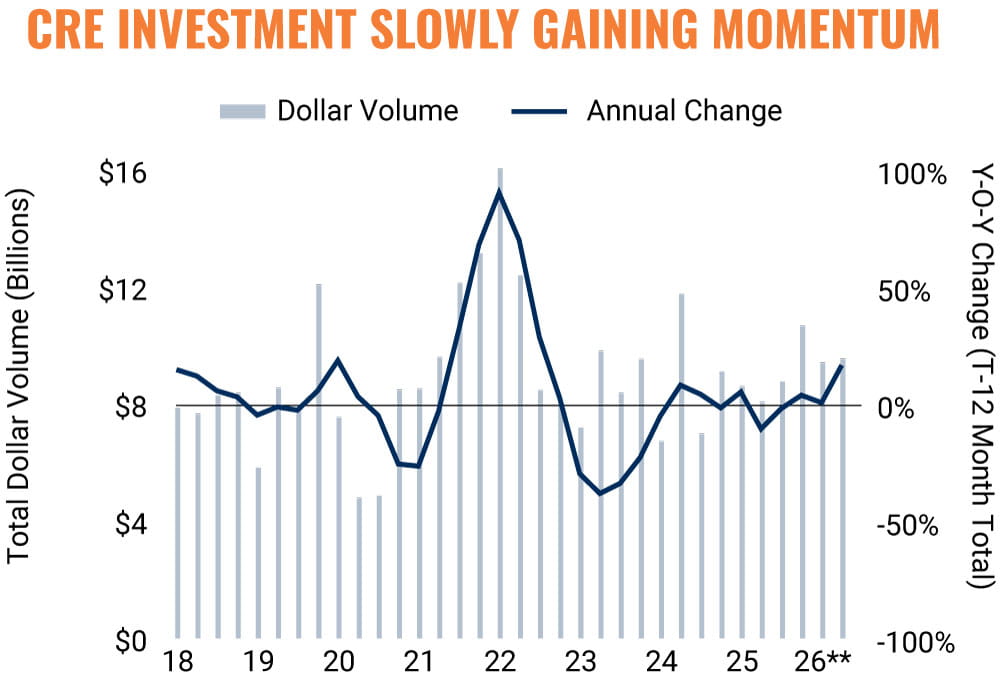
* Through 2Q 2026, forecast thereafter; ** Through 2Q | Sources: Altus Data Solutions; Capital
Economics; CoStar Group, Inc.; Oxford Economics; Statistics Canada
TO READ THE FULL ARTICLE