Research Brief
Canada Industrial
August 2026

Strong Demand Keeps Production Running at Elevated Utilization Rates
Manufacturing extended gains in early summer. Manufacturing sales continued to recover in June, building on the upward momentum since February. While headline sales rose modestly by 0.1 per cent, growth was dampened by a 1.4 per cent decline in industrial product prices, largely reflecting lower global oil prices. In real terms, manufacturing sales increased a robust 1.2 per cent, supported by stronger shipments of chemical, primary metal, computer, and electronic products. The drop in global oil prices after Middle East tensions temporarily eased caused petroleum and coal product shipments to fall 6.1 per cent, the largest drag on manufacturing. Excluding this category, real sales rose a more robust 2.1 per cent — the strongest monthly gain since February.
Bank of Canada remains patient. The manufacturing sector’s continued strength adds to evidence that Canada’s economic recovery remains on track. Importantly, these gains have occurred despite significant volatility in global oil prices, and core inflation measures have remained comfortably within the Bank of Canada’s target range. This combination of firmer economic activity and contained inflation suggests that earlier rate cuts continue to support growth without reigniting broad-based price pressures. Looking ahead, uncertainty remains elevated, including the United States’ planned 50 per cent tariffs on select Canadian exports set to take effect on Aug. 19 and ongoing geopolitical tensions in the Middle East. As a result, the Bank of Canada is expected to keep interest rates unchanged while assessing how these risks affect the economy and the inflation outlook.
Rising order backlogs support industrial space demand. In both May and June, unfilled orders reached their highest levels since early 2020 while capacity utilization stood firmly above 82 per cent. This indicates that production resources are becoming increasingly stretched. As manufacturers work through elevated order volumes, they are likely to maintain strong production levels and invest in additional operational capacity if demand remains strong. This should continue to drive demand for production, warehousing, and logistics space, particularly in markets with a heavy manufacturing presence, as businesses expand to accommodate higher output and greater supply chain needs.
Alberta’s growth extended beyond energy. Although sales of petroleum and coal products declined in June, Alberta’s manufacturing sector continued to outperform the national average, posting a 1.6 per cent monthly increase. Strong growth in chemical, plastics, and transportation equipment more than offset the 7.7 per cent contraction in energy-related production, highlighting the province’s expanding industrial base. The results reinforce a broader trend toward greater economic diversification, with Alberta increasingly benefitting from growth across a wider range of manufacturing industries. This diversification should support the long-term resilience of the province’s industrial sector, reducing its reliance on energy markets while creating a stronger foundation for future industrial development and investment.

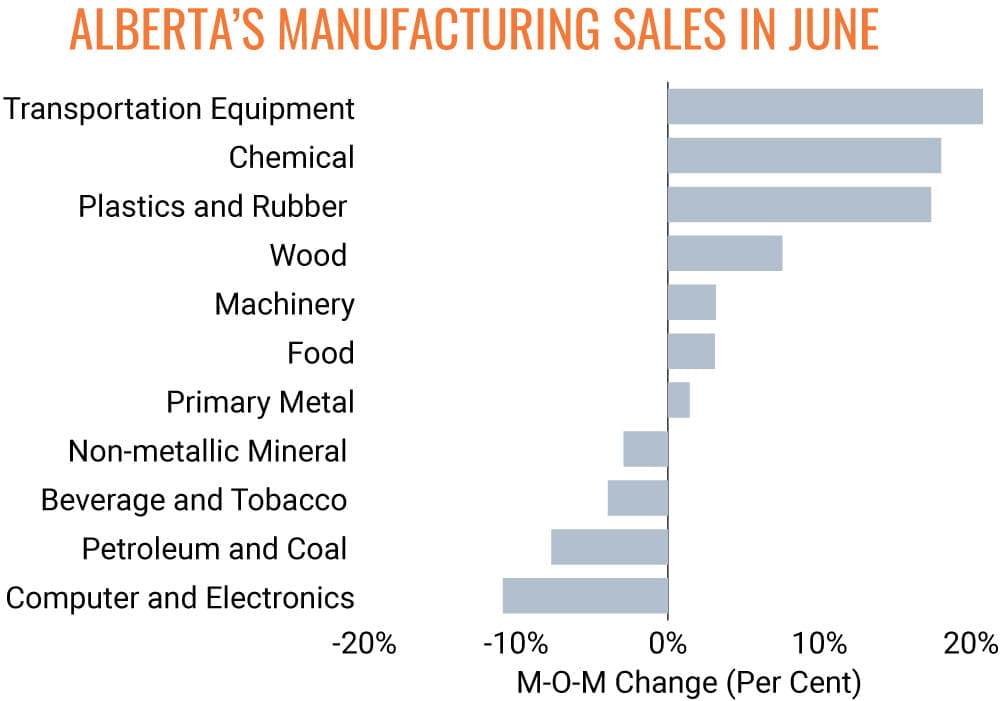
Sources: Capital Economics; Oxford Economics; Statistics Canada
TO READ THE FULL ARTICLE