Research Brief
Canada Housing
August 2026

Housing Recovery Builds as Multifamily Investment Accelerates
Housing recovery continues to build momentum. Canada’s residential property market improved further in July, with home sales up 0.5 per cent month-over-month, marking the fourth consecutive monthly gain. While transactions remained 5.3 per cent below year-ago levels, improving demand and a 1.6 per cent decline in new listings pushed the sales-to-new-listings ratio up to 51.3 per cent, increasingly consistent with balanced market conditions. Inventory also tightened to 4.7 months, its lowest level this year and slightly below the long-term average. Pricing also showed early signs of stabilization, with the median price of a single-family home rising 0.1 per cent month-over-month, its first gain since January 2025. At the same time, the national average sale price continued to see annual declines narrow to 2.9 per cent.
Lower borrowing costs bring buyers off the sidelines. Despite renewed volatility in bond markets, borrowing costs remain well below the highs reached earlier in the tightening cycle. At the same time, the Bank of Canada has lowered its overnight rate to 2.25 per cent. This improvement in financing conditions, combined with softer home prices, is gradually restoring purchasing power and helping to release some previously sidelined housing demand. With borrowing costs now likely near their cyclical trough, prospective buyers may also have greater incentive to enter the market over the coming months. The prospect that mortgage rates could eventually begin to rise may encourage households that have been waiting for improved financing conditions to buy while borrowing costs remain comparatively favourable.
Commercial Real Estate Outlook
Rental construction reshaping landscape. Canada’s development market continues to shift as rentals increasingly replace condos as the primary source of residential deliveries. Apartment development reached historic levels in the first half of 2026, accounting for nearly 60 per cent of all housing starts, while units under construction also hit an all-time high. Government financing, weaker condo presales, and favourable long-term rental fundamentals amid decades of underbuilding have encouraged a pivot toward purpose-built projects. Rising vacancy and slower population growth, however, are beginning to create oversupply concerns, which caused apartment construction starts to trend lower for two straight months as of July.
Multifamily investment activity accelerates. Improving financing conditions and price rediscovery are supporting a rebound in Canada’s apartment investment market. Approximately $6.5 billion of apartments traded during the first half of 2026, up 38 per cent from the same period last year and the second-highest first-half total of the past decade. Transaction counts increased 13 per cent to just over 860 trades, indicating that the recovery extends beyond a handful of large transactions. With rental housing maintaining strong long-term demand fundamentals and borrowing costs well below recent peaks, investor appetite for multifamily assets is likely to remain relatively resilient throughout the rest of the year.

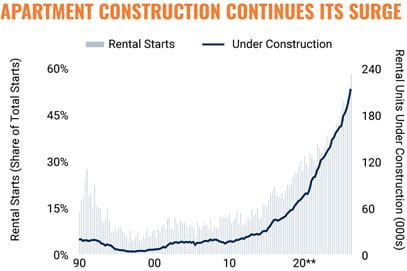
* Forecast; ** Through 2Q 2026 | Sources: Altus Data Solutions; Capital Economics; CMHC;
CoStar Group, Inc.; CREA; Oxford Economics; Statistics Canada
TO READ THE FULL ARTICLE