Research Brief
Retail Sales
July 2026

Summer Events and Decelerating Inflation Support Record Core Retail Sales
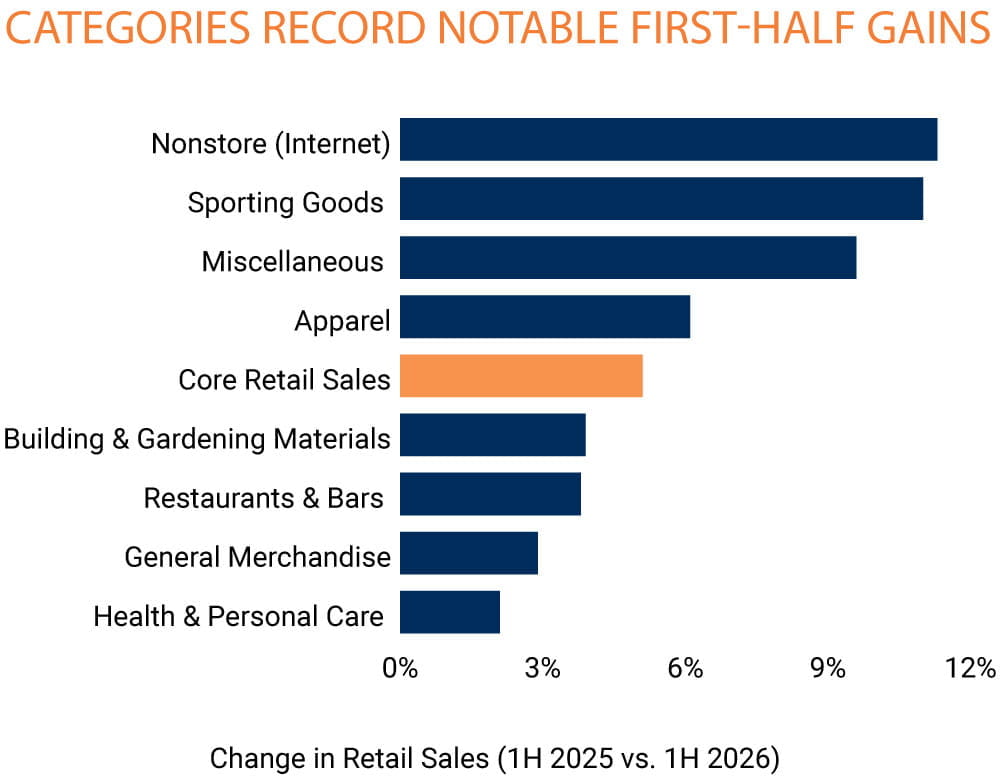
Spending rises for a sixth straight month, but headwinds mount. Consumers’ fortitude was again on display in June, with core retail sales up 0.4 percent monthly and 5.7 percent annually. Household budgets received a respite last month, thanks to a 9.7 percent decline in gas prices, which facilitated the first monthly decrease in inflation since May 2020. Still, not all retail categories benefited equally from the positive sales momentum. Amazon Prime Day, in-store counter-deals by other competing retailers, and World Cuprelated spending contributed to the online retail, sporting goods, and electronics categories notching the largest gains. Concurrently, sales declined across supermarkets, health and personal care stores, and apparel shops, suggesting a shift in discretionary spending among fixed-budget consumers. With fuel-cost pressure renewed in July, the recent decline in inflation could be short-lived. This could prompt some households to reduce both their necessity and discretionary spending.
Renewed conflict casts shadow over near-term inflation trends. The extent to which higher fuel costs are passed on to consumers during the second half of this year remains clouded and will depend on industry competitiveness and retailers’ targeted demographics. Those that cater to a more affluent customer base are most likely to pass costs onto consumers, as these households are more insulated from inflationary pressures. In contrast, larger corporations focused on lower-income households may attempt to avoid cost pass-through, as these retailers are achieving notable profitability by scaling operations and maximizing efficiencies. While real wages were up by 0.8 percent in June after declining in the two prior months, renewed fuel-cost pressure could flip the wage growth-inflation disparity again. If this materializes, more fixed-budget households could curtail how often they dine out and make big-ticket purchases. Others will continue to draw on savings; however, the four-year low personal savings rate in May suggests that spending power for some households may further erode.
Academic-driven sales have implications across retail segments. Back-to-school spending is projected to remain steady this summer, reaching more than $30 billion; however, families are expected to spend 6 percent less year-over-year when accounting for inflation. The implications of this spending extend beyond general merchandise, electronics, apparel, and online retailers, as budget-strapped families are likely to cut back on other expenses, specifically dining out and entertainment, to afford back-to-school essentials. Households are also expected to push purchases closer to the start of the school year, mirroring pre-pandemic trends.
Key Takeaways
- Core retail sales rose 0.4 percent in June and 5.7 percent on an annual basis. Last month’s gain was not inflation-driven, as core CPI was unchanged. Aside from gas prices, a modest drop in apparel pricing was registered.
- The online retail, sporting goods, and electronics categories notched the largest gains last month, with sales declining across supermarkets, health and personal care stores, and apparel shops.
- Renewed conflict with Iran has since lifted oil prices, which could impact households’ discretionary spending.
- Real wages rose 0.8 percent in June, outpacing the inflation rate for the first time in three months. Fuel-cost pressure, however, may flip this dynamic.
0.4% |
5.7% |
|
Rise in Core Retail Sales (Monthly) |
Rise in Core Retail Sales (Year-Over-Year) |
Sources: Marcus & Millichap Research Services; Bureau of Labor Statistics;
Census Bureau; Deloitte; Federal Bank of Atlanta; Numerator
TO READ THE FULL ARTICLE