Research Brief
Canada Retail Sales
July 2026

Resilient Retail Sales Support Property Level Stabilization
Consumer spending remains resilient. Retail sales rose 1.0 per cent in May, extending 2026’s run of monthly increases. Gasoline stations and fuel vendors posted the largest gains, with sales up 3.1 per cent, but much of that was due to higher prices driven by the Middle East war. However, sales also increased across all other major retail subsectors despite higher fuel costs, pointing to improved underlying demand and relatively broad-based strength. After adjusting for inflation, retail sales volumes rose a more modest 0.3 per cent monthly. Still, May’s figures suggest Canadian households are still spending at a healthy pace despite economic uncertainty stemming from elevated oil prices and tariff risks.
Consumer momentum supports second-quarter rebound. Preliminary estimates indicate that retail sales rose 0.4 per cent in June, while goods prices declined sharply, suggesting inflation adjusted spending likely posted an even stronger gain. Combined with improving consumer confidence, recent spending momentum raises hopes for a roughly 2.3 per cent annualized rebound in second-quarter GDP after two consecutive quarters of contraction. However, renewed conflict in the Middle East and the threat of 50 per cent U.S. tariffs have added fresh uncertainty heading into the third quarter. Higher energy prices could once again erode household purchasing power, while escalating trade tensions may weigh on consumer confidence, employment, and business investment, potentially slowing the broader economic recovery.
Commercial Real Estate Outlook
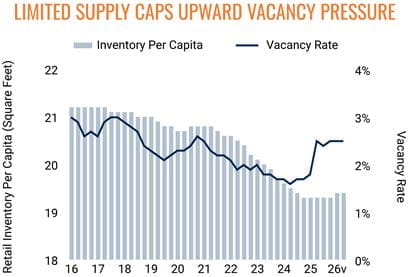
Retail fundamentals are stabilizing. Canada’s retail vacancy rate has risen from its 2024 record low of roughly 1.6 per cent, as heightened economic and trade uncertainty weighed on tenant demand, resulting in negative net absorption last year. Vacancy is expected to stabilize near 2.5 per cent over the coming year, however, as the space vacated by Hudson’s Bay is absorbed and Canada’s economic recovery gradually gains momentum. Essential based and grocery-anchored centers continue to outperform, though fundamentals are expected to stabilize across most retail formats. Broad-based gains in retail sales across all major subsectors in May reinforce this outlook, suggesting that improving consumer activity could support tenant demand.
Limited supply supports retail fundamentals. Canada’s retail property sector remains structurally undersupplied after nearly a decade of subdued development. Construction starts have trended lower since 2016, with activity last year 53 per cent below 2016 levels, amid persistent development feasibility challenges, the rise of e-commerce, and the growing prominence of mixed-use projects. Meanwhile, Canada’s population has increased by 15 per cent, while total property inventory has expanded by just 6 per cent, pushing retail square footage per capita down roughly 8 per cent. This widening supply-demand imbalance should continue to support occupancy and property performance, even as periodic economic uncertainty weighs on tenant demand.

Economics; CoStar Group, Inc.; Oxford Economics; Statistics Canada
* Through May; ** Trailing 12-month total; v Through 2Q | Sources: Altus Data Solutions; Capital
TO READ THE FULL ARTICLE