Research Brief
Canada Inflation
July 2026

Inflation Dynamics Reinforce Stable Rate Outlook and Improving CRE Investment
Commercial Real Estate Outlook
Improving conditions are supporting investment. Contained underlying inflation is helping stabilize the interest rate outlook, despite periodic volatility driven by energy prices and geopolitical developments. Greater certainty around borrowing costs is improving underwriting assumptions and gradually narrowing bid-ask spreads between buyers and sellers. At the same time, strengthening demand across most commercial property sectors and a broad slowdown in nonresidential construction are reinforcing market fundamentals. Together, these factors are supporting a recovery in investment activity, with preliminary estimates indicating that trailing 12-month transaction volume and total dollar volume increased 12 per cent and 18 per cent year-over-year, respectively, in the second quarter.
FIFA World Cup temporarily lifted travel inflation. While broader price pressures remained subdued, several travel-related categories saw notable increases in June as Toronto and Vancouver hosted FIFA World Cup matches. Strong visitor demand pushed prices higher for accommodations, vehicle rentals, and travel services. At the same time, hotel occupancy rose to nearly 80 per cent, and average daily room rates increased by roughly 5 per cent year-over-year. With the tournament now complete, these temporary price pressures are expected to fade, reinforcing the view that underlying inflation remains well contained.

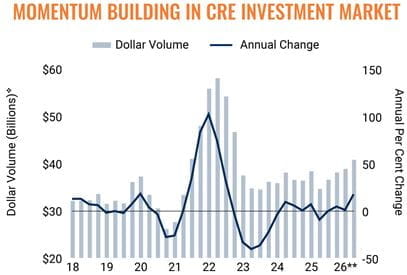
* Through 2Q; ** Trailing 12 months through 2Q; v Trailing 12-month total | Sources: Altus Data Solutions;
Capital Economics; CoStar Group, Inc.; Oxford Economics; Statistics Canada
TO READ THE FULL ARTICLE