Research Brief
Canada Industrial
July 2026

Industrial Recovery Stays on Track as Manufacturing Strength Deepens
Nonenergy sectors gathered further momentum. Manufacturing activity continued to strengthen in May, with total sales rising 1.3 per cent month-over-month and further gains recorded across nonenergy sectors. Motor vehicles, textiles, and chemical products led the advance, with sales increasing 11.8 per cent, 8.5 per cent, and 4.6 per cent, respectively. Sales increased in six provinces, driven primarily by stronger manufacturing of transportation equipment and chemical products in Ontario. Food manufacturing sales in Saskatchewan also increased by more than 20 per cent, supported by robust demand for canola products from China and the United States. In contrast, manufacturing sales in Quebec declined, largely due to weaker petroleum and coal product sales.
Bank of Canada to keep rates unchanged through 2026. The increase in manufacturing activity in May marked the fourth consecutive month of growth, adding to evidence that economic conditions are gradually improving. Alongside stabilizing home sales, stronger exports, and a projected modest increase in business investment, these trends point to a return to economic growth in the second quarter, ending the consecutive GDP contractions recorded since the final quarter of 2025. Nevertheless, important headwinds remain, including an elevated unemployment rate, slower population growth, and persistent uncertainty surrounding Canada-U.S. trade relations. With core inflation measures holding steady and long-term inflation expectations well anchored, the Bank of Canada is expected to maintain the overnight rate at 2.25 per cent through the end of the year.
Manufacturers on the cusp of capacity expansion. Despite four consecutive months of growth, manufacturing sales volume in May remained below the level recorded before Canada-U.S. trade relations deteriorated last year. However, capacity utilization reached an eight-year high, indicating that producers are operating closer to their effective capacity. While some of this divergence may reflect reduced capacity following years of subdued investment, particularly amid heightened trade uncertainty last year, it also suggests that recent gains in production are rapidly absorbing available spare capacity. If production continues to rise, manufacturers may increasingly require additional machinery, equipment, and industrial space to accommodate future growth.
Improving fundamentals to boost investment sentiment. The recent recovery in industrial leasing activity appears consistent with a manufacturing sector that is gradually preparing for a broader ramp-up in production. With manufacturing sales in key industries — including transportation equipment and machinery — already surpassing January 2025 levels, a continued recovery in other sectors is expected to further strengthen demand for industrial space through year-end. Combined with tailwinds from the energy sector and a shrinking construction pipeline, the projected decline in vacancy should help alleviate concerns about lingering supply overhang, bolstering investor confidence and supporting a recovery in industrial investment activity.

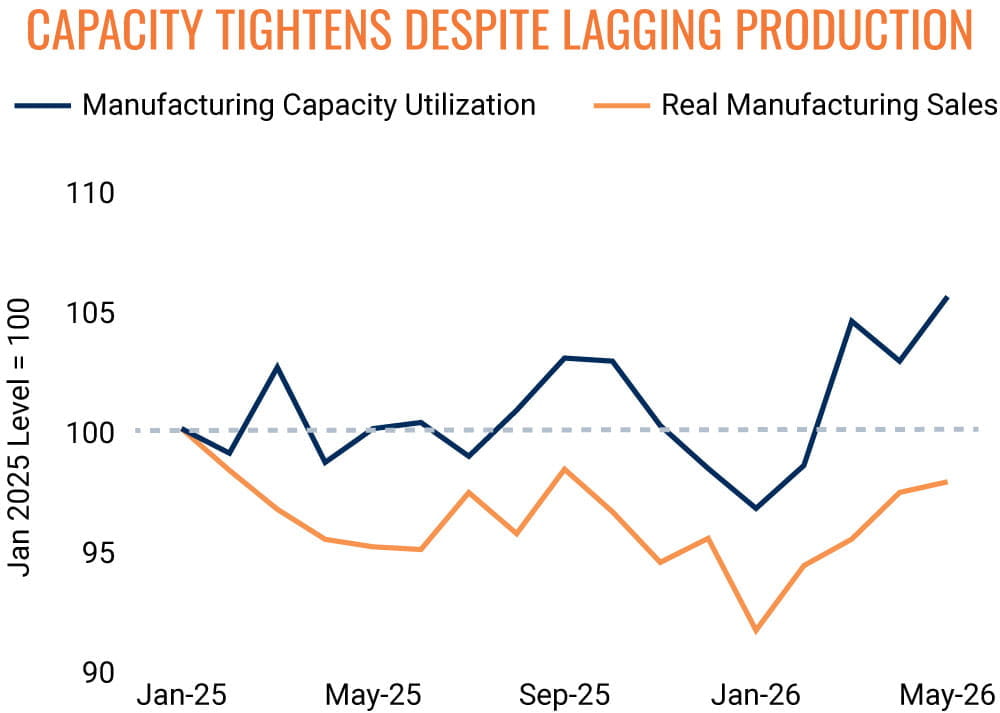
Sources: Capital Economics; Oxford Economics; Statistics Canada
TO READ THE FULL ARTICLE