Research Brief
Inflation and CRE Outlook
July 2026

CRE Remains Solid as Overseas Tension
Reignites Near-Term Inflation Volatility
Inflation eases, yet risks remain. While headline CPI moderated in June, recent escalations in the conflict with Iran may stir energy price volatility, which could lead to a more prolonged inflation cycle.
- Year-over-year CPI slowed from 4.2 percent in May to 3.5 percent in June, a 70-basis-point decline, reflecting inflationary pressure temporarily easing
- The recent deceleration was largely driven by lower oil and gas prices tied to a brief ceasefire in the Middle East conflict.
- However, renewed geopolitical tensions have pushed energy prices higher again, signaling the reprieve may be short-lived.
- Ongoing uncertainty around the conflict in Iran and potential constraints on oil flows through the Strait of Hormuz could sustain elevated energy costs and inflation.
- Excluding energy, inflation remains comparatively stable, with core CPI at 2.6 percent and other categories like food, housing, and medical care hovering in the 2 to mid-3 percent range.
Inflation risks shape rate outlook. Although higher energy costs may sustain inflationary pressures, interest rate expectations appear largely priced in, helping reduce market volatility.
- Higher oil and gas prices and their spillover into transportation costs could keep headline inflation elevated.
- The median age of first-time home buyers has risen to 40 years old, up from 33 years in 2021 and 30 years in 2011.
- As a result, renter retention has improved, and the average age of renter households continues to increase.
- At the same time, young adults living with family have reached a record 25.2 million, a pattern that has historically preceded stronger rental household formation.
- This combination of demographic support, affordability constraints, and delayed household formation points to strengthening multifamily demand over the next five years.
Generational change broadens CRE demand. As millennials shift into higher incomes and changing preferences, demand is expanding across retail, industrial, and other CRE sectors.
- The millennial generation is entering its prime earning and spending years, supporting long-term consumption growth.
- Persistently elevated inflation increases the likelihood of additional Federal Reserve rate hikes, with Wall Street participants currently pricing in a high probability of a 25-50 basis point rate increase by year-end.
- As a result, the cost of debt capital is expected to remain relatively stable, as higher rates are already reflected in Treasury yields and lending markets.
- Although a gap between buyer and seller expectations persists, the risk of transactions being disrupted by significant interest rate volatility has diminished.
- Since late 2024, the 10-year Treasury has remained rangebound between 4.0 percent and 4.5 percent, providing a more stable pricing environment.
- Cap rates have largely adjusted to this range, and while deal underwriting remains challenging and margins are thin, investment opportunities remain.
CRE fundamentals remain resilient. Despite ongoing economic and geopolitical headwinds, sustained demand across property types continues to support the long-term CRE outlook
- From a broader perspective, the CRE investment thesis remains intact, especially in an environment of sustained inflation.
- CRE is one of the few asset classes that offer inflation resistance, supporting its long-term investment appeal.
- Despite elevated uncertainty stemming from geopolitical tensions and tariff-related headwinds, space demand across the four major property types remains positive.
- At the national level, the office sector recorded its ninth consecutive quarter of positive net absorption, contributing to a modest decline in vacancy rates.
- Apartment demand exceeded expectations in the second quarter, lowering vacancy.
- Demand for retail and industrial space remained in balance with new supply, helping to keep vacancy rates stable.
- If tensions in the Middle East ease and inflation moderates, improving economic momentum could further strengthen CRE fundamentals.
- As investors look ahead, the sector’s durability and potential upside place it in a strong position.
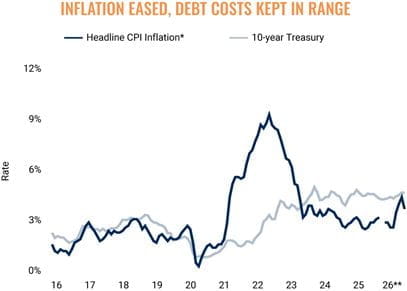
* October 2025 CPI data not published ** Through June | Sources: Marcus & Millichap Research Services; Bureau of Labor Statistics; CME Group; CoStar Group, Inc.; Federal Reserve; Real Capital Analytics; Real Page, Inc.; U.S. Energy Information Administration
TO READ THE FULL ARTICLE