Research Brief
Financial Markets
June 2026

Cost of Capital Likely to Remain High as New Fed Chair Rethinks Playbook
Fed rate unchanged amid a more restrictive outlook. Economic uncertainty led the Federal Open Market Committee to unanimously agree to hold the overnight lending rate at the lower bound of 3.5 percent. The FOMC maintains that the current rate aligns with its dual mandate. However, committee members remain open to data-driven adjustments in the future. According to the Summary of Economic Projections, the median participant judged 3.8 percent to be the appropriate year-end rate, per the dot plot.
Inflation is the binding constraint on policy. The June decision was driven primarily by the Fed’s reassessment of inflation persistence rather than weakness in growth or labor markets. The committee acknowledged that inflation has been above the 2 percent target since 2021. The June Summary of Economic Projections reflected this concern, with the median PCE inflation expectation for 2026 revised upward to 3.6 percent and core inflation to 3.3 percent, in line with the April 2026 reading and well above target. Meanwhile, geopolitical developments could offer some relief, as a pending U.S.-Iran deal could ease energy-driven inflation pressures. At the same time, the economy is still solidly expanding, with real GDP projected at 2.2 percent this year and the unemployment rate stable at 4.3 percent. Sticky inflation combined with steady growth and a still-growing employment market left the Fed little room to ease policy. It also reinforced the view that restrictive policy must remain to curb inflation.
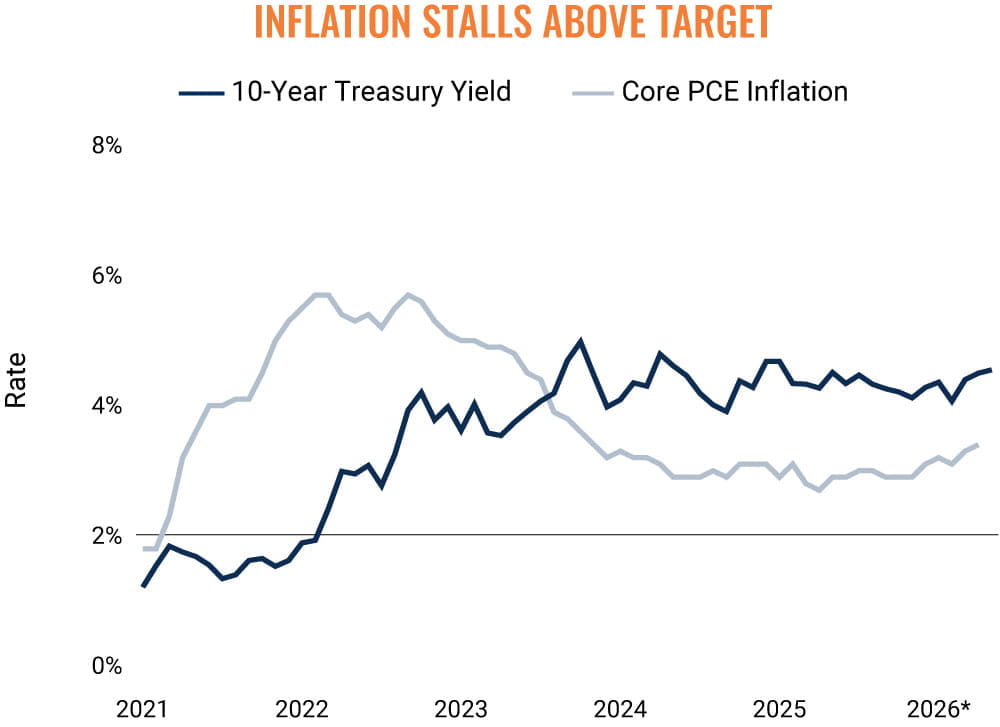 The Fed’s strategy offers less forward guidance. Although the statement was shorter than previous releases, the meeting also highlighted a meaningful shift in the Fed’s internal consensus and operating philosophy under Chairman Kevin Warsh. Policymakers now expect further tightening rather than cuts. Importantly, nearly all participants judged inflation risks to be skewed to the upside, underscoring how one-sided the committee’s concern has become. Warsh reinforced this stance by emphasizing consensus on delivering price stability and by refraining from offering his own rate projections, signaling skepticism about relying on forwardlooking promises. The announcement of new task forces to review communications, balance-sheet policy, data sources, productivity trends (including AI), and inflation frameworks further suggests the Fed is reassessing how it conducts, measures, and explains policy in an environment where inflation outcomes have remained persistent.
Commercial Real Estate Outlook
Borrowing costs expected to stay elevated. For commercial real estate investors, the meeting reinforces that financing conditions are unlikely to ease meaningfully in the near term. Higher-forlonger rate expectations sustain the refinancing risk for loans maturing in 2026 and 2027, particularly assets with weaker cash flows. At the start of this year, 30 percent of outstanding CRE debt was scheduled to mature before 2028. Although down from its recent peak, the 10-year Treasury yield, at 4.46 percent as of June 18, remains elevated relative to its level before the Iran conflict. Regarding acquisitions, transactions were up roughly 12 percent from a year prior when rates were higher. That driver remains at risk, as a 2026 hike, rather than a cut, has become more likely.
Reduced policy visibility could complicate deal timing. The Fed’s shift away from forward guidance may affect how CRE investors plan capital decisions. Less signaling about future rate moves complicates refinance timing, rate-lock strategy, and exit assumptions. Stress is already evident, as overall CMBS delinquencies have risen to 7.1 percent as of April, led by office at 16.7 percent and retail at 7.6 percent. Industrial and multifamily levels remain comparatively resilient, though both have edged higher. Further out, the Fed’s balance sheet review could tighten liquidity and keep long-term rates elevated, while encouraging a more disciplined and transparent lending environment that prices credit more directly off asset fundamentals.
* As of June 2026 | Sources: Marcus & Millichap Research Services; CME Group; Federal
Reserve; MSCI Inc.; Moody’s Analytics; Mortgage Bankers Association; U.S. Bureau of Economic
Analysis; U.S. Department of the Treasury
TO READ THE FULL ARTICLE