Research Brief
Office Outlook
May 2026

Promising Yet Bifurcated Fundamentals
Define the 2026 Office Environment
Office sector showing signs of optimism. While slower job growth in traditionally office-using industries has weighed on demand, rising workplace attendance has increasingly offset these pressures, supporting improved absorption and modest vacancy gains.
- Despite the persistence of remote and hybrid work arrangements, office utilization has continued to trend higher.
- Average office attendance through the trailing 12 months ended March was 31 percent below pre-pandemic norms, a roughly five percentage point improvement from the year prior.
- Increased in-office activity has supported steady gains in office space demand, resulting in eight straight quarters of positive net absorption.
- Over the past two years, total office absorption reached approximately 176 million square feet, placing the annual pace on par with the historical average for 2010-2019.
- National office vacancy has declined from a peak of 17.3 percent in 2024 to 16.1 percent as of the first quarter of 2026.
- Markets posting the strongest demand momentum and lowest vacancy levels include a mix of coastal and Sun Belt metros, such as San Francisco, Miami, and the Inland Empire.
Office performance concentrates at the top. Demand is most evident for newer, smaller, and higher-quality office assets, while supply discipline is helping to contain downside risk.
- Office demand has skewed toward higher-quality assets, with Class A properties capturing 71 percent of total net absorption despite comprising only about 40 percent of inventory.
- Offices built post-2010 average vacancy of just 8 percent, less than half the 18 percent vacancy rate of 1980s‑vintage assets.
- Offices under 250,000 square feet post average vacancy of 12.9 percent, well below the 17.3 percent rate for larger formats.
- Meanwhile, office construction has fallen to near record lows in 2025 and is expected to decline further in 2026, materially limiting new supply risk.
Renewed office activity carries broader implications. Increased deal flow and a lower entry cost are setting the stage for second order demand.
- Office transaction velocity has been rising, with deal volume over the past 12 months running nearly in line with the record pace observed in 2021 and 2022.
- A significant share of recent trades has involved distressed assets transacting well below peak pricing levels.
- This pricing reset has lowered ownership basis, allowing new buyers to compete more effectively on rental rates.
- While the near-term office outlook remains cautiously optimistic, improving fundamentals are positioned to generate spillover benefits for nearby adjacent property types.
- As return-to-office momentum builds, housing and retail demand are likely to strengthen in areas proximate to office nodes, including within urban cores.
- Although a full return to five-day office attendance remains unlikely, the directional shift toward higher in-person attendance is expected to become more pronounced over the
coming years.
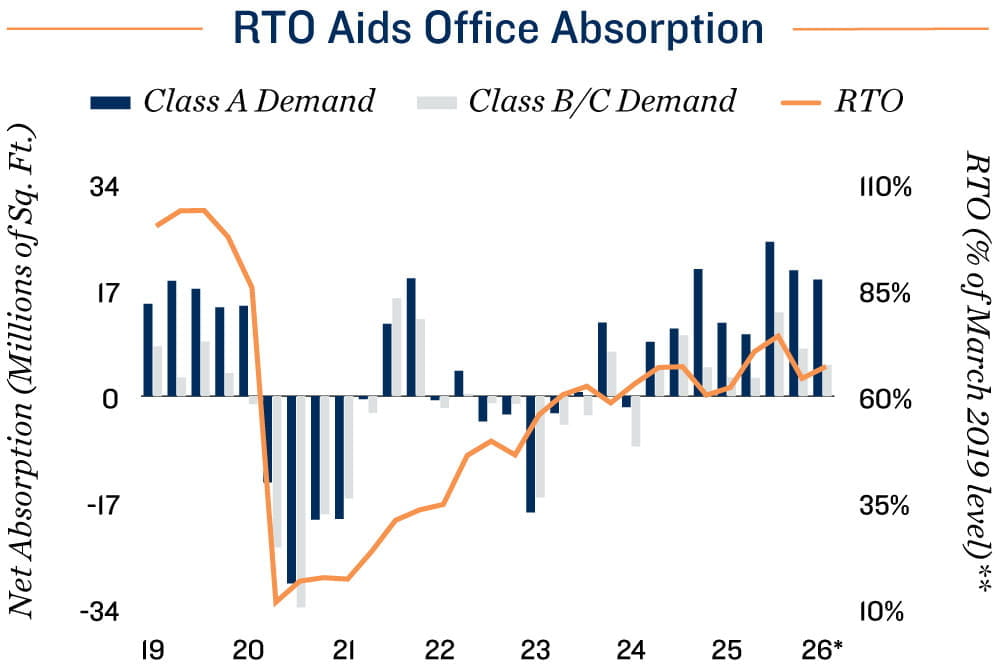
* Through March 2026 ** Average quarterly office visitation as a percentage of March 2019 level
Sources: Marcus & Millichap Research Services; Bureau of Labor Statistics; CoStar Group, Inc.;
Placer.ai; Real Capital Analytics
TO READ THE FULL ARTICLE