Research Brief
Multifamily Outlook
May 2026
Cyclical Headwinds Meet Structural Support,
Shaping Short and Long-Term Trends
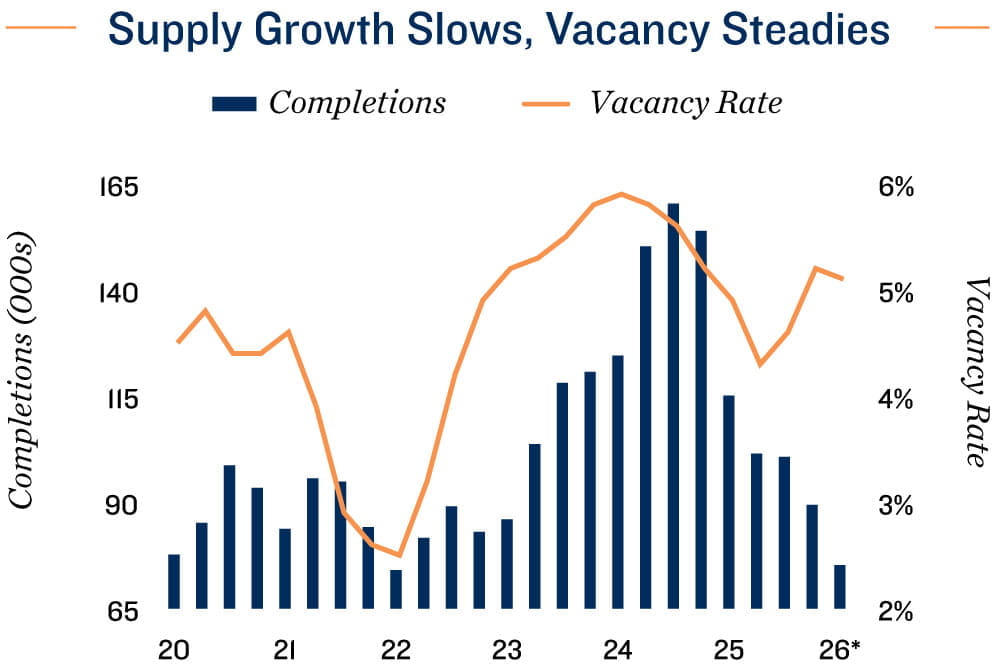
Supply pressures are easing. The historic wave of multifamily construction remains a near-term headwind in select markets, though the overall development pipeline is now tapering and supply risks are becoming increasingly time-bound.
- Since early 2021, developers have added roughly 2.1 million apartment units, expanding the national stock by 11.2 percent.
- New construction activity has been highly concentrated, with about half of all completions occurring in Sun Belt metros, where apartment inventory increased 17.9 percent compared with a 7.8 percent gain in non-Sun Belt markets.
- Although the Sun Belt still faces a supply overhang, construction activity has begun to taper.
- Multifamily starts peaked in 2022, with early 2026 levels roughly 75 percent below that high, while units under construction have fallen to 2016 levels.
- As supply growth slowed, vacancy rates across Sun Belt metros stabilized at 6.3 percent in the first quarter, versus 4.1 percent in non‑Sun Belt markets, underscoring new supply risk as a predominantly short‑term and regional headwind.
Multifamily demand faces headwinds. Softer labor conditions, weaker sentiment, and diminished migration present barriers to near-term apartment absorption.
- Job creation has slowed sharply, with the average monthly gain decelerating from 122,000 jobs in 2024 to 9,700 in 2025.
- The cooling labor market, combined with weak consumer sentiment, has begun to restrain household formation, weighing on new-apartment absorption.
- Sun Belt markets that expanded multifamily construction to meet historically strong, hiring-driven domestic in-migration have been particularly exposed as job growth cooled.
- As employment gains and domestic migration eased, vacancy rates rose, and rent concessions increased across the Sun Belt.
- Meanwhile, international immigration to the U.S. has materially slowed, adding another headwind to the multifamily outlook.
Long-term demand drivers remain intact. As cyclical pressures subside, entrenched demographic trends and affordability constraints are positioned to reassert themselves, supporting multifamily fundamentals over time.
- Over the past 15 years, the median age of first-time homebuyers has increased markedly from 30 to 40, delaying the transition from renting to owning.
- Housing affordability has deteriorated sharply, with monthly payments on a median-priced home now exceeding average effective rents by more than $1,100.
- Only about 31 percent of U.S. households have sufficient income to qualify for a loan on a median-priced home.
- As a result, the renter-age cohort remains robust, with approximately 78 million individuals ages 24 to 40.
- Although apartment demand has softened recently, stable demographic cohorts and record levels of young adults living with family suggest demand has been delayed rather than lost.
- Once short‑term headwinds abate, the multifamily sector is positioned for strengthening absorption, declining vacancy rates, and a reacceleration of rent growth.
*Through 1Q
Sources: Marcus & Millichap Research Services; Bureau of Labor Statistics; Congressional Budget
Office; CoStar Group, Inc.; Freddie Mac; Moody's Analytics; National Association of Realtors; Real
Capital Analytics; RealPage Inc.; University of Michigan; U.S. Census Bureau
TO READ THE FULL ARTICLE