Research Brief
Retail Sales
May 2026

Retail Sales Rise in April, But Demand Increasingly Concentrated
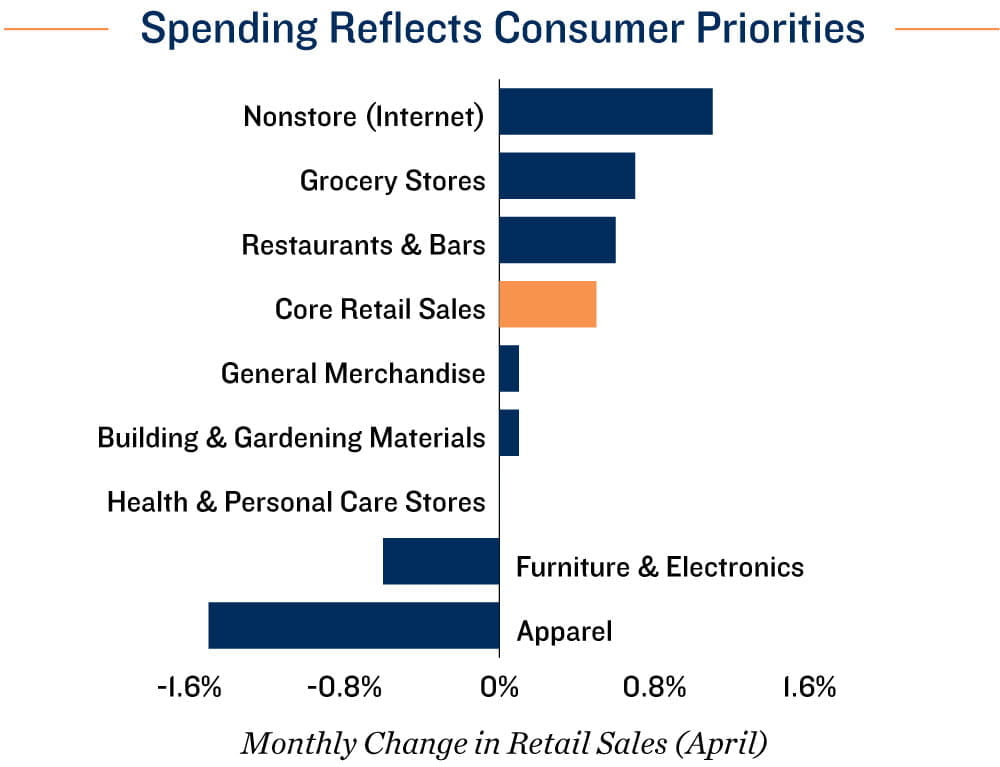
Sales reach new high, but pricing pressures cloud outlook.Consumer resiliency was again on display in April, with core retail sales up 0.5 percent monthly and 4.9 percent annually. However, when factoring for inflation, core spending rose marginally last month, indicating households are feeling the strain of elevated fuel prices and tariff-driven price increases, this despite reportedly limited cost pass-through by businesses. Last month's data also reflects consumers’ prioritization of necessities over discretionary items. During the month, spending on furniture, electronics, and apparel declined, while restaurants and grocery stores notched moderate gains. A more pronounced focus on necessities may materialize among lower- and middle-income households, as headline inflation outpaced wage growth in April for the first time in three years. Additionally, energy prices are projected to remain elevated through this year, even if geopolitical tensions ease, suggesting more consumers may be under pressure.
Extra cash quickly depleted. Many households recently received larger federal income tax refunds; however, the impact these refunds have on consumer spending will be short-lived. A survey commissioned in mid-April found more than 70 percent of respondents had spent their refund or planned to do so. Of these individuals, nearly half used the entire amount on essentials, including bills and groceries. This dynamic suggests more households are likely to draw on savings to support future spending.
Spending trends aid industrial sector. Purchases made online accounted for a record 24.7 percent share of core retail sales in April, with category spending up 1.1 percent. These metrics signal consumers are cutting back on store trips amid higher gas prices and seeking discounts online. While this could weigh on sales for some brick-and-mortar retailers, e-commerce growth has positive implications for last-mile industrial demand. As of May, vacancy among 25,000- to 100,000-square-foot warehouses was at a 10- year high of 5.7 percent, with 17.7 million square feet of this space under construction.
 Trio of categories well positioned. A necessity-focused consumer is poised to benefit value grocers, off-price retailers, and quick-service restaurants. Confident about future spending, a group of these retailers is plotting expansion, with many achieving growth by leasing existing space. This activity and scant grocery store and quick-service vacancy — 2.6 and 1.5 percent, respectively, as of April — may generate additional investor interest for assets net-leased to these tenants. Properties being renovated by tenants may be favored in an inflationary environment.
Retailers shuffle store rosters. A group of major chains will close underperforming stores during the second half of 2026. While this represents an additional hurdle for the retail sector, the impact these shutterings have on property fundamentals may be somewhat offset by the actions of these same retailers — many of whom are planning new locations in the coming quarters. These repositioning efforts indicate some major retailers are doubling down in expanding metros by relinquishing properties elsewhere.
4.9% |
0.5% |
|
Year-Over-Year Rise in Core Retail Sales |
April Increase in Core |
Note: Core retail sales exclude auto and gasoline purchases
Sources: Marcus & Millichap Research Services; CoStar Group, Inc.; Internal Revenue Service; U.S.
Bureau of Labor Statistics; U.S. Census Bureau
TO READ THE FULL ARTICLE