Businesses Still Not Passing Costs to Consumers, Pressuring Tenant Operations
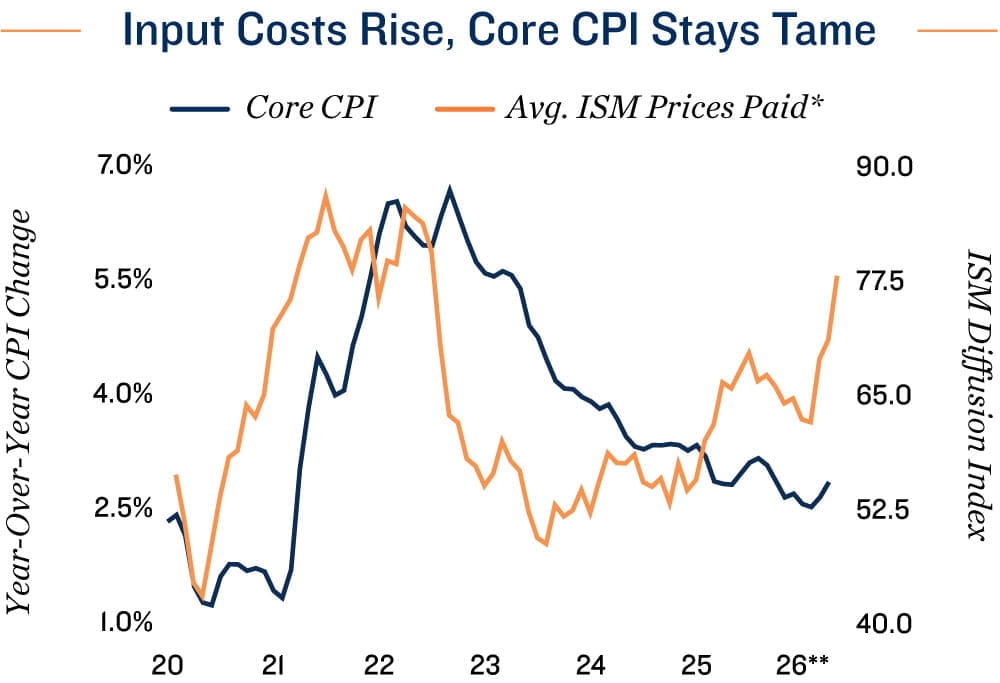
Inflation increase concentrated in food and energy. Consumer prices rose further in April, with headline CPI increasing 0.6 percent month-over-month and 3.8 percent annually. Energy drove much of the jump, while food prices also advanced. Yet broader cost passthrough was limited, as core CPI rose 0.4 percent month-over-month and 2.8 percent year-over-year. Shelter accounted for a large share of that increase. Catching up on rent data missed during the October government shutdown, the BLS index was up 0.6 percent even as market-based rent data still points to softer conditions. Excluding food, energy, and shelter, CPI rose just 0.2 percent month-over-month, suggesting underlying price pressure remains more contained. Higher costs for goods with inelastic demand, such as food and energy, may be squeezing household budgets, thereby limiting cost pass-through.
Weak pricing power limits cost pass-through. As tariffs took effect last year, ISM services and manufacturing prices-paid indices began to rise, yet broad pass-through into consumer prices never fully materialized. The oil shock is now adding another layer of pressure, but the same constraint remains. Households have limited capacity to absorb higher prices after several years of inflation and modest real-wage gains. Record-low consumer sentiment in May reinforces this backdrop, while the Federal Reserve’s Beige Book has noted that many firms are hesitant to raise prices amid concern about price-sensitive customers. As a result, more of the tariff and energy shock may stay at the business level, pressuring tenants more than CPI. For commercial real estate investors, this makes tenant-credit analysis increasingly important, favoring firms with local sourcing, stronger balance sheets, wider margins, and less exposure to lower-income spending.
Inventory buffers return as risk-management tool. Wholesale inventories advanced 0.9 percent in February and 1.3 percent in March, marking the strongest monthly gains since 2022. Petroleum products drove much of the March increase, but the build was not limited to oil. Inventories rose across electrical goods, metals, groceries, farm products, and pharmaceuticals, suggesting more firms are holding safety stock to manage tariff, commodity, and geopolitical volatility. For industrial real estate, that shift could lift warehouse demand among industrial suppliers, importers, and critical-input users, even as softer discretionary demand limits some consumer-goods inventory needs
Income strain splits retail. Real average hourly earnings fell 0.3 percent year-over-year in April, turning negative for the first time since 2023 as headline inflation outpaced wage growth. This will likely weigh most on lower-income households and pressure categories such as restaurants, travel, entertainment, and big-ticket retail. Tertiary metros may also be more exposed, as retail vacancy in these areas rose faster than in primary and secondary markets over the past year, despite remaining lower overall at 4.1 percent. Meanwhile, some value grocers, off-price retailers, and quick-service restaurants could benefit from consumers trading down.
Fed stays data dependent. The hotter inflation print will likely keep the Fed hesitant to cut rates in the near term, while an uncertain business environment also makes additional hikes unlikely. This points to an extended hold as policymakers assess whether higher energy prices spread into broader core inflation. If business conditions weaken further and underlying inflation remains contained, the Fed could still cut rates while keeping policy restrictive, as the federal funds rate remains above most neutral-rate estimates. For CRE investors, the 10-year Treasury holding near 4.4 percent suggests markets are not pricing a sustained inflation breakout, helping preserve a stable backdrop for investment activity.
3.8%
|
2.8%
|
|
Increase in Headline
CPI Year-Over-Year
|
Increase in Core
CPI Year-Over-Year
|
* Average of the ISM Manufacturing Prices Paid Index and ISM Services Prices Paid Index
** Through April
Sources: Marcus & Millichap Research Services; Bureau of Labor Statistics; CME FedWatch; CoStar
Group, Inc.; Federal Reserve; Institute for Supply Management; RealPage, Inc